The Queen Anne’s Lace flower means safety, sanctuary, and delicate strength. It also stands for fantasy, complex beauty, and quiet protection. People give this lacy white bloom to show gentle admiration, or to celebrate beauty found in small, intricate details.
Origin of the Name
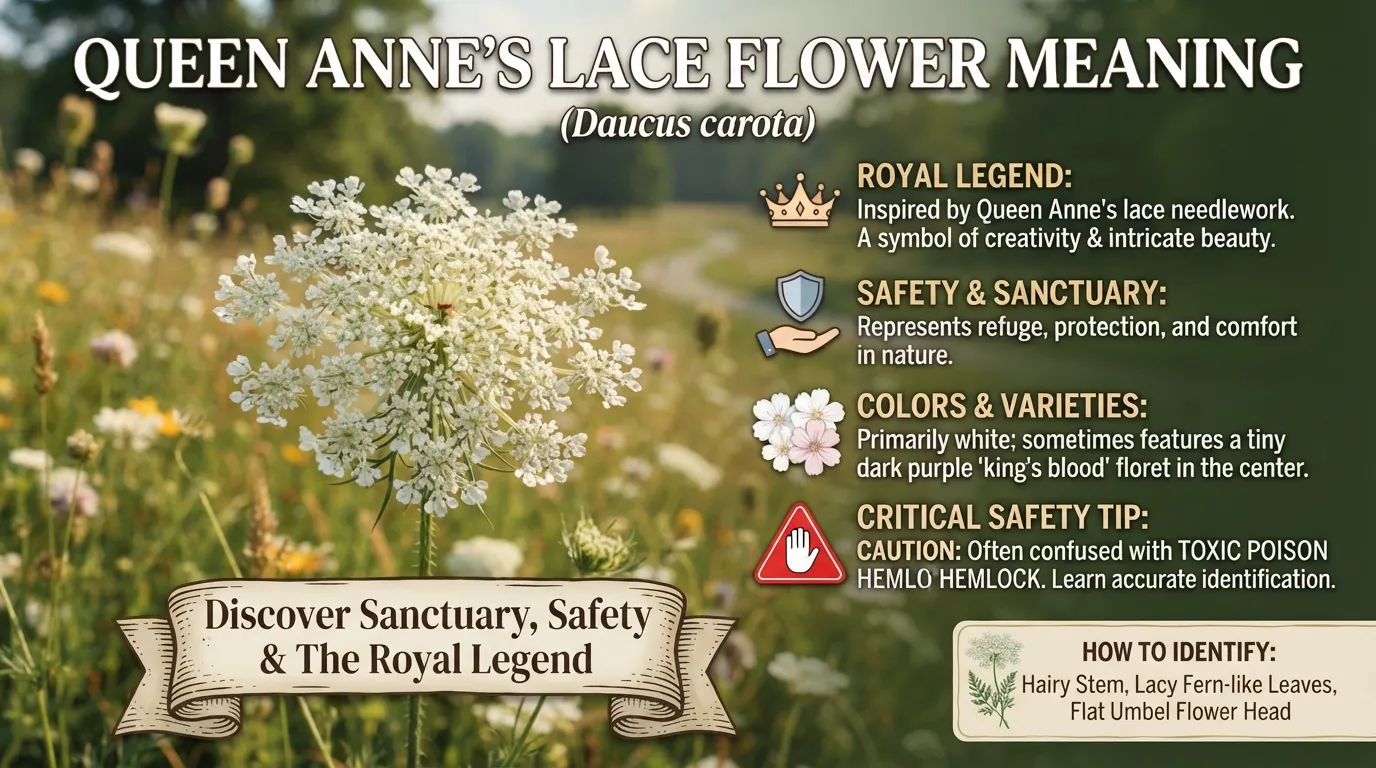
The flower’s name comes from an old legend tied to Queen Anne of England, who ruled in the early 1700s. One popular story says the queen pricked her finger while making lace, and a single drop of blood fell onto the fabric. This legend explains the tiny, dark purple-red floret often found at the very center of the flower’s wide, lacy white bloom. The scientific name, Daucus carota, simply means “carrot,” since this plant is the wild ancestor of the garden carrot.
Queen Anne’s Lace in Victorian Flower Language
In Victorian times, people used flowers to send quiet messages. Queen Anne’s Lace stood for “sanctuary” and “safety.” Some readings also linked it to “fantasy” and delicate, hidden beauty. This meaning grew from the flower’s soft, protective shape. Its tiny blooms cluster tightly together, almost like a small, sheltering nest, offering a sense of calm and quiet protection.
Botanical Foundations & Profile
| Feature | Detail |
|---|---|
| Scientific Name | Daucus carota |
| Native Region | Europe and southwest Asia |
| Bloom Period | Summer through early fall |
| Average Lifespan | Biennial; lives two years, blooming in the second |
| USDA Zones | Zones 3 through 9 |
| Species Count | 1 primary wild species, ancestor of the garden carrot |
History & Cultural Timeline
- Queen Anne’s Lace has grown wild across Europe and Asia for thousands of years.
- The plant is the wild ancestor of the common garden carrot, cultivated for its root over centuries.
- European settlers brought Queen Anne’s Lace to North America, where it later spread widely.
- Today, the flower is a familiar sight in meadows, roadsides, and cottage gardens across many countries.
Symbolism Deep-Dive
Safety and Sanctuary
Queen Anne’s Lace grows in tight, umbrella-shaped clusters that curl slightly inward as they age, almost like cupped hands offering shelter. This gentle, protective shape gave the flower its strong link to safety and quiet sanctuary.
Delicate Complexity
Each Queen Anne’s Lace bloom is actually made up of dozens of tiny individual flowers, arranged in a lacy, detailed pattern. This intricate design ties the flower to complex beauty, the kind found only when you look closely.
Fantasy
The soft, airy texture of Queen Anne’s Lace gives it a dreamy, almost magical look, especially when it sways gently in a summer breeze. This light, whimsical quality gave the flower its old link to fantasy and imagination.
Meaning by Color
Queen Anne’s Lace blooms mostly in white, so this section looks at its natural variations and the symbolic meaning of its famous center floret.
| Feature | Meaning |
|---|---|
| White Petals | Purity, safety, and gentle protection |
| Center Dark Floret | Sacrifice, legend, and hidden depth |
| Pale Green Buds | New beginnings and quiet hope |
Color Meanings & Cultural Safety Matrix
White Queen Anne’s Lace
- Primary sentiment: Purity and gentle protection.
- Geographic nuances: In the West, white Queen Anne’s Lace is a beloved wildflower often used in rustic and cottage-style gifting. In some Eastern cultures, white flowers more broadly can connect to mourning.
- Gifting warning: Check local customs before gifting white blooms at a joyful celebration.
Dark Center Floret
- Primary sentiment: Legend and hidden meaning.
- Geographic nuances: The small purple-red center dot is a unique, storytelling feature often highlighted in Western folklore about the flower’s royal namesake.
- Gifting warning: A charming conversation piece rather than a formal gifting symbol on its own.
Global Traditions & Literary Impact
In many English and American wildflower traditions, Queen Anne’s Lace is a favorite for casual, rustic bouquets, often paired with other meadow flowers in late summer arrangements. Its delicate, lacy look has made it a lasting symbol of simple, natural beauty in cottage gardens.
In literature, Queen Anne’s Lace appears in the short story collection Queen Anne’s Lace references found in various American nature writing and poetry describing summer meadows and roadside beauty. Please double-check any specific literary references, as I cannot search a live database and details may be inaccurate.
Economic, Culinary, and Medicinal Uses
Queen Anne’s Lace is the wild ancestor of the cultivated carrot, and its root is technically edible when young, though it closely resembles the highly poisonous plant called poison hemlock. Because the two plants can be dangerously easy to confuse, foraging Queen Anne’s Lace is strongly discouraged unless done with expert guidance. Always consult an expert before eating or using any wild plant.
Explore Related Flower Meanings:
https://bloomsyflower.com/coreopsis-flower-meaning/
Ultimate Etiquette & Gifting Guide
| Relationship | Recommended Style | The Subtext |
|---|---|---|
| Close Friend | Simple wildflower bouquet | “I offer you comfort and safety.” |
| New Home or Beginning | Paired with pale greenery | “Wishing you a peaceful, sheltered start.” |
| Someone Who Loves Nature | Full, natural arrangement | “Beauty is found in life’s small details.” |
| Casual Romantic Gesture | Mixed with garden roses | “A gentle, dreamy kind of love.” |
Universal Safety Rule
Never forage for wild Queen Anne’s Lace for food because it closely resembles poison hemlock, a deadly plant. Always buy it from a trusted source or grow it yourself from positively identified seeds if you intend to use it for culinary purposes.
Queen Anne’s Lace vs. Close Lookalikes
| Feature | Queen Anne’s Lace | Poison Hemlock | Yarrow |
|---|---|---|---|
| Petal Shape | Lacy, flat-topped clusters with a tiny dark center floret | Lacy, flat-topped clusters, no dark center floret | Tightly packed, flat clusters of tiny blooms |
| Fragrance | Slightly musty, carrot-like scent | Unpleasant, musty odor | Mild, herbal scent |
| Foliage | Fine, fern-like leaves with small hairs on stem | Smooth, hairless stems, often with purple blotches | Feathery, finely divided leaves |
| Bloom Season | Summer through early fall | Late spring through summer | Summer through fall |
| Growth Style | Grows upright, biennial habit | Grows upright, can reach great heights | Grows upright, spreading habit |
How to tell them apart
Check the stem closely. Queen Anne’s Lace has small hairs on its stem, while poison hemlock has a smooth stem, often marked with purple or reddish blotches, a key warning sign of this dangerous lookalike.
Practical Maintenance & Domestic Safety
Care Basics
- Plant Queen Anne’s Lace in full sun for the healthiest blooms.
- Use well-drained soil; the plant tolerates poor, dry conditions well.
- Water moderately; established plants handle dry spells easily.
- Allow some blooms to go to seed if you want the plant to naturally return next year.
Pet Toxicity Warning
The ASPCA lists Queen Anne’s Lace as mildly toxic to cats, dogs, and horses. Eating the plant can cause skin irritation, especially in sunlight, as well as mild digestive upset. Keep pets from grazing on large amounts, and contact a vet if you notice unusual symptoms.
Expert Curations & Misconceptions
10 Quick Fun Facts
- Queen Anne’s Lace is the wild ancestor of the garden carrot.
- The flower’s tiny dark center floret is tied to an old royal legend.
- Each bloom is made up of dozens of tiny individual flowers.
- The plant is a biennial, blooming only in its second year of growth.
- Queen Anne’s Lace closely resembles the deadly poison hemlock plant.
- Bees and other pollinators are drawn to its wide, flat blooms.
- The flower’s stem has fine hairs, unlike its toxic hemlock lookalike.
- Queen Anne’s Lace can be found growing wild along roadsides and meadows.
- The plant is also sometimes called “wild carrot.”
- Some gardeners grow Queen Anne’s Lace intentionally for its delicate, lacy look.
3 Myth vs. Reality Pairs
Myth: Queen Anne’s Lace is always safe to forage and eat.
Reality: It closely resembles deadly poison hemlock, making foraging risky without expert knowledge.
Myth: Queen Anne’s Lace and poison hemlock are impossible to tell apart.
Reality: Careful attention to stem texture and color can help identify the difference, though caution is still advised.
Myth: The flower is purely a weed with no garden value.
Reality: Many gardeners intentionally grow Queen Anne’s Lace for its delicate, romantic, lacy appearance.
2 Quick Florist Tips
- Cut Queen Anne’s Lace stems when blooms are fully open for the longest-lasting display.
- Pair with roses or garden greenery for a soft, romantic, cottage-style arrangement.
Questions About Queen anne’s lace flower meaning
What does Queen Anne’s Lace mean spiritually?
Queen Anne’s Lace means safety and sanctuary, offering a sense of gentle protection and calm.
Is Queen Anne’s Lace a good gift for special occasions?
Yes, it works well in casual, rustic bouquets for new beginnings, comfort, or simple nature-inspired gifts.
What does the dark center floret mean?
The tiny dark floret is tied to an old legend about Queen Anne pricking her finger, symbolizing sacrifice and hidden story.
Is Queen Anne’s Lace toxic to pets?
Yes, the ASPCA lists it as mildly toxic, so keep pets from grazing on large amounts of the plant.
Can you eat Queen Anne’s Lace?
Its root is technically edible, but it closely resembles the deadly poison hemlock and foraging is strongly discouraged without expert guidance.
When does Queen Anne’s Lace bloom?
It typically blooms from summer through early fall, in its second year of growth as a biennial plant.
How did Queen Anne’s Lace get its name?
Its name comes from an old legend about Queen Anne of England pricking her finger while making lace.
What did Queen Anne’s Lace mean in Victorian times?
It meant sanctuary and safety, along with a touch of fantasy and delicate, hidden beauty.
Final Thoughts
Queen Anne’s Lace carries a gentle, storied meaning rooted in safety, sanctuary, and delicate beauty. Its lacy white blooms, each made up of dozens of tiny flowers, offer a quiet reminder that true beauty often lies in small, intricate details easy to overlook.
From its royal legend to its wild meadows across Europe and North America, this humble flower has woven itself into gardens and folklore alike. Whether admired along a roadside or gathered into a soft, romantic bouquet, Queen Anne’s Lace reminds us that even the simplest wildflower can carry a rich and dreamy story. Just remember its one serious caution: always admire this plant with your eyes, not your plate, unless you are certain of its safe identification.

Zahid Abbas is an educator, researcher, and digital publishing strategist behind BloomsyFlower, a flower and gardening resource covering flower meanings, symbolism, history, care, seasonal blooms, and gifting. He combines research with simple, reader-friendly writing to help people understand, grow, and enjoy flowers.