Meaning of Yellow Carnation
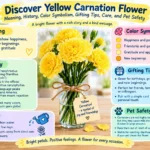
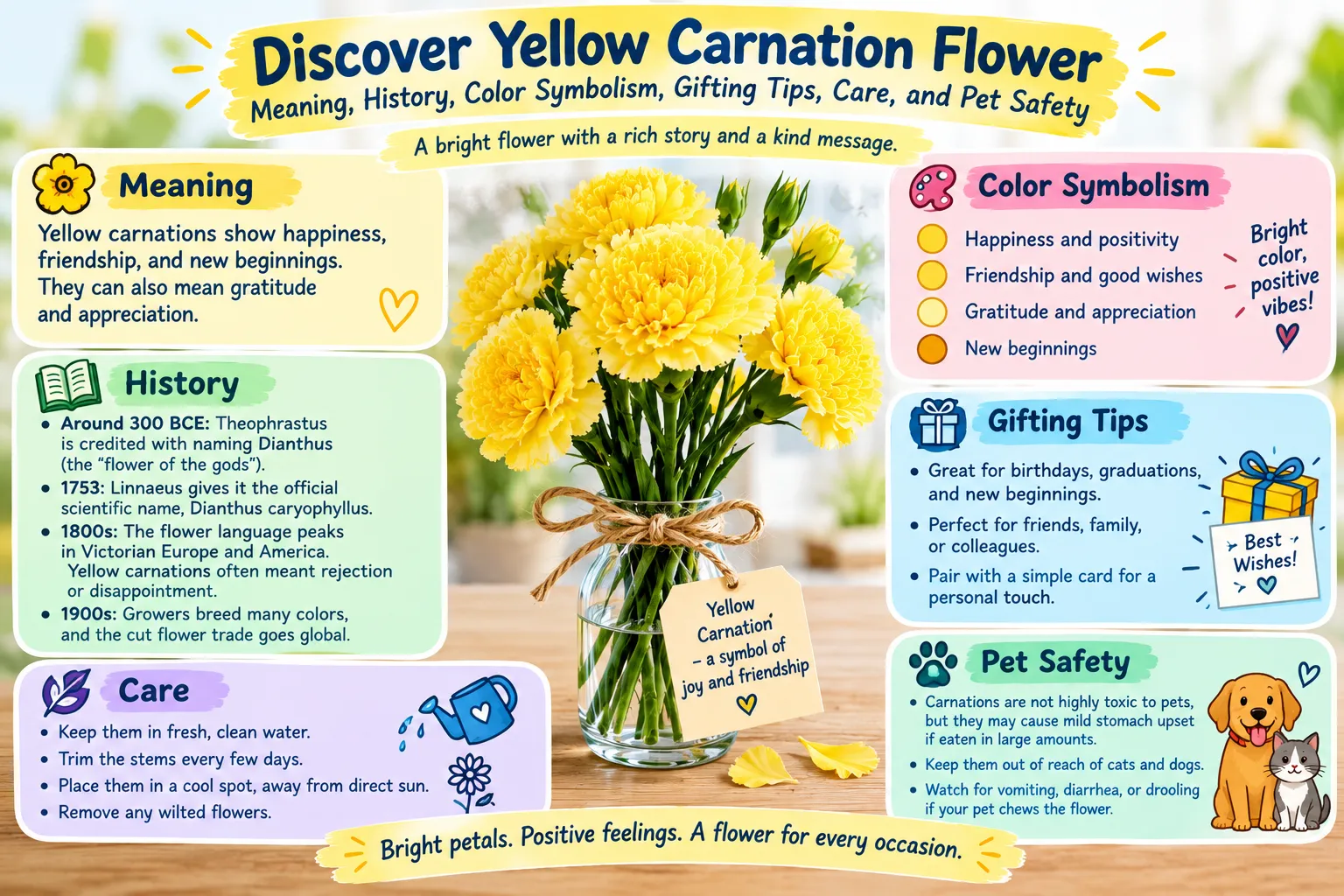
The yellow carnation flower meaning is cheer and friendship today. In Victorian times, it often meant disappointment. Give it for sunny gifts, and add a note so your meaning is clear.
Origin of the Name
Where “Carnation” Comes From
No one is sure where carnation comes from. One idea says it comes from the Latin word carnis, which means “flesh.” The first carnations were pink, like skin. Another idea says it comes from corona, which means “crown.” People once wove carnations into flower crowns.
Where the Science Name Comes From
The plant’s science name is Dianthus caryophyllus. Dianthus comes from two Greek words. Dios means “of the gods.” Anthos means “flower.” So it means “flower of the gods.” Many sources credit Theophrastus, an ancient Greek plant scholar, for the name. He lived around 300 BCE.
Caryophyllus is Greek for the clove tree. Many carnations smell a bit like cloves. Carl Linnaeus, a Swedish scientist, gave the full name its modern form in 1753.
Yellow Carnation in Victorian Flower Language
The Victorians loved flower language. This was a secret code of flowers. It was very popular in the 1800s.
In that code, yellow carnations often meant disappointment or rejection. They could also say, “You have let me down.” Yellow flowers often carried cooler meanings then. Many bright yellow blooms stood for jealousy or scorn.
Guides did not always agree. But most shared these meanings:
| Color | Victorian Message |
| Yellow | Disappointment or rejection |
| White | Pure love, innocence, good luck |
| Pink | “I will never forget you” |
| Red | Admiration; “my heart aches for you” |
| Striped | “Sorry, I cannot be with you” |
Today, many florists see yellow in a happier way. It looks like sunshine, so it now often says “cheer up” or “thank you.”
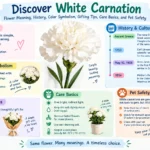
Related Flower Meanings https://bloomsyflower.com/white-carnation-flower-meaning/
Botanical Foundations & Profile
| Scientific Name | Native Region | Bloom Period | Average Lifespan | USDA Zones | Species Count |
| Dianthus caryophyllus | Mediterranean region | Spring to early summer outdoors; year-round in florist greenhouses | Often 3 to 5 years as a garden plant; cut flowers last 1 to 3 weeks | Mostly 6–9, depending on the variety | About 300 in the Dianthus family |
Notes to double-check: Experts count species in different ways, so 300 is a rough number. Lifespan and zones change by variety and climate. (USDA zones are a map of winter cold. They help gardeners pick plants.)
History & Cultural Timeline
- Around 300 BCE: Theophrastus, an ancient Greek philosopher and botanist, is traditionally credited with using the name Dianthus. The name comes from Greek words meaning “divine flower” or “flower of Zeus.” The exact date is approximate.
- 1753: Carl Linnaeus published the scientific name Dianthus caryophyllus for the carnation in Species Plantarum.
- 1800s: The language of flowers became popular in Victorian Britain and America. In many flower dictionaries, yellow carnations symbolized rejection, disdain, or disappointment, although meanings varied by source.
- 1800s–1900s: Carnation breeding and commercial production expanded. Modern varieties developed a wider range of colors, and carnations became important cut flowers sold around the world.
Symbolism Deep-Dive
Cheer and Joy
The yellow color looks like sunshine. A bunch of them can light up a plain room. That bright look is why many people now link yellow carnations with joy and good news.
Friendship
Many carnations are sold as spray types. That means many small blooms grow on one stem. The cluster looks like a friendly crowd. It is a good fit for a thank-you or a “thinking of you” gift.
Disappointment (The Old Meaning)
Yellow carnations have fringed, zigzag petal edges. They can look a bit like torn paper. Victorian guides tied that look to hurt feelings. Most people no longer read it that way. But a few still know the old code.
Meaning by Color: Cultural Safety Matrix
Yellow is the star here. But carnations come in other colors too. Each color sends a different message. Yellow carnation flower meaning can change from place to place. So these notes are general guides, not strict rules.
Yellow
- Primary sentiment: Today: cheer, friendship, and new starts. Long ago: disappointment or rejection.
- Geographic nuance: In the US and UK, most people now see yellow as friendly. Some old guides still use the Victorian meaning. In Russia and some nearby countries, yellow flowers are often linked to breakups or betrayal.
- Gifting warning: Skip yellow carnations for a love note. Mix them with white or green for a friendly look.
White
- Primary sentiment: Pure love, innocence, good luck, and remembrance.
- Geographic nuance: In the US, white is worn on Mother’s Day to honor a mother who has passed. In China, white is strongly linked with mourning.
- Gifting warning: White can feel sad to some people. Mix it with bright blooms for happy events.
Pink
- Primary sentiment: Gratitude and a mother’s love. It says, “I will never forget you.”
- Geographic nuance: In the US and UK, pink is common for Mother’s Day gifts. In Japan, pink and red carnations are also common on Mother’s Day.
- Gifting warning: Pink is very safe. A short note helps make the meaning clear.
Red
- Primary sentiment: Admiration and deep love.
- Geographic nuance: In Portugal, the red carnation is a symbol of the 1974 “Carnation Revolution.” In Korea, red carnations are given to living parents on Parents’ Day.
- Gifting warning: Dark red can mean “my heart aches.” Pick a bright shade for a happy gift.
Color Meaning Table
| Color | Main Meaning | Culture Notes | Gifting Warning |
| Yellow | Today: cheer, friendship. Old: rejection | US and UK: friendly. Russia: often a breakup sign | Skip for romance; add a note |
| White | Pure love, luck, remembrance | US: late mothers. China: mourning | Can feel sad; mix with bright flowers |
| Pink | Gratitude, “I’ll never forget you” | US, UK, and Japan: Mother’s Day | Very safe; add a note |
| Red | Admiration, deep love | Portugal: freedom. Korea: living parents | Dark red may feel heavy |
| Striped or purple (less common) | Old: refusal or change of heart | Victorian guides in the West | Meanings vary; add a note |
Global Traditions & Literary Impact
Victorian Tussie-Mussies
In the 1800s, people carried small, hand-held bouquets called tussie-mussies. Each flower in the bunch had a coded yellow carnation flower meaning. A yellow carnation could send a cool, quiet message without any words. Today, florists sometimes make these bouquets for fun or for history fans.
A Famous Play: The Winter’s Tale
William Shakespeare’s play The Winter’s Tale mentions “carnations” among the flowers of the season. It was written around 1610 to 1611. Unverified: please double-check the play, the scene, and the date before you publish.
Economic, Culinary, and Medicinal Uses
- Cut flower trade: Carnations are one of the most popular cut flowers in the world. They are hardy and last long, so many shops and events use them.
- Perfume: The spicy, clove-like scent has been used in perfume. Many modern perfumes use artificial scents instead.
- Garnish: Some cooks use petals to decorate cakes and salads. Use only flowers grown for food, without sprays. Many store-bought flowers are not safe to eat. If you are unsure, skip it. The white base of each petal can taste bitter.
- Tea: Some herbal tea blends use dried petals. Buy from a trusted maker.
- Traditional medicine: Old herbal books mention carnations for headaches and fevers. Science has not proven these uses. Flowers should not replace a doctor. Please ask a health expert before you try any plant remedy.
Ultimate Etiquette & Gifting Guide
| Relationship | Recommended Color | The Subtext |
| Close friend | Yellow (mixed with white or green) | “You bring me joy.” |
| Neighbor or housewarming | Yellow | “Welcome. Have a sunny home.” |
| Coworker or teacher | Yellow or pink | “Thank you for your help.” |
| Someone feeling down | Yellow with pink | “I am cheering for you.” |
| New love | Pink or red | “I care about you.” |
| Mother, living | Pink or red | “Thank you. I love you.” |
| Mother, passed away | White | “I remember you with love.” |
| Sympathy | White | “I share your sorrow.” |
| Romance (avoid) | Not yellow | Old guides may read it as “no” |
Universal Safety Rule
When you are unsure, mix yellow carnations with white or green stems and add a kind note. If your friend loves flower language, a quick note will clear up any old yellow carnation flower meaning.
Yellow Carnation vs. Close Lookalikes
| Trait | Yellow Carnation | Yellow Rose | Yellow Chrysanthemum | Yellow Ranunculus |
| Petal Shape | Ruffled, with fringed, zigzag edges | Smooth, soft, in spiral layers | Many narrow petals; daisy or pompon shape | Thin, paper-like petals in tight layers |
| Fragrance | Light, spicy, clove-like; some are faint | Often strong | Earthy and mild | Faint or none |
| Foliage | Narrow, gray-green leaves on jointed stems | Toothed leaflets; thorns on stems | Lobed leaves with a sharp smell | Lacy, fern-like leaves |
| Bloom Season | Spring to summer; florists sell year-round | Late spring to fall | Fall | Spring |
| Pet Safety (ASPCA-style listings) | Listed as mildly toxic | Listed as non-toxic; thorns can hurt | Listed as toxic | Listed as toxic |
How to tell them apart: Look at the petal edges first. Fringed, zigzag edges point to a carnation. Then check the stem. A carnation stem has swollen joints, like knuckles.
Practical Maintenance & Domestic Safety
Care Basics
- Sun: Give it full sun. Aim for at least six hours a day.
- Soil: Use light, well-drained soil that is neutral to a little alkaline. (Alkaline soil is the opposite of acidic.)
- Water: Water at the base. Let the top of the soil dry between drinks. Wet leaves can invite mold.
- Pruning: Snip off spent blooms. This helps new buds form. Stake tall stems if they flop.
Pet Toxicity Warning
The ASPCA lists carnations as mildly toxic to dogs and cats. Chewing on them may cause stomach upset. Signs can include vomiting, loose stool, or drooling. Some pets may get a mild skin rash. Keep vases out of reach. Call your vet if your pet seems unwell. Always check the latest ASPCA guidance.
Expert Curations & Misconceptions
10 Quick Fun Facts
- The name Dianthus means “flower of the gods.”
- The word caryophyllus is Greek for the clove tree.
- Carnations are the birth flower for January.
- Florists sell carnations in many shades, from yellow to deep red.
- Spray carnations carry many small blooms on one stem.
- A cut carnation can last one to three weeks with care.
- In Victorian code, yellow meant disappointment. Today, many see cheer.
- The ruffled petals have zigzag edges, as if cut with pinking shears.
- Carnations are among the most popular cut flowers in the world.
- Portugal’s 1974 change of government is called the Carnation Revolution.
3 Myth vs. Reality
| Myth | Reality |
| Yellow carnations always mean rejection. | That is the old Victorian meaning. Many florists and gift-givers now use yellow for cheer and friendship. |
| Carnations have no scent. | Many florist types are faint. Many garden types smell spicy, like cloves. |
| Carnations are only for Mother’s Day. | People give them all year, for friendship, thanks, and joy. |
2 Quick Florist Tips
- Keep carnations away from ripe fruit. Ripe fruit gives off a gas that makes blooms age faster.
- Mix yellow with white or green. This softens any old meaning and looks fresh. Trim stems at an angle, just above a joint, and change the water every two days.
Understanding Yellow Carnation Flower Meaning
What is the spiritual meaning of a yellow carnation?
Many people link it to joy, sunshine, and hope. Some also see it as a gentle reminder to let go of hurt.
What are the best occasions to give yellow carnations?
Good times include friendship gifts, thank-yous, birthdays, and housewarmings. Skip them for romantic gestures.
What do the different carnation colors mean?
Yellow means cheer and friendship today. It once meant disappointment. White means pure love. Pink means gratitude. Red means admiration and deep love.
Are yellow carnations toxic or edible?
The ASPCA lists carnations as mildly toxic to dogs and cats. People sometimes eat petals as a garnish. Eat only flowers grown for food, and skip store-bought bouquets.
When do yellow carnations bloom?
Garden plants bloom from spring to early summer. Florists grow them in greenhouses, so you can buy them all year.
Are yellow carnations invasive? How hard are they to care for?
They are not known as invasive in most places. Please check your local rules. They like full sun, light soil, and water at the base.
Where does the name carnation come from?
No one is sure. It may come from a Latin word for “flesh” or “crown.” Dianthus, the science name, means “flower of the gods.”
What did a yellow carnation mean in the Victorian era?
It often meant disappointment or rejection. Many yellow flowers had cool meanings in that code.
Is it bad to give someone yellow carnations?
Not usually. Most people today see them as cheerful. Still, add a note if the person loves flower language, and skip them for romance.
How long do cut yellow carnations last?
With care, they can last one to three weeks. Change the water often and keep them away from ripe fruit.
Final Thoughts
Yellow carnation flower meaning starts with a bright, tough flower that is full of story. Its sunny color speaks of cheer and friendship. Flowers strong stems and long life say, “I am here for you.” Its history adds a twist. Victorians once read it as a sign of hurt. Now it is mostly a smile in flower form.
Now it is your turn. Plant a few in a sunny bed. Give a bunch to a friend who needs a lift. Or put some in a vase and enjoy the glow. Whatever you choose, add a short note. The flower says a lot, but your words make it personal. Ready to begin? Pick a yellow carnation today, and let it say “thank you.

Zahid Abbas is an educator, researcher, and digital publishing strategist behind BloomsyFlower, a flower and gardening resource covering flower meanings, symbolism, history, care, seasonal blooms, and gifting. He combines research with simple, reader-friendly writing to help people understand, grow, and enjoy flowers.