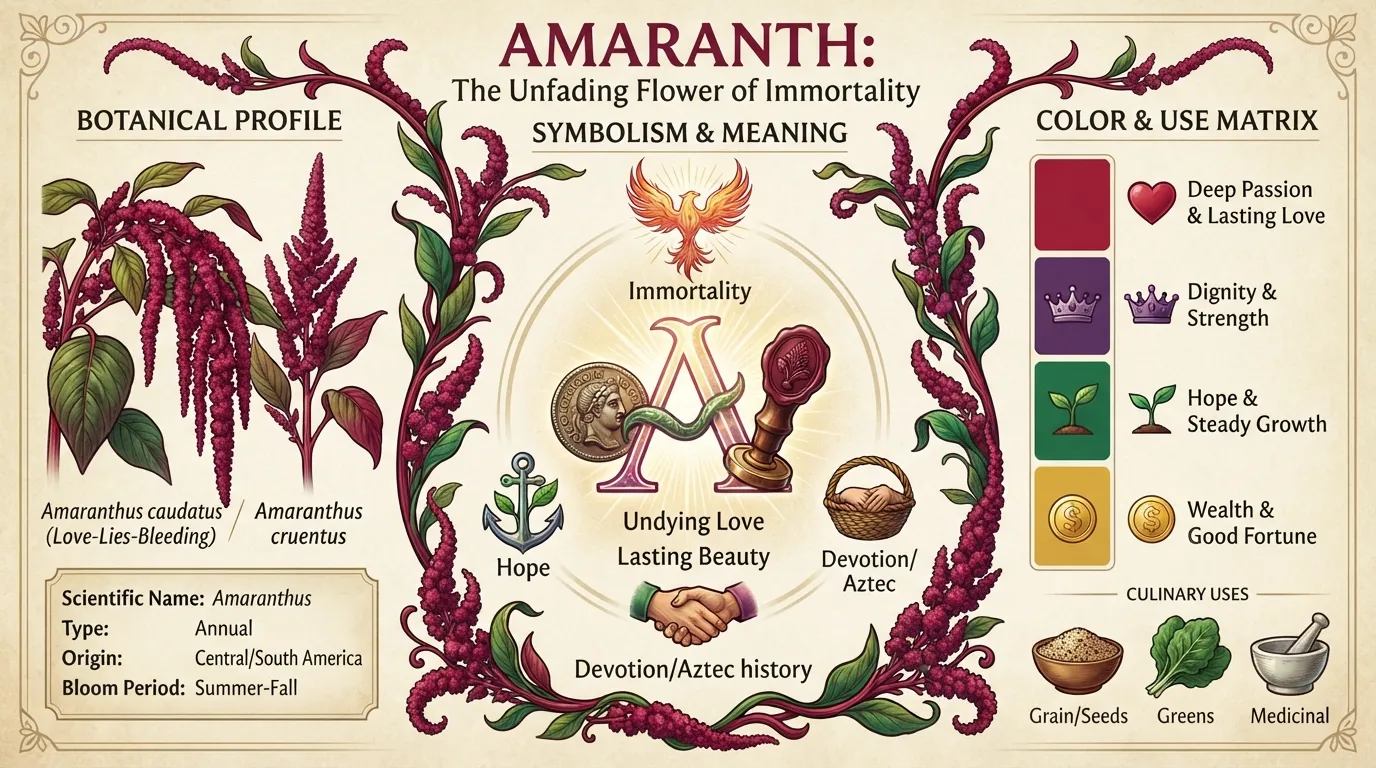
The amaranth flower means immortality, undying love, and lasting beauty. It also stands for hope that never fades. People give amaranth to show a love that will not die, even through time or hardship.
Origin of the Name
The word “amaranth” comes from an old Greek word, amarantos. This word means “unfading” or “does not wither.” Ancient Greek poets used this word to describe flowers that seem to stay fresh forever. Botanists later gave this exact name to the plant, since its dried blooms can hold their color for a very long time.
Amaranth in Victorian Flower Language
In Victorian times, people used flowers to send silent messages. Each flower carried its own special meaning.
Giving someone an amaranth flower meant “I will love you forever” or “my love will never die.” This meaning grew from a true fact about the plant. Even after amaranth is cut and dried, its bright color often stays strong for months. This lasting beauty made it a perfect symbol of love that never fades.
Botanical Foundations & Profile
| Feature | Detail |
|---|---|
| Scientific Name | Amaranthus (genus with many species) |
| Native Region | Central and South America |
| Bloom Period | Summer through early fall |
| Average Lifespan | Grows as an annual, living one season |
| USDA Zones | Zones 2 through 11, grown as an annual |
| Species Count | About 60 to 70 species |
History & Cultural Timeline
- Ancient Aztec people grew amaranth as a key food crop over 8,000 years ago.
- Amaranth seeds were once used in Aztec religious ceremonies and daily meals.
- Spanish settlers banned amaranth farming in the 1500s due to its tie to Aztec religion.
- Today, amaranth has returned as a popular grain crop and garden flower worldwide.
Symbolism Deep-Dive
Immortality
Dried amaranth flowers keep their bright color for a very long time. This rare trait gave the plant its strong link to lasting life and love that never fades.
Hope
Amaranth grows fast and strong, even in poor soil. This tough, hopeful growth pattern ties the flower to the idea of hope surviving hard times.
Devotion
Ancient Aztec people relied on amaranth as a key food source. This deep, daily bond between people and plant gave amaranth a lasting link to loyalty and devotion.
Discover the Meaning of More Flowers:
https://bloomsyflower.com/nerine-flower-meaning/
Meaning by Color
| Color | Meaning |
|---|---|
| Red | Deep love and lasting passion |
| Purple | Dignity and quiet strength |
| Green | Hope and steady growth |
| Golden | Wealth and good fortune |
Color Meanings & Cultural Safety Matrix
Red Amaranth
- Primary sentiment: Deep, lasting love and passion.
- Geographic nuances: In Mexico, red amaranth holds strong ties to ancient Aztec tradition. In Western flower language, red often means romantic love.
- Gifting warning: A meaningful choice for close partners, not casual friends.
Purple Amaranth
- Primary sentiment: Dignity and quiet inner strength.
- Geographic nuances: In many cultures, purple flowers carry a sense of nobility and respect.
- Gifting warning: Best suited for formal or respectful gifts.
Green Amaranth
- Primary sentiment: Hope and steady, calm growth.
- Geographic nuances: Green amaranth is often grown as food in parts of Asia and Africa, tied to daily nourishment and life.
- Gifting warning: A safe, gentle choice for almost any occasion.
Golden Amaranth
- Primary sentiment: Wealth and good fortune.
- Geographic nuances: Golden and yellow tones often link to prosperity across many cultures.
- Gifting warning: A cheerful pick for celebrations and new ventures.
Global Traditions & Literary Impact
In ancient Aztec culture, amaranth seeds were mixed with honey or blood to form small figures used in religious ceremonies. This tradition was so central to Aztec life that Spanish colonizers later banned the crop, fearing its deep religious ties. Today, amaranth has made a strong comeback, both as a health food and a garden flower.
In literature, the amaranth flower appears in the poem Lycidas by John Milton, published in 1637, where it symbolizes an unfading, eternal kind of beauty. Please double-check this literary reference, as I cannot search a live database and details may be inaccurate.
Economic, Culinary, and Medicinal Uses
Amaranth seeds are a true superfood, packed with protein and nutrients. People cook the seeds like a grain, similar to quinoa, in soups, cereals, and breads. The leaves are also eaten as leafy greens in many parts of Africa, Asia, and Latin America. Amaranth is generally considered safe to eat when prepared properly, but as with any new food, it’s wise to check with a doctor if you have allergies or health concerns.
Ultimate Etiquette & Gifting Guide
| Relationship | Recommended Color | The Subtext |
|---|---|---|
| Spouse or Partner | Red | “My love for you will never fade.” |
| Respected Elder | Purple | “I honor your strength and wisdom.” |
| Grieving Friend | Green | “I hope for peace and healing for you.” |
| New Business Venture | Golden | “Wishing you wealth and good fortune.” |
Universal Safety Rule
Choose dried amaranth for gifts meant to last, since its color holds strong for months, making it a lasting symbol of your message.
Amaranth vs. Close Lookalikes
| Feature | Amaranth | Celosia | Love-Lies-Bleeding (Amaranthus caudatus) |
|---|---|---|---|
| Petal Shape | Small clustered blooms on upright spikes | Fuzzy, flame-like clusters | Long, trailing, rope-like clusters |
| Fragrance | Little to no scent | Little to no scent | Little to no scent |
| Foliage | Broad, oval, often colorful leaves | Broad green leaves | Broad, deep green leaves |
| Bloom Season | Summer through fall | Summer through fall | Summer through fall |
| Growth Style | Grows upright in tall spikes | Grows upright in bushy clusters | Grows in long, drooping strands |
How to tell them apart
Look at the shape. Upright amaranth stands tall and straight. Love-lies-bleeding, a type of amaranth, droops down in long, rope-like strands instead.
Practical Maintenance & Domestic Safety
Care Basics
- Plant amaranth in full sun for the best color and growth.
- Use well-drained soil; amaranth tolerates poor soil well.
- Water moderately; the plant handles dry spells better than most flowers.
- Cut and dry blooms in late summer to keep their color for months.
Pet Toxicity Warning
Amaranth is generally considered non-toxic to cats and dogs. However, some amaranth species can gather high nitrate levels from soil, which may cause mild stomach upset in animals that eat large amounts. Watch for unusual symptoms and contact a vet if you have concerns.
Expert Curations & Misconceptions
10 Quick Fun Facts
- Amaranth was once a key food crop for the ancient Aztec people.
- The name “amaranth” means “unfading” in Greek.
- Dried amaranth flowers can keep their color for many months.
- Amaranth seeds are considered a modern superfood, rich in protein.
- Some amaranth varieties grow over six feet tall.
- NASA has studied amaranth as a possible food crop for space travel.
- Amaranth leaves are eaten as leafy greens in many countries.
- One amaranth plant can produce thousands of tiny seeds.
- Spanish colonizers once banned amaranth farming in the 1500s.
- Amaranth is gluten-free, making it popular in health food today.
3 Myth vs. Reality Pairs
Myth: Amaranth is only a decorative flower.
Reality: Amaranth is also a nutritious food crop, eaten as both seeds and leaves.
Myth: All amaranth flowers grow upright.
Reality: Some types, like love-lies-bleeding, grow in long, drooping strands instead.
Myth: Amaranth is a modern, newly discovered plant.
Reality: People have grown and eaten amaranth for thousands of years.
2 Quick Florist Tips
- Cut amaranth stems when the blooms are fully open for the best, longest-lasting color.
- Hang amaranth upside down in a dry, dark room to preserve its color for dried arrangements.
Common Questions and Answers
What does the amaranth flower mean spiritually?
Amaranth means undying love and lasting hope, tied to its ability to keep its color long after being cut.
Is amaranth a good gift for special occasions?
Yes, it works well for anniversaries, weddings, and any moment meant to celebrate lasting love or devotion.
What does a red amaranth mean?
Red amaranth stands for deep, lasting love and strong passion between two people.
Can you eat amaranth?
Yes, amaranth seeds and leaves are edible and packed with nutrients. Always prepare them properly before eating.
When does amaranth bloom?
Amaranth typically blooms from summer through early fall.
Is amaranth easy to grow at home?
Yes, amaranth is a hardy, easy-to-grow plant that thrives even in poor soil with little care.
How did the amaranth flower get its name?
The name comes from the Greek word amarantos, meaning “unfading,” due to its long-lasting color.
What did amaranth mean historically?
Historically, amaranth held deep spiritual meaning for the Aztec people and later symbolized undying love in Victorian flower language.
Final Thoughts
The amaranth flower carries a powerful message of love that never fades. Its long history, from ancient Aztec ceremonies to Victorian love notes, shows just how deeply people have connected with this plant across time. Its unique ability to hold color long after being cut makes it a true symbol of lasting beauty and devotion.
Whether grown for its striking blooms, eaten for its rich nutrition, or gifted to express a love that will never die, amaranth remains a flower full of deep meaning. Consider planting amaranth in a sunny garden spot, or gifting a dried bundle to someone whose place in your heart will never fade.

Zahid Abbas is an educator, researcher, and digital publishing strategist behind BloomsyFlower, a flower and gardening resource covering flower meanings, symbolism, history, care, seasonal blooms, and gifting. He combines research with simple, reader-friendly writing to help people understand, grow, and enjoy flowers.