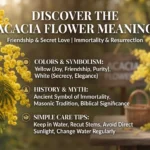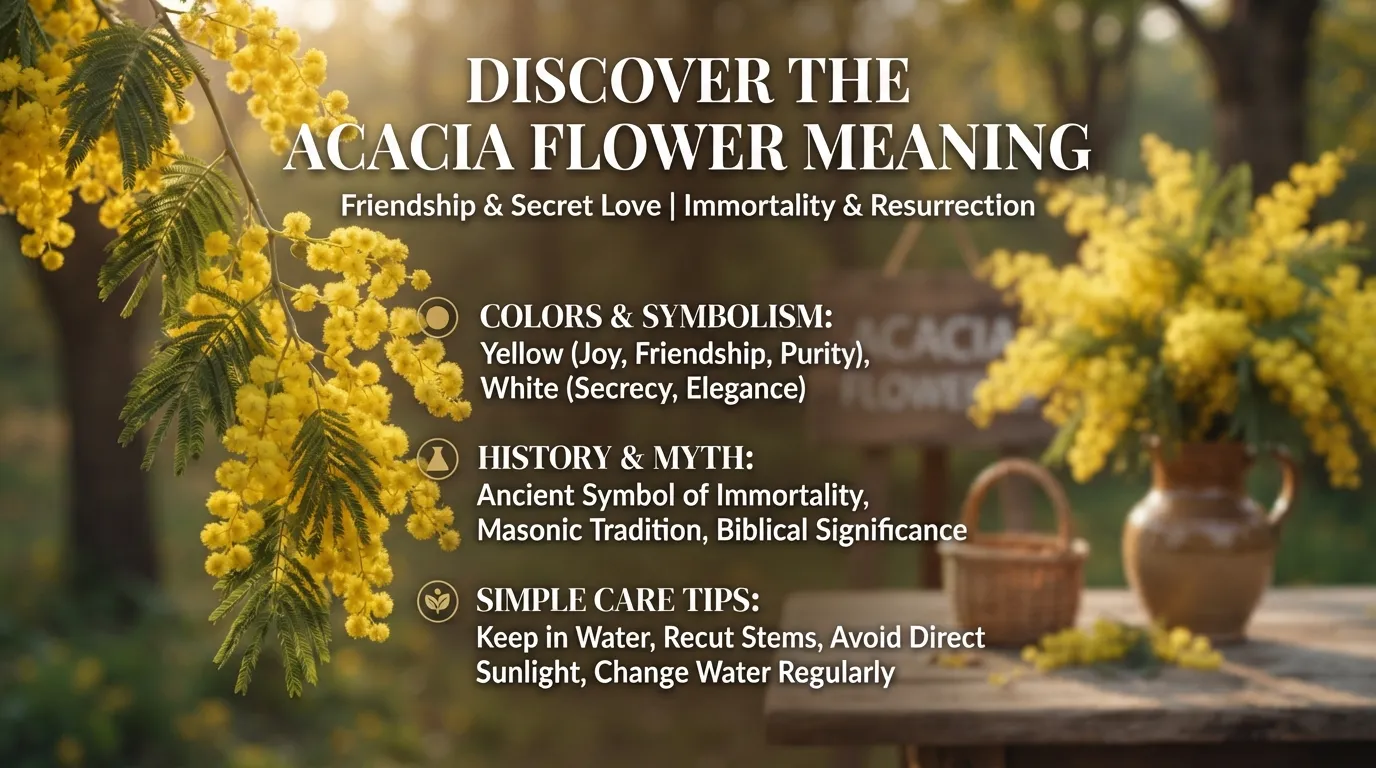
The acacia flower means friendship, elegance, and secret love. It also stands for immortality and resurrection. People give acacia to celebrate a trusted bond, or to share quiet feelings not yet spoken aloud.
Origin of the Name
The word “acacia” comes from the ancient Greek word akakia. This word traces back even further to the Greek word ake, meaning “thorn” or “point,” since many acacia species have sharp thorns along their branches. Ancient Greek writers used this name for the thorny tree long before modern botanists adopted it into scientific use.
Acacia in Victorian Flower Language
In Victorian times, people used flowers to send quiet messages. Acacia stood for “secret love” and “friendship.” Some readings also linked it to “elegance” and even “chaste love.” This meaning grew from the plant’s delicate, feathery blooms paired with its tough, thorny branches, a mix of softness and strength that mirrored love held close and protected.
Botanical Foundations & Profile
| Feature | Detail |
|---|---|
| Scientific Name | Acacia (genus with many species, e.g. Acacia dealbata) |
| Native Region | Africa, Australia, and parts of Asia and the Americas |
| Bloom Period | Winter through spring, depending on species |
| Average Lifespan | Perennial tree or shrub; can live decades |
| USDA Zones | Zones 9 through 11, depending on species |
| Species Count | Over 1,000 species |
History & Cultural Timeline
- Acacia has grown across Africa, Asia, and Australia for thousands of years.
- Ancient Egyptians used acacia wood and resin in daily life, including in early embalming practices.
- Acacia appears in the Bible, described as the wood used to build the Ark of the Covenant.
- Today, acacia remains a key symbol in Freemason tradition, representing immortality and the soul.
Symbolism Deep-Dive
Immortality
Acacia wood resists decay far longer than many other woods, staying strong and solid for a long time. This lasting toughness gave the plant its deep link to immortality and life beyond death.
Friendship
Acacia trees often grow in groups, their branches intertwining and offering shade and support to nearby plants and animals. This close, connected growth pattern ties the plant to trust and steady friendship.
Secret Love
Acacia blooms are soft, fragrant, and often hidden among thorny branches. This gentle contrast, delicate flowers protected by sharp thorns, gave the plant its old meaning of love kept quiet and guarded.
Meaning by Color
| Color | Meaning |
|---|---|
| Yellow | Joy, friendship, and new beginnings |
| White | Purity and spiritual meaning |
| Pink | Gentle affection and secret love |
| Cream | Elegance and quiet grace |
Color Meanings & Cultural Safety Matrix
Yellow Acacia
- Primary sentiment: Joy and strong friendship.
- Geographic nuances: In Australia, yellow acacia (the golden wattle) is the national floral emblem, symbolizing unity and resilience. In the West, yellow often signals cheerful friendship.
- Gifting warning: A safe, warm choice for most occasions.
White Acacia
- Primary sentiment: Purity and spiritual depth.
- Geographic nuances: In Freemason tradition, white acacia symbolizes the immortality of the soul. In the West more broadly, white often means fresh starts.
- Gifting warning: Fitting for respectful, reflective, or memorial occasions.
Pink Acacia
- Primary sentiment: Gentle affection and secret love.
- Geographic nuances: Across many cultures, soft pink tones suggest quiet, tender feelings not yet spoken.
- Gifting warning: A thoughtful choice for early or private romantic feelings.
Global Traditions & Literary Impact
In Australia, the golden wattle, a bright yellow acacia, is the country’s official national floral emblem, celebrated each year on National Wattle Day. Its hardy nature and golden color reflect the Australian landscape and spirit of resilience.
In literature, acacia appears in the Bible, where it is named as the wood used to build the Ark of the Covenant and other sacred objects, described in the Book of Exodus. Please double-check this literary reference, as I cannot search a live database and details may be inaccurate.
Economic, Culinary, and Medicinal Uses
Acacia gum, also called gum arabic, comes from certain acacia species and is widely used as a thickener in foods, drinks, and even in some art supplies like watercolor paint. Acacia honey, made from acacia blossoms, is a popular, mild-flavored honey enjoyed around the world. Some traditional practices have also used acacia bark and leaves in herbal remedies, though always check with a doctor before using any plant for health purposes.
Ultimate Etiquette & Gifting Guide
| Relationship | Recommended Color | The Subtext |
|---|---|---|
| Close Friend | Yellow | “Our friendship is steady and true.” |
| Early Romantic Interest | Pink | “I feel something I haven’t said yet.” |
| Memorial or Reflection | White | “I honor what lasts beyond this life.” |
| Respected Colleague | Cream | “I admire your quiet, steady grace.” |
Universal Safety Rule
Handle acacia branches with care, since many species have sharp thorns, and always pair the gift with a short note if your message is meant to stay private.
Acacia vs. Close Lookalikes
| Feature | Acacia | Mimosa | Broom (Cytisus) |
|---|---|---|---|
| Petal Shape | Tiny, fluffy, round or oval clusters | Tiny, fluffy, round pom-pom clusters | Small, pea-like, open flowers |
| Fragrance | Sweet, often strong scent | Sweet, light scent | Mild, sometimes sweet scent |
| Foliage | Fine, feathery leaves; often thorny stems | Fine, fern-like leaves | Small, simple leaves, few thorns |
| Bloom Season | Winter through spring | Late winter to spring | Spring |
| Growth Style | Grows as a tree or large shrub | Grows as a tree or shrub | Grows as a low to medium shrub |
How to tell them apart
Check the stems for thorns. Many acacia species have sharp thorns along their branches, while mimosa and broom plants usually do not.
Related Flower Meanings: https://bloomsyflower.com/trillium-flower-meaning/
Practical Maintenance & Domestic Safety
Care Basics
- Plant acacia in full sun for the healthiest growth.
- Use well-drained soil, since acacia dislikes standing water.
- Water young trees regularly; established acacia handles dry spells well.
- Prune carefully, wearing gloves, since many species have sharp thorns.
Pet Toxicity Warning
Most ornamental acacia species are generally considered non-toxic to cats and dogs, according to common pet plant guides. Still, the thorns on many species can cause physical injury, and eating large amounts of any plant may cause mild stomach upset. Keep pets away from thorny branches, and contact a vet if you notice unusual symptoms.
Expert Curations & Misconceptions
10 Quick Fun Facts
- Acacia is the national floral emblem of Australia, known there as golden wattle.
- Acacia wood was described as the material used to build the Ark of the Covenant.
- Gum arabic, used in food and art, comes from certain acacia species.
- Some acacia species have a close, protective relationship with specific ant colonies.
- Acacia honey is prized worldwide for its light, mild flavor.
- Many acacia trees bloom with bright yellow, fluffy flower clusters.
- Acacia wood resists decay, making it historically valuable for building and tools.
- Freemason tradition uses the acacia plant as a symbol of the immortal soul.
- Some acacia species can grow over 70 feet tall.
- Australia celebrates National Wattle Day each year on September 1st.
3 Myth vs. Reality Pairs
Myth: All acacia trees have thorns.
Reality: While many species do, some acacia varieties grow with few or no thorns at all.
Myth: Acacia only grows in Australia.
Reality: Acacia species are native to Africa, Asia, and the Americas, not just Australia.
Myth: Acacia flowers have no practical use beyond decoration.
Reality: Acacia gum and acacia honey are both widely used in food and other products.
2 Quick Florist Tips
- Cut acacia branches when blooms are freshly open for the strongest, sweetest fragrance.
- Handle stems carefully with gloves to avoid thorns when arranging acacia in a bouquet.
Questions About Acacia flower meaning
What does the acacia flower mean spiritually?
Acacia means immortality and the lasting soul, deeply tied to its symbolic role in ancient and Freemason tradition.
Is acacia a good gift for special occasions?
Yes, it works well for friendship gifts, quiet romantic gestures, and respectful or memorial occasions.
What does yellow acacia mean?
Yellow acacia stands for joy, friendship, and new beginnings, and is Australia’s national floral emblem.
Is acacia toxic to pets?
Most ornamental acacia species are considered non-toxic, though thorns can cause injury, so keep pets away from the branches.
Can you eat acacia?
Acacia gum and acacia honey are both commonly used in food, though not all parts of every acacia species are meant to be eaten.
When does acacia bloom?
Acacia typically blooms from winter through spring, depending on the species and climate.
How did acacia get its name?
Its name comes from the ancient Greek word for “thorn,” referring to the sharp spines found on many acacia species.
What did acacia mean historically?
Historically, acacia symbolized immortality and friendship, and it holds deep significance in both biblical history and Freemason tradition.
Final Thoughts
The acacia flower carries a meaningful blend of friendship, elegance, and quiet, enduring love. Its soft, fragrant blooms contrast beautifully with its tough, thorny branches, much like a love or bond that stays gentle yet strong through time.
From its sacred role in ancient history to its status as Australia’s national emblem, acacia has long held a place of deep respect across cultures. Whether grown for its golden, fragrant blooms or gifted to honor a steady friendship, acacia reminds us that true connection can be both delicate and unbreakable. Consider planting acacia in a sunny garden spot, or sharing a sprig with someone whose friendship you quietly treasure.

Zahid Abbas is an educator, researcher, and digital publishing strategist behind BloomsyFlower, a flower and gardening resource covering flower meanings, symbolism, history, care, seasonal blooms, and gifting. He combines research with simple, reader-friendly writing to help people understand, grow, and enjoy flowers.