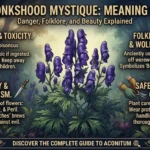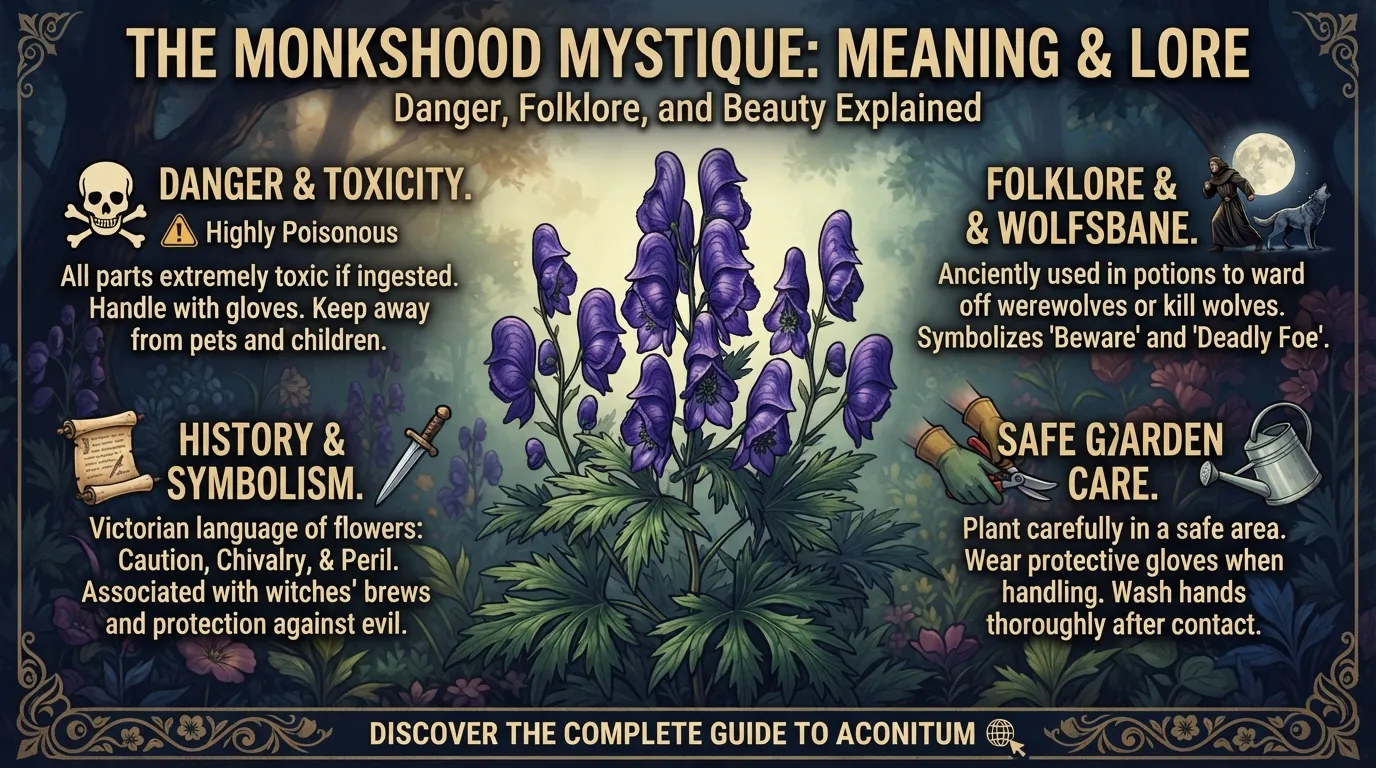
The monkshood flower means danger, beware, and caution against a deceitful approach. It also stands for chivalry and knightly honor in some older readings. This striking, hooded flower carries one of the strongest warnings in all of flower language, due to its highly poisonous nature.
Origin of the Name
The name “monkshood” comes from the flower’s unique shape. Its top petal curves up and over the rest of the bloom, forming a hood that looks much like the hood worn by monks in old religious robes. The scientific name, Aconitum, comes from the ancient Greek word akoniton, a name used by early Greek writers for this same poisonous plant.
Monkshood in Victorian Flower Language
In Victorian times, people used flowers to send quiet, coded messages. Monkshood carried one of the clearest and most serious warnings of all. It meant “beware, a deadly foe is near.” This meaning grew directly from the plant’s true danger. Every part of monkshood holds strong natural poison, and even small amounts can cause serious harm, making it one of the most feared flowers in the garden.
Botanical Foundations & Profile
| Feature | Detail |
|---|---|
| Scientific Name | Aconitum (genus with many species, e.g. Aconitum napellus) |
| Native Region | Europe, Asia, and North America |
| Bloom Period | Late summer through fall |
| Average Lifespan | Perennial; can live many years in the right conditions |
| USDA Zones | Zones 3 through 7 |
| Species Count | About 250 species |
History & Cultural Timeline
- Ancient Greek and Roman writers recorded monkshood’s deadly poison thousands of years ago.
- Old legends say hunters once used monkshood poison on arrows and spears to take down wolves, earning it the nickname “wolfsbane.”
- European herbalists in the Middle Ages studied the plant carefully, mainly to understand and avoid its dangers.
- Today, monkshood remains a popular but carefully handled garden plant, admired for its tall, striking blooms.
Symbolism Deep-Dive
Danger
Every part of the monkshood plant, from root to petal, contains strong natural toxins. This real, serious danger shaped its long-standing role as one of the clearest warning symbols in flower history.
Chivalry
In some older traditions, the tall, upright shape of monkshood, along with its hooded, almost helmet-like bloom, linked the flower to knights and chivalry, standing guard with quiet strength.
Mystery
Monkshood’s deep blue-purple color and hidden, hooded shape give it a secretive, mysterious look. This visual mystery matches its true nature: a quiet, deadly power hidden beneath striking beauty.
Meaning by Color
| Color | Meaning |
|---|---|
| Deep Blue/Purple | Danger and mysterious power |
| White | A rarer warning, paired with false purity |
| Yellow | Caution mixed with hidden risk |
Color Meanings & Cultural Safety Matrix
Deep Blue-Purple Monkshood
- Primary sentiment: Danger and hidden power.
- Geographic nuances: Across much of Europe, deep blue-purple monkshood is the most recognized and feared form, tied closely to old poison folklore.
- Gifting warning: Monkshood is not a typical gift flower; it is best admired in a garden, never handled casually.
White Monkshood
- Primary sentiment: False purity hiding real danger.
- Geographic nuances: Rarer in gardens, white monkshood still carries the same serious toxicity as other colors.
- Gifting warning: Treat with the same caution as any other monkshood color.
Yellow Monkshood
- Primary sentiment: Caution layered with hidden risk.
- Geographic nuances: Less common, yellow monkshood species appear in parts of Asia and North America.
- Gifting warning: Like all monkshood, this is a plant for viewing only, never for gifting as a cut flower.
Global Traditions & Literary Impact
In old European folklore, monkshood earned the nickname “wolfsbane” because hunters were said to coat their weapons with its poison to hunt wolves. This grim legend tied the flower closely to danger, death, and the wild, untamed forest.
In literature, monkshood, also known as “aconite,” often appears in classic mystery and fantasy works as a symbol of poison and danger, especially in stories involving witchcraft and traditional herbal lore. Please double-check any specific literary references, as I cannot search a live database and details may be inaccurate.
Related Flower Meanings: https://bloomsyflower.com/camellia-flower-meaning/
Economic, Culinary, and Medicinal Uses
Historically, very small and carefully controlled amounts of monkshood were used in traditional medicine. However, this practice was extremely dangerous and led to accidental poisonings throughout history. Today, monkshood is not used in food or home remedies because of its toxicity. It is mainly grown as an ornamental garden plant. This article provides historical and cultural information only and is not intended to offer medical advice. No part of the plant should be used without guidance from a qualified medical professional.
Ultimate Etiquette & Gifting Guide
Because monkshood is highly toxic, it is not a traditional gifting flower. Its meaning is shared mainly through garden admiration and storytelling rather than bouquets.
| Setting | Recommended Use | The Subtext |
|---|---|---|
| Garden Display | Grow in a clearly marked, controlled bed | “A striking reminder that beauty can carry real danger.” |
| Botanical Collection | Label with clear warnings | “Respect nature’s power, even in its loveliest forms.” |
| Gothic or Woodland Garden | Plant among other dramatic, dark-toned flowers | “A touch of mystery and old folklore.” |
Universal Safety Rule
Always wear gloves when handling monkshood, and wash hands thoroughly afterward, since its toxins can absorb through skin; keep it completely out of reach of children and pets.
Monkshood vs. Close Lookalikes
| Feature | Monkshood | Larkspur | Delphinium |
|---|---|---|---|
| Petal Shape | Hooded, helmet-like top petal | Spurred, open-faced blooms | Open, rounded, spurred blooms |
| Fragrance | Little to no scent | Little to no scent | Little to no scent |
| Foliage | Deeply lobed, dark green leaves | Finely divided, feathery leaves | Deeply lobed, broad leaves |
| Bloom Season | Late summer through fall | Spring through summer | Summer |
| Growth Style | Grows upright on tall spikes | Grows upright on tall spikes | Grows upright on tall spikes |
How to tell them apart
Look closely at the top petal. Monkshood has a distinct, closed hood shape covering the center, while larkspur and delphinium blooms stay open-faced without this hooded cover.
Practical Maintenance & Domestic Safety
Care Basics
- Plant monkshood in partial shade with rich, moist soil.
- Keep soil consistently damp, since monkshood dislikes drying out.
- Water regularly, especially during dry summer spells.
- Always wear gloves when pruning, dividing, or handling the plant.
Pet Toxicity Warning
The ASPCA lists monkshood as highly toxic to cats, dogs, and horses. Eating any part of the plant can cause vomiting, irregular heartbeat, difficulty breathing, and in serious cases, death. Keep pets away from this plant. If they eat any part of it, contact your veterinarian or an animal poison helpline right away.
Expert Curations & Misconceptions
10 Quick Fun Facts
- Monkshood is also commonly called “wolfsbane.”
- Every part of the plant, including the roots, is highly toxic.
- The flower’s hooded shape gives it its common name.
- Monkshood toxins can be absorbed through skin, not just by eating the plant.
- Ancient hunters reportedly used monkshood poison on weapons.
- The plant typically blooms in late summer and fall, later than many garden flowers.
- Monkshood prefers cooler, shaded garden spots over full sun.
- Some monkshood species can grow over four feet tall.
- The plant belongs to the buttercup family, along with several other toxic relatives.
- Monkshood has appeared in folklore tied to witchcraft and old poison legends.
3 Myth vs. Reality Pairs
Myth: Monkshood is safe to touch as long as you don’t eat it.
Reality: Its toxins can be absorbed through the skin, so wearing gloves is strongly recommended when handling it.
Myth: Monkshood and larkspur are the same plant.
Reality: They are different plants, though both belong to related flower families and share a tall, spiky growth habit.
Myth: A beautiful flower can’t truly be dangerous.
Reality: Monkshood proves that striking, elegant beauty and serious danger can exist in the very same bloom.
2 Quick Florist Tips
- Monkshood is rarely, if ever, used in cut flower arrangements due to its serious toxicity.
- If grown for garden display, always place clear warning labels nearby, especially around children or pets.
Questions About Monkshood flower meaning
What does the monkshood flower mean spiritually?
Monkshood symbolizes danger and caution, suggesting that beauty can sometimes conceal something harmful.
Is monkshood a good gift flower?
No, monkshood is not suitable as a cut flower gift because it is highly toxic. It is best admired safely in the garden rather than given as a bouquet.
What does deep blue-purple monkshood mean?
Deep blue-purple monkshood represents danger and hidden power, the most classic and recognized warning shade of the flower.
Can you eat monkshood?
No, every part of monkshood is highly toxic, and eating any part can cause severe harm or death.
When does monkshood bloom?
Monkshood typically blooms in late summer through fall, later than many other garden perennials.
Is monkshood dangerous to simply touch?
Yes, its toxins can absorb through the skin, so gloves are strongly recommended whenever handling the plant.
How did monkshood get its name?
Its name comes from the hooded shape of its top petal, which resembles the hood worn by monks in old religious robes.
Why is monkshood also called “wolfsbane”?
Old folklore claims hunters coated weapons with monkshood poison to hunt wolves, giving the plant this grim nickname.
Final Thoughts
The monkshood flower stands as one of nature’s clearest warnings, wrapped in striking, hooded beauty. Its tall, deep purple spikes look elegant and almost regal in a garden, yet beneath that beauty lies one of the most poisonous plants known.
Across history, cultures from ancient Greece to medieval Europe have treated monkshood with deep respect and real fear. It reminds us that nature’s beauty does not always promise safety. If you choose to grow monkshood, treat it as a dramatic, carefully managed garden feature, always kept far from children, pets, and bare hands. Admire its quiet, hooded mystery from a safe distance, and let it serve as a true lesson in respecting nature’s hidden power.

Zahid Abbas is an educator, researcher, and digital publishing strategist behind BloomsyFlower, a flower and gardening resource covering flower meanings, symbolism, history, care, seasonal blooms, and gifting. He combines research with simple, reader-friendly writing to help people understand, grow, and enjoy flowers.