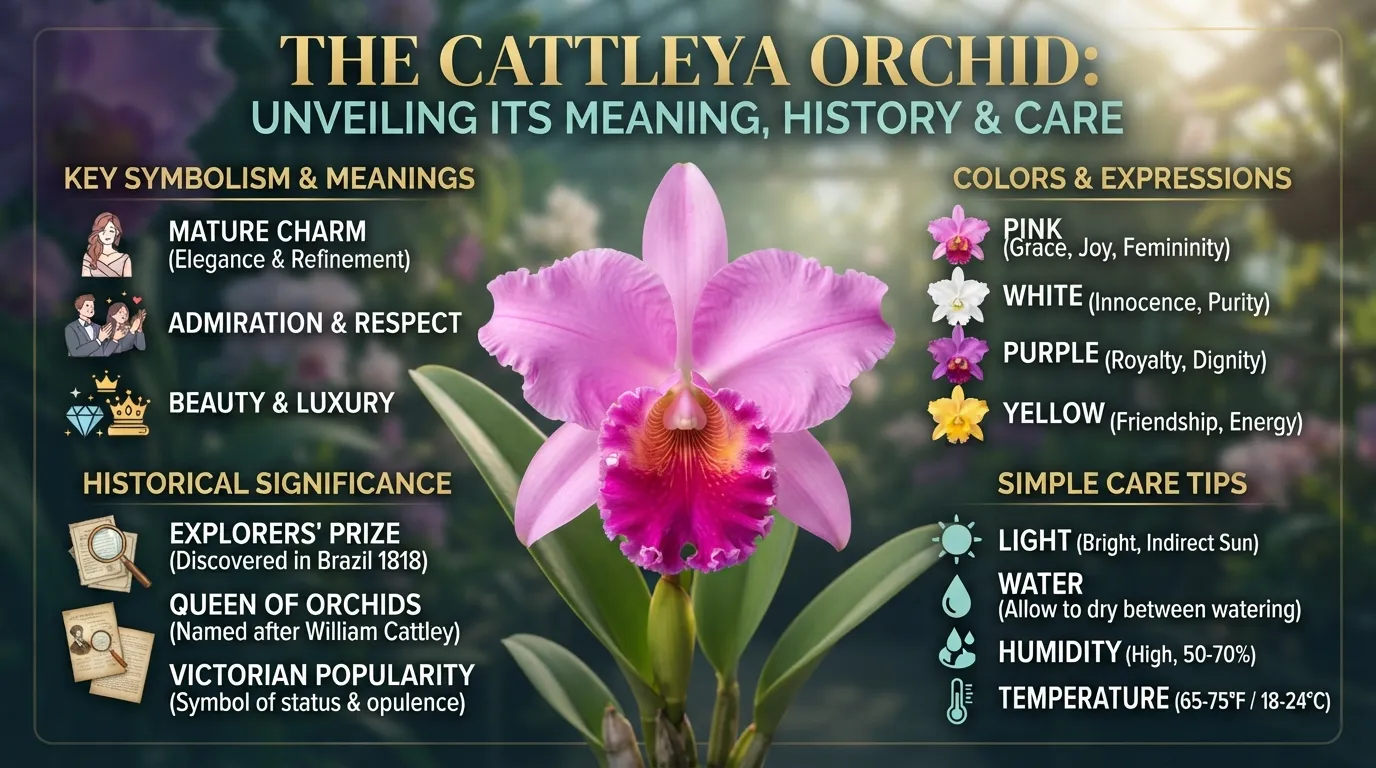
The cattleya flower means mature charm, admiration, and refined elegance. It also stands for thoughtfulness and repeated success. People give cattleya to honor someone’s beauty and grace, or to celebrate a well-earned achievement.
Origin of the Name
The word “cattleya” comes from the name of William Cattley, an English horticulturist who lived in the early 1800s. In 1818, botanist John Lindley named the flower after him, since Cattley was the first person known to grow this orchid to bloom in cultivation. The name has stayed with the plant in science ever since.
Cattleya in Victorian Flower Language
In Victorian times, people used flowers to send hidden messages. Orchids in general stood for “luxury” and “rare beauty.” Cattleya, being one of the showiest orchids, often carried the deeper meaning of “mature charm” and “admiration.” This meaning grew from the flower’s large, bold blooms, which stood out as a true showpiece among garden and greenhouse flowers.
Botanical Foundations & Profile
| Feature | Detail |
|---|---|
| Scientific Name | Cattleya (genus with many species and hybrids) |
| Native Region | Central and South America |
| Bloom Period | Varies by species; many bloom in fall or spring |
| Average Lifespan | Perennial; can live many years with care |
| USDA Zones | Zones 10 through 11; often grown indoors elsewhere |
| Species Count | About 42 to 113 species, depending on classification |
History & Cultural Timeline
- Cattleya orchids were first collected from South America in the early 1800s.
- William Cattley successfully bloomed the flower in England around 1818.
- Botanist John Lindley officially named the genus Cattleya in his honor.
- Cattleya became a favorite flower for corsages and formal events throughout the 1900s.
Symbolism Deep-Dive
Mature Charm
Cattleya blooms are large, full, and richly colored, often seen as more developed and striking than smaller orchid types. This bold, grown presence gave the flower its link to mature beauty and confident charm.
Admiration
For much of the 1900s, cattleya was the most popular corsage flower for special events. Being worn and admired at dances, weddings, and ceremonies tied the flower closely to recognition and admiration.
Related Flower Meanings: https://bloomsyflower.com/rue-flower-meaning/
Thoughtfulness
Growing cattleya well takes patience, care, and the right conditions. This need for careful, attentive growing gave the flower a quiet connection to thoughtfulness and dedicated effort.
Meaning by Color
| Color | Meaning |
|---|---|
| Lavender/Purple | Elegance and dignity |
| White | Purity and innocent beauty |
| Yellow | Joy and new success |
| Pink | Gentle admiration and grace |
| Red | Deep passion and desire |
Color Meanings & Cultural Safety Matrix
Lavender Cattleya
- Primary sentiment: Elegance and quiet dignity.
- Geographic nuances: In the West, lavender orchids are prized for formal events. In parts of Asia, purple tones often suggest nobility.
- Gifting warning: A refined, safe choice for respectful or formal occasions.
White Cattleya
- Primary sentiment: Purity and graceful beauty.
- Geographic nuances: In the West, white often marks weddings and new beginnings. In some Eastern homes, white flowers can connect to mourning.
- Gifting warning: Check local customs before gifting white cattleya at a celebration.
Yellow Cattleya
- Primary sentiment: Joy and fresh success.
- Geographic nuances: In many cultures, yellow flowers mark happy milestones and achievements.
- Gifting warning: A cheerful choice for graduations or new ventures.
Red Cattleya
- Primary sentiment: Passion and strong desire.
- Geographic nuances: Red widely symbolizes romantic love across both Western and Eastern traditions.
- Gifting warning: Save red cattleya for close, loving relationships.
Global Traditions & Literary Impact
In the United States, cattleya became the classic corsage flower of the 1900s, especially for prom nights, weddings, and Mother’s Day. Its large, graceful bloom stood out beautifully, making it ideal when a single flower needed to command attention.
In literature, orchids, including cattleya, often appear as symbols of rare beauty and luxury in writing about high society and formal events. Please double-check any specific literary references, as I cannot search a live database and details may be inaccurate.
Economic, Culinary, and Medicinal Uses
Cattleya is grown almost entirely for ornamental beauty and is a favorite among orchid collectors worldwide. It is not considered a food or medicinal plant, and there is no notable traditional culinary or medicinal use tied to this species. Enjoy cattleya for its striking blooms rather than any practical use, and always research a plant fully before considering any non-ornamental use.
Ultimate Etiquette & Gifting Guide
| Relationship | Recommended Color | The Subtext |
|---|---|---|
| Prom Date or Formal Event | Lavender or White | “You look stunning tonight.” |
| Mother or Mother Figure | Pink | “I admire and cherish you.” |
| Graduate or Achiever | Yellow | “Congratulations on your success.” |
| Spouse or Partner | Red | “My passion for you runs deep.” |
Universal Safety Rule
Since cattleya blooms are delicate, handle them gently and keep them away from direct heat or sunlight to help them last through a full event.
Cattleya vs. Close Lookalikes
| Feature | Cattleya | Phalaenopsis (Moth Orchid) | Dendrobium |
|---|---|---|---|
| Petal Shape | Large, ruffled petals with a bold lip | Smooth, flat, wide petals | Narrow, slightly ruffled petals |
| Fragrance | Often strongly fragrant | Little to no scent | Mild scent in some types |
| Foliage | Thick, upright, leathery leaves | Broad, flat, glossy leaves | Long, cane-like stems with narrow leaves |
| Bloom Season | Varies, often fall or spring | Can bloom several times a year | Varies by species |
| Growth Style | Grows from thick pseudobulbs | Grows as a single stem, no pseudobulbs | Grows in tall, cane-like clusters |
How to tell them apart
Look at the base of the plant. Cattleya has thick, swollen stems called pseudobulbs, which moth orchids do not have.
Practical Maintenance & Domestic Safety
Care Basics
- Place cattleya in bright, indirect light.
- Use a special orchid mix, not regular potting soil.
- Water when the mix dries out, then let it drain fully.
- Feed with diluted orchid fertilizer during active growth.
Pet Toxicity Warning
Cattleya orchids are generally considered non-toxic to cats and dogs, according to common pet plant guides. Still, eating any plant material in large amounts can cause mild stomach upset in pets. Watch for unusual symptoms, and contact a vet if you have concerns.
Expert Curations & Misconceptions
10 Quick Fun Facts
- Cattleya is often called the “Queen of Orchids.”
- The flower was named after English horticulturist William Cattley.
- Cattleya was once the top choice for corsages at American proms.
- Some cattleya blooms can measure up to eight inches across.
- Many cattleya species have a strong, pleasant fragrance.
- Cattleya is the national flower of Colombia and Costa Rica.
- The plant grows naturally high in trees in South American rainforests.
- Cattleya flowers can last several weeks when properly cared for.
- Breeders have created thousands of cattleya hybrids over the years.
- Cattleya was first successfully bloomed in cultivation in 1818.
3 Myth vs. Reality Pairs
Myth: All orchids are the same as cattleya.
Reality: Cattleya is just one of many orchid types, each with its own shape and care needs.
Myth: Cattleya is too difficult for beginner gardeners.
Reality: With bright light and proper watering, cattleya can be manageable even for new orchid growers.
Myth: Cattleya blooms only once and then dies.
Reality: Healthy cattleya plants can rebloom for many years with good care.
2 Quick Florist Tips
- Choose cattleya blooms that are fully open but still firm for the longest-lasting corsage or arrangement.
- Store cattleya in a cool spot, away from fruit, since fruit gases can cause the blooms to fade faster.
Questions About Cattleya flower meaning
What does the cattleya flower mean spiritually?
Cattleya means mature charm and refined beauty, often tied to admiration and quiet confidence.
Is cattleya a good gift for special occasions?
Yes, it is a classic choice for proms, weddings, Mother’s Day, and milestones worth celebrating.
What does a purple cattleya mean?
Purple cattleya stands for elegance and quiet dignity.
Is cattleya toxic to pets?
Cattleya is generally considered non-toxic to cats and dogs, though large amounts of any plant may cause mild stomach upset.
Can you eat or use cattleya for health purposes?
No, cattleya has no notable food or medicinal use and is grown purely for its ornamental beauty.
When does cattleya bloom?
Bloom time varies by species, though many cattleya varieties bloom in fall or spring.
How did cattleya get its name?
The flower was named in honor of William Cattley, an English horticulturist who first brought it into bloom in cultivation in 1818.
Is cattleya hard to grow at home?
With bright, indirect light and the right care, even beginners can grow Cattleya orchids successfully.
Final Thoughts
The cattleya flower stands as a symbol of mature charm, admiration, and refined elegance. Its bold, ruffled blooms once defined an entire era of American formal events, worn proudly as the perfect finishing touch for proms, weddings, and heartfelt celebrations.
As the national flower of both Colombia and Costa Rica, cattleya also carries deep cultural pride across Latin America. Whether you grow it as a prized collector’s orchid or gift it to celebrate someone’s grace and achievement, cattleya remains one of the most striking and meaningful flowers in the world. A Cattleya is an excellent choice for special occasions, offering bold, elegant blooms that naturally attract attention.

Zahid Abbas is an educator, researcher, and digital publishing strategist behind BloomsyFlower, a flower and gardening resource covering flower meanings, symbolism, history, care, seasonal blooms, and gifting. He combines research with simple, reader-friendly writing to help people understand, grow, and enjoy flowers.