Quick Meaning of Tulip
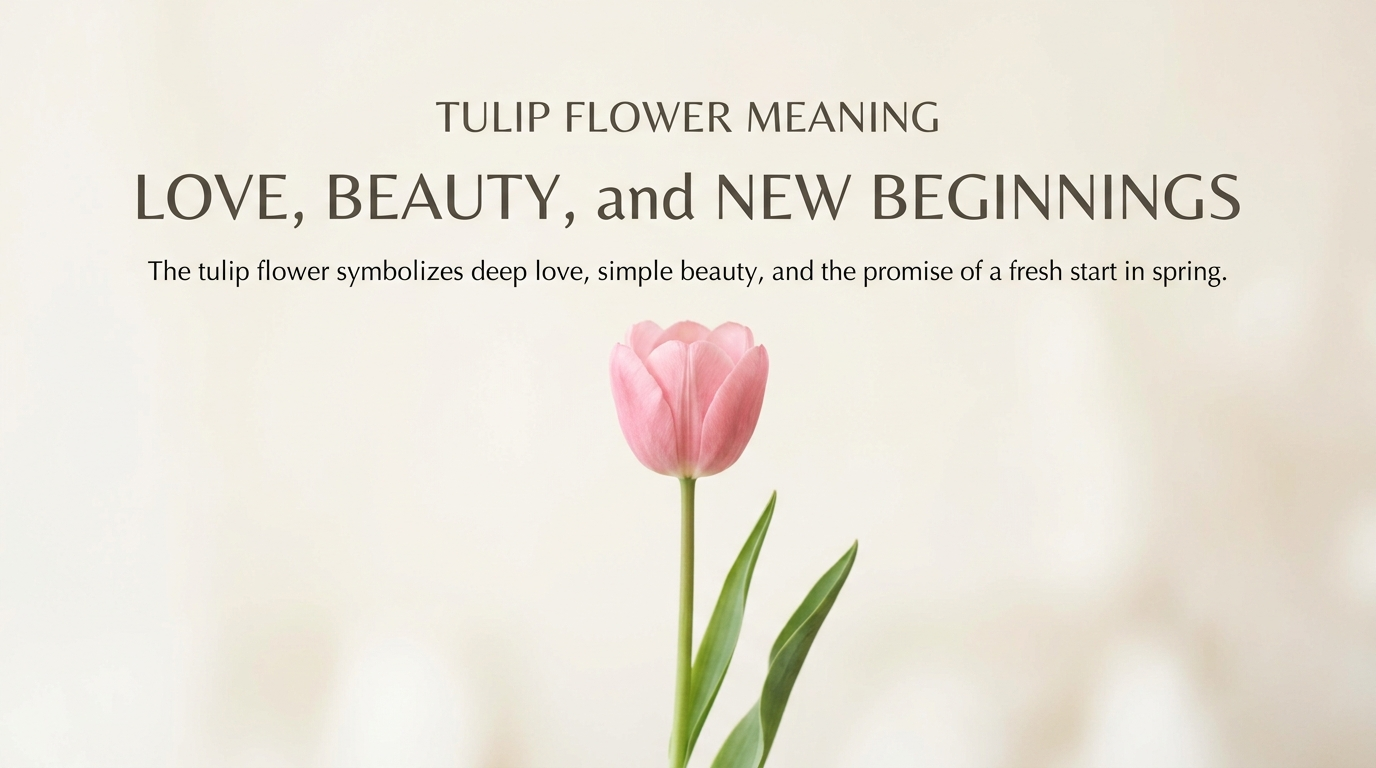
The tulip flower meaning is love, beauty, and fresh starts.
Tulips can also show care, joy, and true love.
However, their meaning can change with the flower color.
For example, red tulips often show love, while yellow ones bring cheer.
Tulips are also linked with spring.
Because their blooms are so bright, they can make a gift feel fresh and happy.
Origin of the Name
The word tulip has a long and interesting story.
First, the plant name is Tulipa.
It is the scientific name for the tulip group.
The name is linked to the Turkish word tülbend.
That word means turban, a type of head covering.
Because of this, the flower may have been named for its shape.
However, tulips did not first come from the Netherlands.
Instead, wild tulips grew across parts of Europe and Asia.
For example, Kew lists the native range from southern Europe to Mongolia.
Turkey, Iran, and Central Asia are important parts of this range.
In fact, the tulip was grown in the Ottoman world for many years.
Later, it became very popular in Europe.
Carolus Clusius was an important early tulip grower.
For instance, he helped grow tulips in the Netherlands in the late 1500s.
After that, the name Tulipa was used by Carl Linnaeus.
He published the genus name in 1753.
Tulip in Victorian Flower Language
Flowers had special messages in Victorian times.
For this reason, people used flowers to share feelings without many words.
As a result, tulips became linked with love and strong feelings.
Also, some old flower books gave different meanings to tulips.
For example, yellow tulips were linked with hopeless love.
Likewise, red tulips were linked with a declaration of love.
In addition, variegated tulips were linked with beautiful eyes.
Some old flower guides also gave tulips the meaning perfect love.
This meaning is still common today.
However, the meanings were not always the same in every book.
So, old flower meanings should be treated as guides, not rules.
Botanical Foundations & Profile
Tulips belong to the Tulipa genus.
A genus is a group of closely related plants.
In addition, they belong to the lily family, called Liliaceae.
Tulips grow from bulbs and bloom in spring.
| Botanical Detail | Tulip |
|---|---|
| Scientific Name | Tulipa spp. |
| Plant Family | Liliaceae |
| Native Region | Southern Europe to Central Asia |
| Bloom Period | Early to late spring |
| Average Lifespan | Perennial; many garden types bloom for a few years |
| USDA Zones | About 3–8, depending on type |
| Species Count | 95 accepted species listed by Kew |
| Main Colors | Red, pink, yellow, orange, white, purple |
| Flower Shape | Cup, bowl, star, or fringed forms |
Kew currently lists 95 accepted Tulipa species.
Tulips are perennial plants.
This means they can live for more than one year.
Still, many garden tulips do not bloom well for many years.
In fact, some modern types give their best show in the first year.
History & Cultural Timeline
1500s: Tulips Grow in Europe
Tulips began to spread into Europe in the 1500s.
Meanwhile, Carolus Clusius became an important early tulip grower.
1590s: Tulips Reach the Netherlands
Tulips became part of Dutch gardens in the late 1500s.
Then, they quickly became loved for their bright colors.
1600s: Tulip Mania
Tulips became very valuable in the Netherlands.
For example, people bought and sold rare bulbs at high prices.
This time became known as Tulip Mania.
However, modern historians say some stories about it were later exaggerated.
Today: A Spring Favorite
Since then, tulips have spread to many countries.
For example, they are popular in gardens, parks, and flower shops.
They are also a major spring flower in the Netherlands.
In addition, tulip festivals are held in many places around the world.
Also read more about:https://bloomsyflower.com/cyclamen-flower-meaning/
Symbolism Deep-Dive
Love
Tulips are strongly linked with love.
Their smooth petals form a simple cup shape.
As a result, the clean look can feel calm and warm.
Red tulips are especially linked with romantic love.
For this reason, they are often used when someone wants to say, “I love you.”
New Beginnings
Tulips bloom when spring begins.
Since they return after winter, they are a sign of fresh starts.
In this way, they can remind us that a new season is here.
Because of this, tulips make nice gifts for new chapters.
For example, they can suit a new home, new job, or new year.
Joy and Beauty
Tulips come in many bright colors.
As a result, their open flowers can make a room feel happy.
Their simple shape also gives them a clean and fresh look.
Yellow and orange tulips, in particular, can feel especially cheerful.
For this reason, they are often chosen for happy events and friendly gifts.
Meaning by Color
Tulip colors can change the message of a gift.
These meanings are common flower-giving ideas.
However, they are not fixed rules for every culture.
| Tulip Color | Main Meaning | Good Gift For |
|---|---|---|
| Red | Love and deep affection | Partner or spouse |
| Pink | Care and friendship | Friend or family |
| Yellow | Joy and cheerful thoughts | Friend or family |
| White | Forgiveness and respect | Apology or new start |
| Purple | Royalty and admiration | Someone you respect |
| Orange | Energy and excitement | Celebration |
| Variegated | Beautiful eyes | Romantic gift |
| Green | Freshness and new growth | New beginning |
Red Tulips
Red tulips are the classic love tulips.
They can show deep love and strong affection.
For this reason, they are often used for romantic gifts.
In Victorian flower language, red tulips could mean a declaration of love.
Likewise, Persian stories also linked red tulips with deep love.
Meanwhile, in Ottoman art, tulips were loved as rich flower designs.
Gifting tip: So, red tulips are a clear romantic choice.
Pink Tulips
Pink tulips often show care and warm feelings.
They can feel softer than red tulips.
Because of this, they are useful for friends and family.
In many Western flower guides, pink means caring and good wishes.
However, pink flowers can also carry different meanings in other places.
So, think about the person’s culture before sending a special message.
Gifting tip: Pink works well when love is warm but not strongly romantic.
Yellow Tulips
Yellow tulips are bright and cheerful.
Today, they often mean happiness and sunshine.
As a result, they can make a friendly and happy gift.
But older flower books gave yellow tulips a sad meaning.
For example, they sometimes meant hopeless love.
This shows how flower meanings can change with time.
Gifting tip: Use yellow tulips for joy and friendship today.
White Tulips
White tulips have a clean and peaceful look.
Because of this, they are often linked with forgiveness and respect.
They can also suit a fresh start.
For example, some Western flower guides use white tulips for apology.
However, white flowers can mean mourning in some cultures.
So, check the person’s customs before giving white flowers for romance.
Gifting tip: White tulips can work well for an apology or new start.
Purple Tulips
Purple tulips often suggest royalty and respect.
The rich color can make the flowers feel special.
As a result, they can suit someone you admire.
In many modern flower guides, purple flowers are linked with royalty.
Likewise, in Ottoman art, purple was also used with tulip designs.
Still, color meanings vary between cultures and times.
Gifting tip: Purple tulips are nice for respect and admiration.
Orange Tulips
Orange tulips feel bright and full of energy.
Because of this, they can fit a party or happy event.
They can also show excitement and warm feelings.
However, orange has different meanings around the world.
So, use the color as a guide, not a strict rule.
Gifting tip: Choose orange tulips for birthdays and celebrations.
Variegated Tulips
Variegated tulips have more than one color.
In old flower books, they were given a special message.
For example, they were linked with beautiful eyes.
Also, their striped or mixed colors make them eye-catching.
Gifting tip: They can be a sweet romantic gift.
Green Tulips
These tulips have green parts on their petals.
Green often brings thoughts of nature and growth.
Because of this, green tulips can fit a new beginning.
However, their meaning is mostly a modern flower-giving idea.
In other words, it is not a fixed old Victorian rule.
Gifting tip: Green tulips can suit a new home or fresh start.
Global Traditions & Literary Impact
Tulips have deep links with Persian and Ottoman culture.
For example, in Persian writing, tulips appear in old spring scenes.
The Shahnameh, or Book of Kings, also includes tulips in its spring images.
Tulips were also important in Ottoman art.
For instance, artists used tulips on tiles, cloth, and other objects.
As a result, they became one of the best-known Ottoman flower designs.
A Literary Reference
Alexandre Dumas wrote The Black Tulip in 1850.
The novel tells a story about a rare black tulip.
In addition, it mixes flowers, history, love, and rivalry.
Reference note: Double-check the book and date before using this as a formal source.
Economic, Culinary, and Medicinal Uses
Tulips are mainly grown for gardens and cut flowers.
They are also an important flower crop.
In fact, tulip bulbs are sold and planted around the world.
Tulip bulbs have sometimes been eaten during famine.
However, this does not mean tulip bulbs are safe food.
In fact, Poison Control reports illness after people ate tulip bulbs.
It also warns about skin problems from handling bulbs.
This skin problem is sometimes called “tulip fingers.”
It can cause a painful skin reaction.
For this reason, tulips should not be treated as a food or home medicine.
If someone eats a bulb by mistake, seek poison advice.
Ultimate Etiquette & Gifting Guide
| Relationship | Recommended Color | The Subtext |
|---|---|---|
| Partner | Red | “I love you.” |
| Spouse | Red | “My love is strong.” |
| Best friend | Yellow | “You bring me joy.” |
| Close friend | Pink | “I care about you.” |
| Parent | Pink | “Thank you for your care.” |
| Family member | Yellow or pink | “You make me happy.” |
| New love | Pink or red | “I have warm feelings for you.” |
| Apology | White | “I am sorry.” |
| New home | White or green | “Here is to a fresh start.” |
| Graduation | Orange or purple | “I am proud of you.” |
| Birthday | Yellow or orange | “Have a happy day.” |
| Romantic anniversary | Red | “Our love still matters.” |
Universal Safety Rule
Tulips are beautiful, but they are not a food plant.
So, keep bulbs away from children and pets.
Also, use care when handling bulbs, especially if your skin is sensitive.
Tulips vs. Close Lookalikes
Several spring flowers can look a little like tulips.
However, their shape, leaves, and bloom time can help you tell them apart.
| Trait | Tulip | Lily | Daffodil | Hyacinth |
|---|---|---|---|---|
| Petal Shape | Cup or bowl | Open or curved | Trumpet center | Small star-like flowers |
| Fragrance | Low to light | Often strong | Often sweet | Often strong |
| Foliage | Broad, strap-like | Long and narrow | Flat and strap-like | Thick and narrow |
| Bloom Season | Spring | Often summer | Early spring | Spring |
| Flower Style | One large flower per stem | Large flowers | Trumpet center | Many small flowers on one stem |
How to Tell Them Apart
First, look at the flower head.
A tulip usually has one large flower on one stem.
Its petals form a cup or bowl.
In contrast, a daffodil has a clear trumpet in the middle.
A hyacinth, on the other hand, has many small flowers on one stem.
A lily usually has larger flowers with a wider open shape.
In short, the simple cup shape is a helpful tulip clue.
Practical Maintenance & Domestic Safety
Care Basics
First, plant tulip bulbs in fall for spring flowers.
Give them full sun or light shade.
Also, use soil that drains water well.
Wet soil can cause bulbs to rot.
So, water them during growth, but avoid soggy soil.
After flowers fade, remove the old flower head.
Then, let the leaves turn yellow before cutting them back.
This helps the bulb store food for the next season.
Pet Toxicity Warning
Tulips are listed as toxic to dogs, cats, and horses by the ASPCA.
In fact, the bulbs have the highest level of the toxic compounds.
After eating them, pets may have vomiting, diarrhea, drooling, or low energy.
So, keep tulip bulbs away from pets.
If a pet eats a tulip, contact a vet or animal poison service.
Expert Curations & Misconceptions
10 Quick Fun Facts
- Tulips grow from bulbs.
- Also, tulips belong to the lily family.
- They bloom mainly in spring.
- In fact, there are many different tulip species.
- For example, Kew lists 95 accepted Tulipa species.
- Tulips also come in many bright colors.
- However, true blue tulips are not found naturally.
- Tulips became very popular in the Netherlands.
- They were also important in Ottoman art.
- Finally, red tulips are strongly linked with love.
Myth vs. Reality
Myth: Tulips first came from the Netherlands.
Reality: Tulips are native across parts of Europe and Asia.
The Netherlands, however, later became famous for growing them.
Myth: Every tulip bulb will bloom for many years.
Reality: Some tulips bloom well for only a few years.
Still, some types return better than others.
Myth: There are natural bright blue tulips.
Reality: True blue tulips are not part of the normal tulip color range.
However, some purple tulips may look blue in certain light.
2 Quick Florist Tips
Tip 1: Pick red tulips for a clear love message.
Tip 2: Instead, pick yellow or pink tulips for a friendly gift.
Questions About Tulip Flower Meaning
What is the spiritual meaning of a tulip?
Tulips can represent love, beauty, and new beginnings.
Because they bloom in spring, they are also a sign of fresh starts.
What does a red tulip mean?
A red tulip usually means love and deep affection.
As a result, it is a popular romantic flower.
What does a yellow tulip mean?
Today, yellow tulips often mean joy and cheerful thoughts.
However, older flower books sometimes gave them a sad love meaning.
What does a white tulip mean?
White tulips can mean forgiveness and respect.
Also, they can suit an apology or fresh start.
What does a pink tulip mean?
Pink tulips can show care, friendship, and warm feelings.
However, they are less direct than red tulips.
When do tulips bloom?
Most tulips bloom in spring.
For example, some bloom early in spring.
Others bloom in the middle or later part of spring.
Are tulips hard to grow?
Tulips are fairly easy to grow.
They just need good light and soil that drains well.
However, wet soil can cause problems with the bulbs.
Do tulips spread?
Some tulips can make new bulbs or naturalize.
In fact, specialist tulips often return and multiply better.
However, many garden tulips are replaced each year for the best display.
Can you eat tulip bulbs?
Tulip bulbs should not be treated as food.
Some people have eaten them during famine.
However, Poison Control reports that eating tulip bulbs can cause illness.
Are tulips safe for pets?
No.
The ASPCA lists tulips as toxic to dogs, cats, and horses.
In particular, the bulbs are the most dangerous part.
Where did the name tulip come from?
The name Tulipa is linked to the Turkish word tülbend.
That word means turban.
What did tulips mean in old flower language?
Tulips were linked with love in many flower guides.
Also, some old books gave special meanings to different colors.
Final Thoughts
The tulip flower meaning is full of love, beauty, and fresh starts.
Tulips are simple flowers with a rich past.
First, they grow from bulbs and bloom in spring.
Also, they come in many bright colors and shapes.
For example, red tulips can show deep love.
Pink tulips, on the other hand, can show care and friendship.
Yellow tulips can bring joy and happy thoughts.
Meanwhile, white tulips can show respect and forgiveness.
Purple tulips can show praise and honor.
In addition, tulips have strong links with Turkey, Persia, and the Netherlands.
Their story reaches back hundreds of years.
So, you can plant tulips in your garden.
You can also give them as a thoughtful gift.
Or you can enjoy their bright spring color at home.
In the end, a tulip can say a lot without many words.
Choose the color that fits your message, then let the flowers speak.

Zahid Abbas is an educator, researcher, and digital publishing strategist behind BloomsyFlower, a flower and gardening resource covering flower meanings, symbolism, history, care, seasonal blooms, and gifting. He combines research with simple, reader-friendly writing to help people understand, grow, and enjoy flowers.