The cyclamen flower means goodbye, lasting love, and shyness. It also stands for sincerity and modesty. People give cyclamen to say a heartfelt farewell or to show quiet, true affection.
Origin of the Name
The word “cyclamen” comes from the old Greek word kyklos, meaning “circle.” Ancient Greeks likely named the plant for its round tuber, the bulb-like root that grows underground. Botanists kept this Greek root when naming the flower in later scientific writing.
Cyclamen in Victorian Flower Language
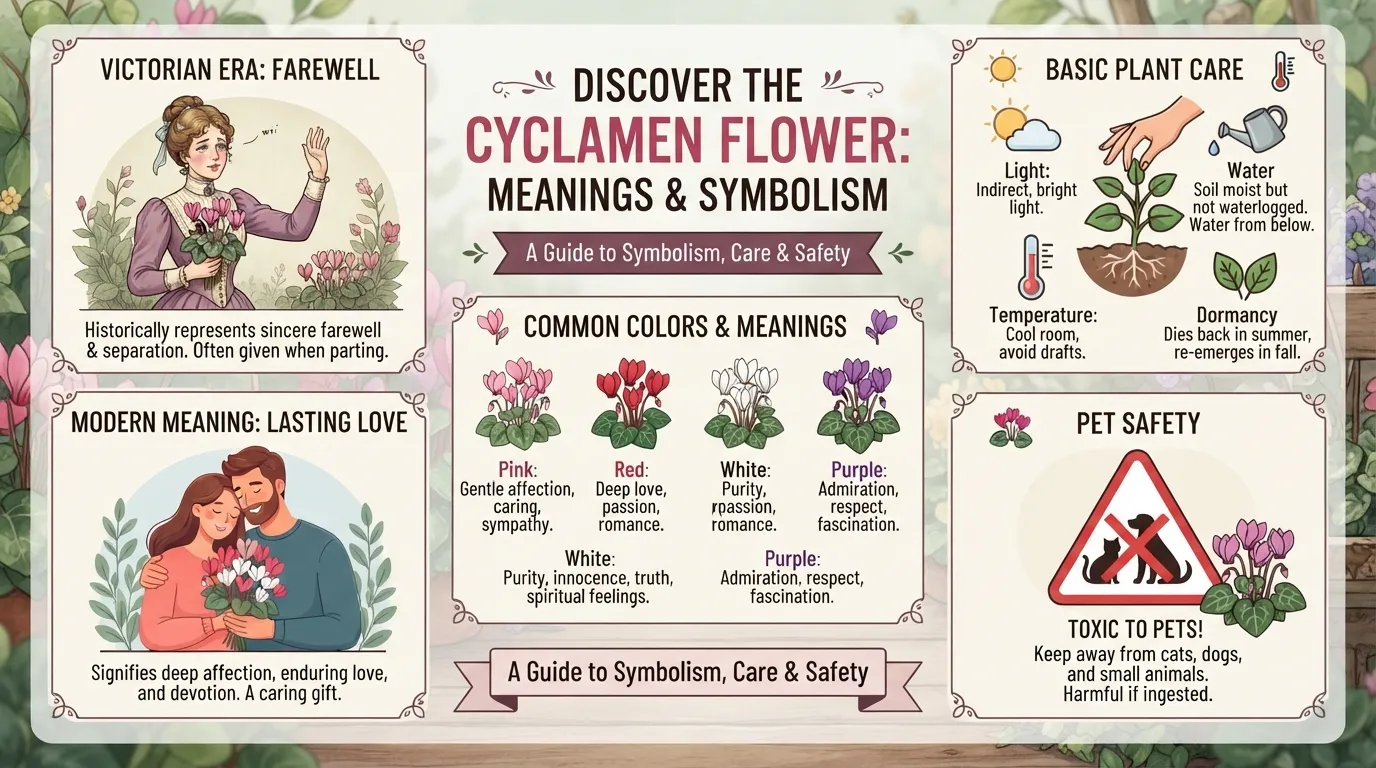
In Victorian times, people used flowers to send quiet messages. Cyclamen carried a bittersweet meaning. It stood for “goodbye” and “resignation,” but also “lasting love” in some readings. This dual meaning grew from the flower’s delicate, bowed shape. Its petals fold back like a person turning away, yet its bright color still shows warmth underneath.
Botanical Foundations & Profile
| Feature | Detail |
|---|---|
| Scientific Name | Cyclamen (e.g. Cyclamen persicum, florist’s cyclamen) |
| Native Region | Mediterranean region and parts of the Middle East |
| Bloom Period | Fall through spring, depending on type |
| Average Lifespan | Perennial tubers can live many years |
| USDA Zones | Zones 5 through 9 outdoors; often grown indoors |
| Species Count | About 23 species |
History & Cultural Timeline
- Cyclamen has grown wild across the Mediterranean for thousands of years.
- Ancient Greek and Roman writers wrote about cyclamen in early plant texts.
- European gardeners began growing cyclamen indoors as a popular houseplant in the 1800s.
- Today, florist’s cyclamen is a common winter gift plant around the world.
Symbolism Deep-Dive
Farewell
Cyclamen petals often bend backward, away from the center of the flower. This shape looks like someone glancing back while walking away. This gentle motion gave the flower its old link to goodbye and parting.
Modesty
Cyclamen flowers often nod downward on thin, curved stems. This shy, bowed posture ties the flower to modesty and quiet humility, rather than bold display.
Lasting Love
Despite its farewell meaning, cyclamen tubers can live and bloom again year after year. This long life gave the flower a second meaning: a love that survives time and distance.
Meaning by Color
| Color | Meaning |
|---|---|
| Pink | Gentle love and quiet devotion |
| Red | Deep passion mixed with farewell |
| White | Purity and a peaceful goodbye |
| Purple | Dignity and lasting respect |
Color Meanings & Cultural Safety Matrix
Pink Cyclamen
- Primary sentiment: Gentle love and quiet devotion.
- Geographic nuances: In Europe, pink cyclamen is a common winter gift plant. In Japan, pink often signals youth and soft feeling.
- Gifting warning: A safe, warm choice for most occasions.
Red Cyclamen
- Primary sentiment: Deep passion touched with sadness.
- Geographic nuances: In the West, red usually means love. Paired with cyclamen’s farewell history, it can suggest bittersweet love.
- Gifting warning: Best for meaningful, heartfelt moments rather than casual gifts.
White Cyclamen
- Primary sentiment: Purity and a peaceful goodbye.
- Geographic nuances: In the West, white often means new beginnings. In some Eastern homes, white flowers connect to mourning.
- Gifting warning: Fitting for sympathy gifts, but check customs before using it at a celebration.
Purple Cyclamen
- Primary sentiment: Dignity and lasting respect.
- Geographic nuances: Purple flowers often carry noble meaning across many cultures.
- Gifting warning: Best suited for formal or respectful occasions.
Related Flower Meanings:https://bloomsyflower.com/daphne-flower-meaning/
Global Traditions & Literary Impact
In parts of Europe, cyclamen is a favorite winter gift, often given as a potted plant during colder months when few other flowers bloom. Its cheerful color against dark green leaves made it a popular symbol of hope during the gray winter season.
In literature, cyclamen appears in various garden and nature writings describing Mediterranean hillsides and woodland floors covered in these small, nodding blooms. Please double-check any specific literary references, as I cannot search a live database and details may be inaccurate.
Economic, Culinary, and Medicinal Uses
Cyclamen is grown mainly as an ornamental plant, prized for its winter blooms and heart-shaped leaves. It is not considered a food plant, and its tubers actually contain compounds that can cause harm if eaten. Some old folk traditions used small, controlled amounts of cyclamen in home remedies, but this is not considered safe today. Always keep cyclamen out of reach for eating, and consult a doctor before using any plant for health purposes.
Ultimate Etiquette & Gifting Guide
| Relationship | Recommended Color | The Subtext |
|---|---|---|
| Someone Moving Away | White or Pink | “Wishing you peace on your new path.” |
| Spouse or Partner | Red | “My love for you remains, even through change.” |
| Respected Elder | Purple | “I hold you in lasting respect.” |
| Grieving Friend | White | “I share in your quiet sorrow.” |
Universal Safety Rule
Keep cyclamen tubers and leaves away from pets and small children, since eating them can cause stomach upset, and always pair the gift with a short note to make your message clear.
Cyclamen vs. Close Lookalikes
| Feature | Cyclamen | Violet | Begonia |
|---|---|---|---|
| Petal Shape | Swept-back petals pointing upward | Small, rounded, flat petals | Rounded, ruffled petals |
| Fragrance | Light or no scent | Sweet, gentle scent | Little to no scent |
| Foliage | Heart-shaped leaves with silver marbling | Small, round, textured leaves | Broad, glossy, sometimes colorful leaves |
| Bloom Season | Fall through spring | Early spring | Spring through fall |
| Growth Style | Grows from an underground tuber | Grows low to the ground | Grows from fibrous roots or tubers |
How to tell them apart
Look at the leaves. Cyclamen leaves are heart-shaped with silvery, marbled patterns, which violets and begonias do not have.
Practical Maintenance & Domestic Safety
Care Basics
- Place cyclamen in bright, indirect light.
- Water from the bottom to avoid wetting the tuber.
- Keep in cool rooms, since cyclamen dislikes heat.
- Let the plant rest, with less water, after it stops blooming.
Pet Toxicity Warning
The ASPCA lists cyclamen as toxic to cats and dogs, especially the tuber. Eating it can cause vomiting, drooling, and in large amounts, more serious symptoms like seizures or heart problems. Keep the plant well out of reach of pets, and call a vet right away if you suspect they have eaten any part of it.
Expert Curations & Misconceptions
10 Quick Fun Facts
- Cyclamen flowers often bloom in the coldest months of the year.
- The plant grows from a round, flattened tuber, not a bulb.
- Cyclamen leaves often show silver or gray marbled patterns.
- Wild cyclamen grows across rocky hillsides in the Mediterranean.
- Cyclamen petals twist and fold back as they open.
- Some cyclamen species have a light, sweet fragrance.
- Cyclamen can rebloom for many years if cared for properly.
- The plant goes dormant, or rests, during hot summer months.
- Cyclamen is a popular holiday gift plant in many countries.
- Ants help spread cyclamen seeds in the wild.
3 Myth vs. Reality Pairs
Myth: Cyclamen is easy to keep alive indoors without any care.
Reality: It needs cool temperatures and careful watering to truly thrive.
Myth: Cyclamen only means sadness or goodbye.
Reality: It also carries meanings of lasting love and quiet devotion.
Myth: All cyclamen plants are the same.
Reality: There are 23 different species, with wild types differing from common florist varieties.
2 Quick Florist Tips
- Choose cyclamen with several unopened buds for the longest-lasting display.
- Water the soil, not the crown of the plant, to help prevent rot.
Questions About Cyclamen flower meaning
What does the cyclamen flower mean spiritually?
Cyclamen means quiet farewell and lasting love, showing that goodbye and devotion can exist together.
Is cyclamen a good gift for special occasions?
Yes, especially for winter holidays, sympathy gifts, or moments of heartfelt farewell.
What does a red cyclamen mean?
Red cyclamen suggests deep passion mixed with a touch of bittersweet farewell.
Is cyclamen toxic to pets?
Yes, the ASPCA lists cyclamen as toxic to cats and dogs, especially the tuber. Keep it away from pets.
Can you eat cyclamen?
No, cyclamen is not a food plant, and its tuber can cause harm if eaten.
When does cyclamen bloom?
Most cyclamen bloom from fall through spring, often flowering in the coldest months.
How did cyclamen get its name?
Its name comes from the Greek word for “circle,” likely referring to its round tuber.
What did cyclamen mean in Victorian times?
It meant “goodbye” and “resignation,” though some readings also linked it to lasting love.
Final Thoughts
The cyclamen flower carries a gentle, bittersweet meaning. Its swept-back petals suggest a quiet goodbye, yet its ability to bloom year after year speaks of a love that endures. This small, nodding flower brings color and hope during the coldest, darkest months of the year.
Whether given as a winter gift, a farewell gesture, or simply enjoyed as a houseplant, cyclamen reminds us that goodbyes and lasting affection can share the same quiet space. Consider placing a cyclamen on a cool windowsill, or gifting one to someone stepping into a new chapter of life.

Zahid Abbas is an educator, researcher, and digital publishing strategist behind BloomsyFlower, a flower and gardening resource covering flower meanings, symbolism, history, care, seasonal blooms, and gifting. He combines research with simple, reader-friendly writing to help people understand, grow, and enjoy flowers.