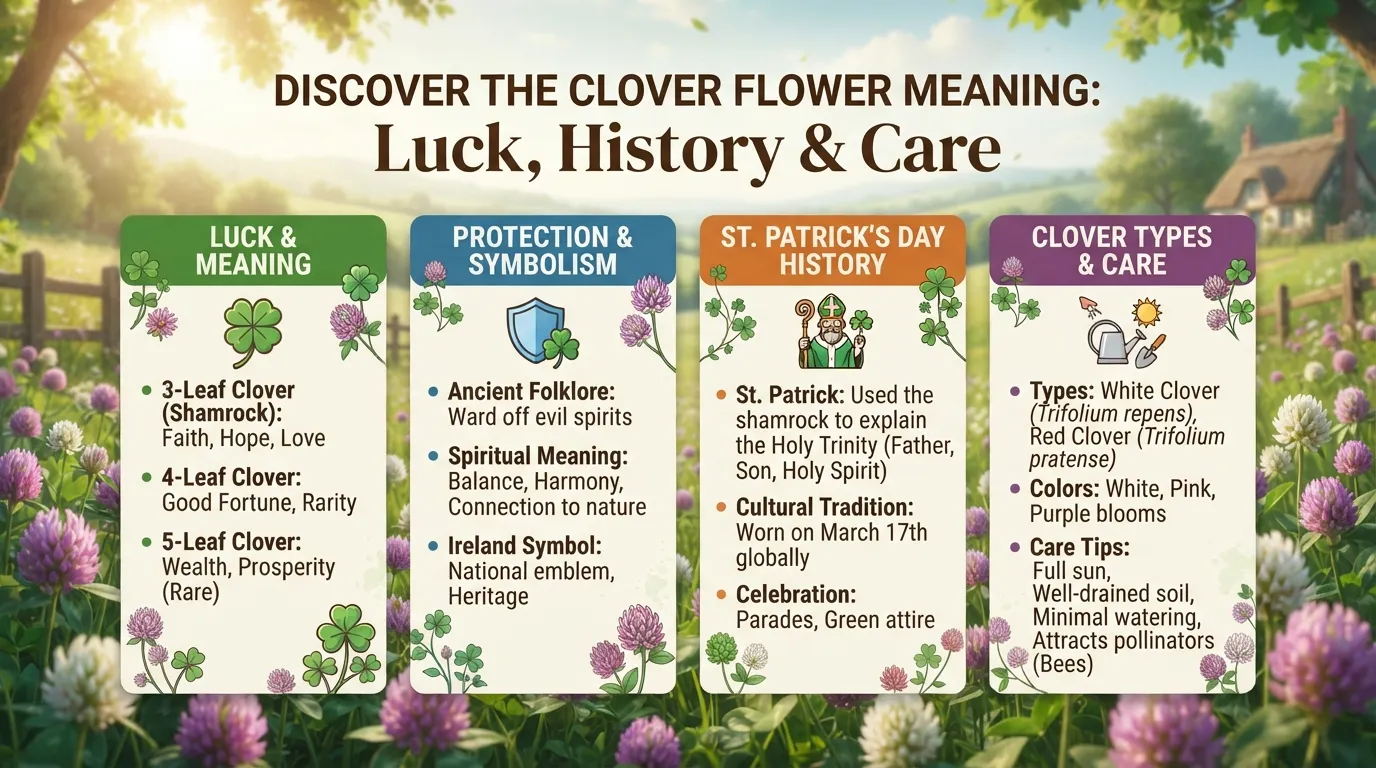
The clover flower means luck, good fortune, and promise. It also stands for protection and hope. People give clover to wish someone well, or to share in the idea that good things are coming.
Origin of the Name
The word “clover” comes from the Old English word clafre, which has roots in old Germanic languages. These old words simply meant the plant we still call clover today. The scientific name, Trifolium, comes from Latin. Tri means “three,” and folium means “leaf,” pointing to the plant’s well-known three-leaf shape.
Clover in Victorian Flower Language
In Victorian times, people used flowers to send quiet messages. Clover stood for “think of me” and “be mine.” Some readings also link it to “promise” and “good luck.” This meaning grew from the plant’s deep folk history, especially the rare four-leaf clover, long believed to bring fortune to whoever found one.
Botanical Foundations & Profile
| Feature | Detail |
|---|---|
| Scientific Name | Trifolium (e.g. Trifolium repens, white clover) |
| Native Region | Europe, Asia, and parts of North Africa |
| Bloom Period | Spring through fall |
| Average Lifespan | Perennial or annual, by species; often returns for years |
| USDA Zones | Zones 3 through 10, depending on species |
| Species Count | About 300 species |
History & Cultural Timeline
- Clover has grown wild across Europe and Asia for thousands of years.
- Ancient Celtic people in Ireland saw clover as a sacred plant tied to nature.
- Clover became linked to Saint Patrick, who is said to have used it to teach about faith in the 400s CE.
- Farmers began planting clover widely in the 1700s to improve soil health for crops.
Symbolism Deep-Dive
Luck
The rare four-leaf clover stands out from the common three-leaf kind. Finding one by chance has long been seen as a sign of coming good fortune, making clover a lasting symbol of luck.
Protection
Old folklore across Europe held that clover could guard against bad spirits and harm. People sometimes carried clover or hung it at home, tying the plant to safety and protection.
Hope
Clover grows quickly and spreads easily, often appearing in open fields after hard seasons. This steady, hopeful growth links the plant to fresh starts and brighter days ahead.
Meaning by Color
Clover blooms mostly come in a few natural shades, each with its own gentle meaning.
| Color | Meaning |
|---|---|
| White | Purity and new promise |
| Pink/Red | Warmth and gentle love |
| Purple-Pink | Loyalty and quiet devotion |
| Green (leaves) | Luck and steady growth |
Color Meanings & Cultural Safety Matrix
White Clover
- Primary sentiment: Purity and new promise.
- Geographic nuances: In Ireland, white clover is tied closely to Saint Patrick and faith. In the West more broadly, white often signals fresh starts.
- Gifting warning: A safe, gentle choice for most occasions.
Pink/Red Clover
- Primary sentiment: Warmth and gentle love.
- Geographic nuances: In parts of Europe, red clover fields are linked to summer and rural life. In the West, red and pink tones often suggest affection.
- Gifting warning: Fitting for casual, warm-hearted gifts.
Purple-Pink Clover
- Primary sentiment: Loyalty and quiet devotion.
- Geographic nuances: Many cultures link deeper pink-purple shades to steady, lasting bonds.
- Gifting warning: A thoughtful pick for close friends or family.
Global Traditions & Literary Impact
In Ireland, the shamrock, a young clover sprig, became a national symbol tied to Saint Patrick’s Day. Legend says Saint Patrick used the three leaves of a clover to explain a religious teaching to new believers. Today, the shamrock still represents Irish pride and heritage around the world.
In literature, clover appears in various folk tales and children’s stories about luck and wishes, often tied to the rare four-leaf clover. Please double-check any specific literary references, as I cannot search a live database and details may be inaccurate.
Economic, Culinary, and Medicinal Uses
Clover is widely planted by farmers to improve soil health, since it adds natural nitrogen back into the ground. Clover flowers and young leaves are also edible and sometimes used in salads or teas in various traditions. Red clover, in particular, has been studied in some herbal health practices. As with any plant, always check with a doctor before using clover for health purposes, especially if pregnant, nursing, or taking medication.
Related Flower Meanings: https://bloomsyflower.com/rhododendron-flower-meaning/
Ultimate Etiquette & Gifting Guide
| Relationship | Recommended Type | The Subtext |
|---|---|---|
| Friend Starting Something New | Four-Leaf Clover | “Wishing you good luck ahead.” |
| Spouse or Partner | Pink/Red Clover | “You bring warmth into my life.” |
| Someone Facing Hard Times | White Clover | “I hope for brighter days for you.” |
| Loyal Friend | Purple-Pink Clover | “Thank you for your steady loyalty.” |
Universal Safety Rule
If gifting a pressed or dried clover, especially a rare four-leaf find, add a short note explaining the gesture, since its meaning may not be obvious to everyone.
Clover vs. Close Lookalikes
| Feature | Clover | Wood Sorrel (Oxalis) | Medick (Medicago) |
|---|---|---|---|
| Leaf Shape | Rounded, often with a pale “V” marking | Heart-shaped leaflets, folded in the middle | Oval leaflets with tiny teeth near the tip |
| Flower Shape | Small, round, puffy flower clusters | Small, five-petaled, often yellow or pink | Small, yellow, pea-like flowers |
| Foliage | Three rounded leaflets per stem | Three heart-shaped leaflets per stem | Three oval leaflets, slightly toothed |
| Bloom Season | Spring through fall | Spring through fall | Spring through summer |
| Growth Style | Low, spreading ground cover | Low, spreading ground cover | Low, spreading or trailing |
How to tell them apart
Look closely at the leaf shape. Clover leaves are rounded, while wood sorrel leaves are heart-shaped and often fold closed at night.
Practical Maintenance & Domestic Safety
Care Basics
- Plant clover in full sun to partial shade.
- Use average, well-drained soil; clover is not picky.
- Water lightly; established clover handles dry spells well.
- Mow or trim occasionally to keep clover patches tidy, if desired.
Pet Toxicity Warning
Clover is generally considered non-toxic to cats, dogs, and horses, according to common pet plant guides. Still, eating very large amounts could cause mild stomach upset in some animals. Watch for unusual symptoms, and contact a vet if you have concerns.
Expert Curations & Misconceptions
10 Quick Fun Facts
- Most clover has three leaves; four-leaf clovers are rare natural variations.
- The odds of finding a four-leaf clover are roughly 1 in 10,000.
- Clover helps improve soil health by adding natural nitrogen.
- Bees and butterflies love visiting clover blooms.
- Clover honey is a popular, mild-flavored honey type.
- The shamrock is a young, small clover sprig, not a separate plant.
- Some clover species can grow in lawns without regular watering.
- Clover was historically grown as livestock feed on many farms.
- A five-leaf clover is even rarer than a four-leaf one.
- Clover flowers can be white, pink, red, or purple, depending on species.
3 Myth vs. Reality Pairs
Myth: All four-leaf clovers bring guaranteed good luck.
Reality: The luck meaning is folklore and tradition, not a proven fact.
Myth: Shamrock and clover are two different plants.
Reality: A shamrock is simply a young clover sprig, often from a specific clover species.
Myth: Clover is a weed with no real benefit.
Reality: Clover actually improves soil health and supports pollinators like bees.
2 Quick Florist Tips
- Press and dry a four-leaf clover between book pages to preserve it as a lasting keepsake gift.
- Pair fresh clover sprigs with other small blooms for a simple, natural bouquet.
FAQs
What does the clover flower mean spiritually?
Clover means luck, hope, and protection, with deep folklore ties to good fortune and new beginnings.
Is clover a good gift for special occasions?
Yes, especially for new ventures, graduations, or wishing someone luck during a big change.
What does a four-leaf clover mean?
A four-leaf clover is a rare find believed to bring good luck to whoever discovers it.
Is clover toxic to pets?
Clover is generally considered non-toxic to pets, though large amounts of any plant can cause mild stomach upset.
Can you eat clover?
Yes, clover flowers and young leaves are edible and sometimes used in salads or herbal teas.
When does clover bloom?
Clover typically blooms from spring through fall, depending on the climate and species.
How did clover get its name?
Its name comes from the Old English word clafre, while its scientific name, Trifolium, means “three-leaf” in Latin.
What does clover have to do with Saint Patrick’s Day?
Legend says Saint Patrick used a clover’s three leaves to teach a religious lesson, which later made the shamrock a symbol of Irish heritage.
Final Thoughts
The clover flower carries a cheerful, hopeful meaning rooted in luck, protection, and promise. Its humble, three-leaf shape has grown into one of the most recognized symbols of good fortune across the world, especially through the rare and treasured four-leaf clover.
Beyond folklore, clover also quietly supports healthy soil and busy pollinators like bees. Whether you search for a lucky four-leaf find, plant clover in a sunny garden patch, or simply enjoy its cheerful blooms, this small plant carries a big, hopeful message. Consider gifting a pressed clover to someone who could use a little extra luck today.

Zahid Abbas is an educator, researcher, and digital publishing strategist behind BloomsyFlower, a flower and gardening resource covering flower meanings, symbolism, history, care, seasonal blooms, and gifting. He combines research with simple, reader-friendly writing to help people understand, grow, and enjoy flowers.