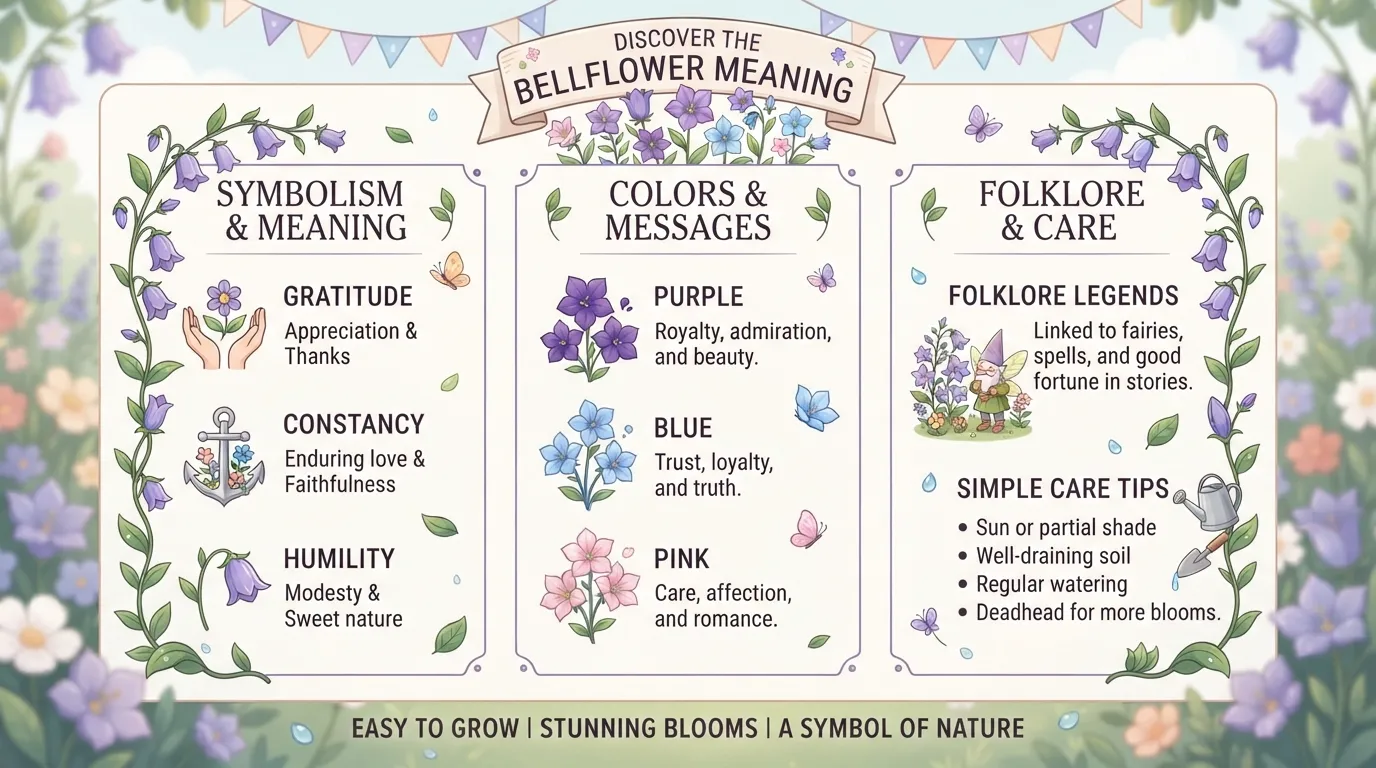
The bell flower meaning gratitude, constancy, and humble love. It also stands for everlasting affection and quiet devotion. People give bellflower to say thank you, or to show a love that stays steady through time.
Origin of the Name
The word “bellflower” comes straight from the flower’s shape. Its blooms look like small, hanging bells. The scientific name, Campanula, comes from the Latin word campana, meaning “bell.” This Latin root has been used in plant science since the 1700s.
Bellflower in Victorian Flower Language
In Victorian times, people used flowers to send quiet messages. Bellflower stood for “gratitude” and “constancy.” Some readings also link it to “unchanging love.” This bell flower meaning grew from the flower’s steady, upright growth and its gentle bell shape, which never fully opens wide, like a love held close and never shaken.
Botanical Foundations & Profile
| Feature | Detail |
|---|---|
| Scientific Name | Campanula (e.g. Campanula rotundifolia, harebell) |
| Native Region | Europe, Asia, and North America |
| Bloom Period | Late spring through summer |
| Average Lifespan | Perennials often live 3 to 5 years or longer |
| USDA Zones | Zones 3 through 8, depending on species |
| Species Count | About 500 species |
History & Cultural Timeline
- Bellflowers have grown wild across Europe and Asia for thousands of years.
- Ancient herbalists wrote about bellflowers in early plant and healing texts.
- Carl Linnaeus used the name Campanula in his plant classification work in the 1700s.
- Bellflowers became popular cottage garden plants in Europe during the 1800s.
Symbolism Deep-Dive
Gratitude
Bellflower blooms often nod gently downward, as if bowing in thanks. This soft, humble posture gave the flower its lasting link to gratitude and thankfulness.
Constancy
Many bellflower species are perennials, returning faithfully each year without fail. This steady, repeating bloom pattern ties the flower to constancy and a love that does not waver.
Humility
Bellflowers rarely grow tall or showy compared to bolder garden blooms. Their soft colors and gentle, bell-shaped form give them a quiet, humble character, admired without needing to shout for attention.
Meaning by Color
| Color | Meaning |
|---|---|
| Blue-Violet | Faithfulness and calm devotion |
| White | Purity and quiet sincerity |
| Pink | Gentle love and soft affection |
| Purple | Dignity and lasting respect |
Color Meanings & Cultural Safety Matrix
Blue-Violet Bellflower
- Primary sentiment: Faithfulness and calm, steady devotion.
- Geographic nuances: In parts of Scotland, the blue harebell is tied to folklore and fairy legends. In Western flower language, blue often means trust.
- Gifting warning: A thoughtful, safe choice for most close relationships.
White Bellflower
- Primary sentiment: Purity and quiet sincerity.
- Geographic nuances: In the West, white often signals fresh starts. In some Eastern homes, white flowers connect to mourning.
- Gifting warning: Check local customs before gifting white bellflower at a joyful event.
Pink Bellflower
- Primary sentiment: Gentle love and soft affection.
- Geographic nuances: In Japan, pink often stands for youth and springtime joy.
- Gifting warning: A safe, warm pick for most happy occasions.
Purple Bellflower
- Primary sentiment: Dignity and lasting respect.
- Geographic nuances: Purple flowers often carry noble meaning across many cultures.
- Gifting warning: Best suited for formal or respectful gifts.
Global Traditions & Literary Impact
In Scottish folklore, the harebell, a type of bellflower, is sometimes called the “fairy thimble.” Old stories say fairies used the small, bell-shaped blooms as hats or cups, giving the flower a magical, gentle reputation in local tales.
In literature, bellflowers appear in nature poetry and garden writing describing quiet meadows and woodland edges. Please double-check any specific literary references, as I cannot search a live database and details may be inaccurate.
You May Also Like: https://bloomsyflower.com/rhododendron-flower-meaning/
Economic, Culinary, and Medicinal Uses
Some bellflower species and bell flower meaning, like Campanula rapunculus, have edible roots and leaves, and were once grown as a food crop in parts of Europe. However, not all bellflower species are safe to eat, so it’s wise to confirm the exact species before trying any part of the plant. Bellflowers are mostly grown today for their ornamental beauty rather than food. Always check with a doctor or expert before eating any wild or garden plant.
Ultimate Etiquette & Gifting Guide
| Relationship | Recommended Color | The Subtext |
|---|---|---|
| Spouse or Partner | Blue-Violet | “My devotion to you never wavers.” |
| Someone Who Helped You | Pink | “Thank you for your kindness.” |
| Respected Elder | Purple | “I hold you in lasting respect.” |
| New Beginning | White | “Wishing you peace and sincerity.” |
Universal Safety Rule
Pair bellflower with a short note of thanks, since its main meaning centers on gratitude and steady devotion.
Bellflower vs. Close Lookalikes
| Feature | Bellflower | Foxglove | Lily of the Valley |
|---|---|---|---|
| Petal Shape | Open, bell-shaped blooms | Long, tubular, spotted blooms | Tiny, rounded bell clusters |
| Fragrance | Little to no scent | Little to no scent | Strong, sweet scent |
| Foliage | Rounded or narrow green leaves | Large, fuzzy, soft leaves | Broad, smooth, pointed leaves |
| Bloom Season | Late spring through summer | Late spring to early summer | Spring |
| Growth Style | Grows upright or trailing, by type | Grows as a tall, upright spike | Grows low in spreading patches |
How to tell them apart
Check the bloom size. Bellflower blooms are usually wider and more open than the tiny, tightly closed bells of lily of the valley.
Practical Maintenance & Domestic Safety
Care Basics
- Plant bellflower in full sun to partial shade.
- Use well-drained soil for the healthiest roots.
- Water regularly, especially during dry summer weeks.
- Trim spent blooms to encourage more flowers through the season.
Pet Toxicity Warning
Most common garden bellflowers are generally considered non-toxic to cats and dogs. Still, eating large amounts of any plant can cause mild stomach upset in pets. Watch for unusual symptoms, and contact a vet if you have any concerns.
Expert Curations & Misconceptions
10 Quick Fun Facts
- Bellflower gets its name from its small, bell-shaped blooms.
- The harebell, a type of bellflower, is Scotland’s unofficial flower.
- Bellflowers come in shades of blue, purple, pink, and white.
- Some bellflower species grow low and spreading, like ground cover.
- Bees are strongly attracted to bellflower blooms.
- Certain bellflower roots were once eaten like a vegetable in Europe.
- Bellflowers can grow in rocky, thin soil where other plants struggle.
- Some bellflower types are called “Canterbury bells” in gardens.
- Bellflower blooms often face downward, protecting pollen from rain.
- Over 500 species of bellflower exist around the world.
3 Myth vs. Reality Pairs
Myth: All bellflowers are edible.
Reality: Only certain species are safe to eat; others are grown only for beauty.
Myth: Bellflowers only grow in cold climates.
Reality: Many bellflower species grow well in warm, mild gardens too.
Myth: Bellflower and foxglove are the same plant.
Reality: They look somewhat alike but belong to entirely different plant families.
2 Quick Florist Tips
- Cut bellflower stems when about half the blooms on the stem are open.
- Place cut bellflowers in cool water away from direct sun to help them last longer.
What People Ask About Bell flower meaning
What does the bellflower mean spiritually?
Bellflower means gratitude and steady devotion, showing a love or bond that stays strong over time.
Is bellflower a good gift for special occasions?
Yes, it works well for thank-you gifts, anniversaries, and moments meant to honor lasting loyalty.
What does a blue bellflower mean?
Blue bellflower stands for faithfulness and calm, steady devotion.
Is bellflower toxic to pets?
Most common bellflowers are considered non-toxic, but it’s wise to watch for stomach upset if a pet eats a large amount.
Can you eat bellflower?
Some species, like Campanula rapunculus, have edible roots and leaves, but not all bellflowers are safe to eat.
When does bellflower bloom?
Bellflower typically blooms from late spring through summer.
How did bellflower get its name?
Its name comes from its bell-shaped blooms, and its scientific name, Campanula, comes from the Latin word for “bell.”
What did bellflower mean in Victorian times?
It meant gratitude and constancy, standing for a thankful heart and a love that does not change.
Final Thoughts
The bellflower carries a sweet, humble meaning rooted in gratitude and lasting devotion. Bell flower meaning gentle, nodding blooms seem to bow in quiet thanks, while its faithful, returning growth each year speaks of a love that never wavers.From Scottish fairy folklore to cottage garden borders, bellflower has long been a symbol of steady, sincere affection. Consider planting bellflower in a sunny garden bed, or gifting a small bunch to someone whose quiet loyalty means the world to you.

Zahid Abbas is an educator, researcher, and digital publishing strategist behind BloomsyFlower, a flower and gardening resource covering flower meanings, symbolism, history, care, seasonal blooms, and gifting. He combines research with simple, reader-friendly writing to help people understand, grow, and enjoy flowers.