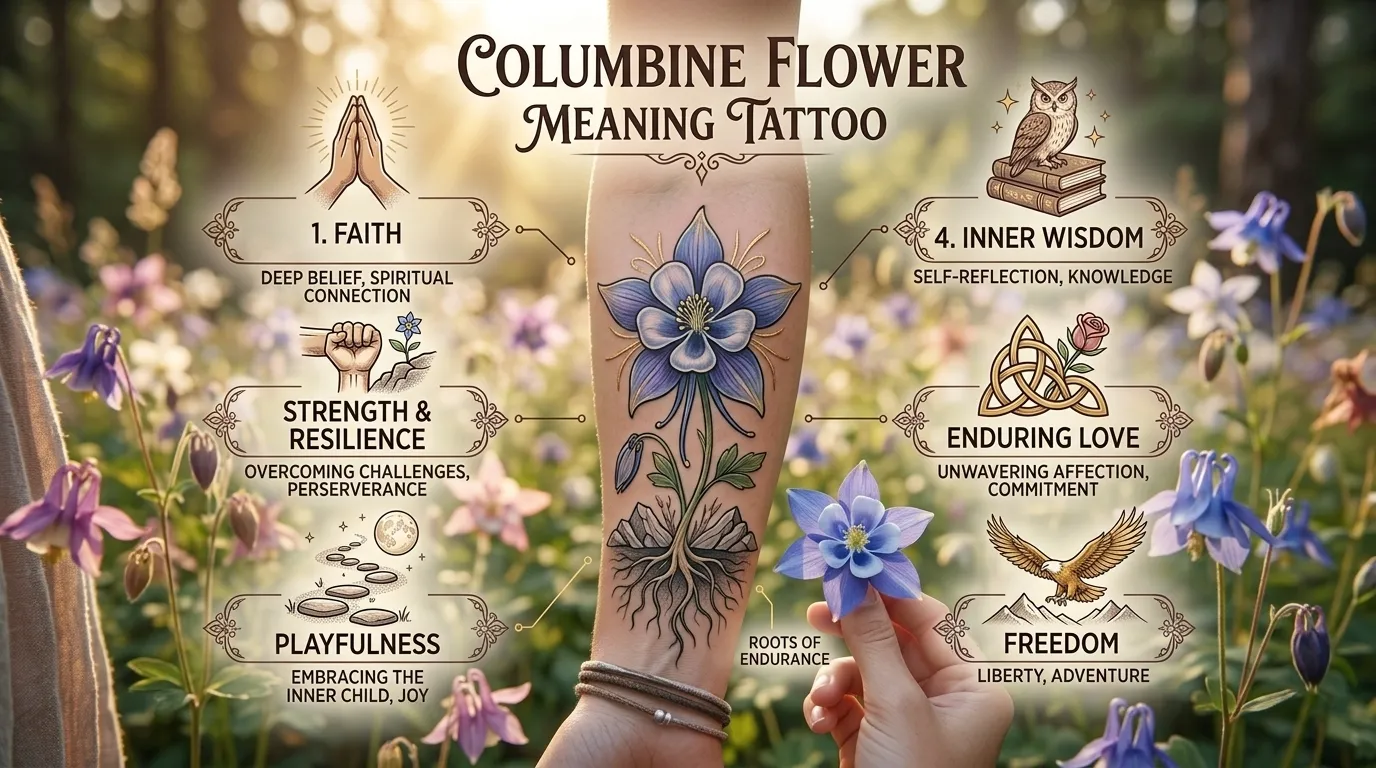
Look at a columbine bloom up close. You’ll see five little hoods. Each one curls into a hollow spur. Turn the flower upside down. Now the spurs look like doves. They circle around, as if drinking from one dish. That’s where the name comes from. “Columbine” comes from the Latin word for dove, columba. Monks saw those doves long ago. They put the flower right into church art.
The Definitive Answer Block
Columbine has two clashing meanings. One is folly, or foolishness. The other is deep devotion. The flower’s curved spurs look like a jester’s cap. That’s why Victorians called it folly. But its dove-like shape gave it an older, gentler meaning first. That meaning was faithful love.
| Flower Color | Dominant Meaning | Best Occasion |
|---|---|---|
| Blue/Purple | Faithfulness, quiet devotion | Sympathy, remembrance gifts |
| Red | Eager, nervous love | Early romance, admiration |
| Yellow | A wish to win someone over | Bold romantic gestures |
| White | Innocence, or foolishness | Use with care, check context |
Botanical Foundations & Profile
Columbine’s scientific name is Aquilegia. That comes from the Latin word for eagle, aquila. Its curved spurs look like eagle claws. The plant sits in the buttercup family, called Ranunculaceae. Wild columbine grows across North America, Europe, and parts of Asia. One kind, Aquilegia caerulea, grows wild in the Rockies. Colorado made it the state flower in 1899.
| Category | Detail |
|---|---|
| Scientific Classification | Aquilegia spp., family Ranunculaceae |
| Native Region | North America, Europe, temperate Asia |
| Bloom Period | Late spring to early summer |
| Average Lifespan | Plant: 3–4 years. It often reseeds itself |
| USDA Zones | 3–9 |
| Cultivar Count vs. Wild Species | Hundreds of cultivars vs. about 60–70 wild species |
Deep History & Cultural Timeline
Medieval Christian art used columbine a lot. Its dove-shaped petals stood in for the Holy Spirit. Some paintings grouped seven blooms together. This stood for the seven gifts of the Spirit. Carl Linnaeus named the genus Aquilegia in 1753. He wrote it in his book Species Plantarum. English herbalist Nicholas Culpeper wrote about the plant in 1652. His book was called The English Physician. Native groups like the Meskwaki crushed columbine seeds. They rubbed them on skin as a charm, for the scent. Colorado named columbine its state flower in 1899. The state later passed a law to protect it in the wild.
Symbolism Deep-Dive
Folly.
The curved spurs look like a jester’s cap. Victorians saw this shape and called the flower foolish.
Faithfulness.
Older tradition read the same five spurs a different way. They saw five doves, drinking side by side. That’s a picture of quiet devotion.
Desertion.
Some old guides also linked columbine to a lost or abandoned love. The bloom nods downward. Maybe that looked sad to them.
Resolve.
In some folk tales, giving columbine meant one thing. It meant, “I will win your heart.” That turns the odd shape into a sign of courage.
Color Meanings & Cultural Safety Matrix
Blue/Purple
- Primary sentiment: Faithfulness, quiet devotion
- Geographic nuances: In North America, blue columbine carries state pride too. It’s Colorado’s official flower.
- Gifting warning: Safe for sympathy or remembrance. It won’t send a strong romantic message on its own.
Red
- Primary sentiment: Eager, nervous love
- Geographic nuances: Red columbine grows wild in North America. It didn’t carry the old “folly” label, since Victorian guides were mostly European.
- Gifting warning: Good for early romance. Skip it if you want to show calm, settled love instead.
Yellow
- Primary sentiment: A wish to win someone’s heart
- Geographic nuances: Yellow columbine mostly comes from modern garden breeding. It carries less old folklore than blue or red.
- Gifting warning: Best for a bold, clear romantic move. Not a subtle choice.
White
- Primary sentiment: Innocence, though some old guides still read it as folly
- Geographic nuances: White softens the “foolish” meaning. It doesn’t erase it fully in older flower-language books.
- Gifting warning: Check your meaning first. Old guides don’t fully agree on white columbine.
Global Traditions & Literary Impact
Victorian flower-language books argued about columbine. Some called it folly. Others called it desertion. A few even called it resolve. That disagreement is part of the story. William Shakespeare put columbine in Hamlet. Ophelia hands out flowers there, each one tied to a meaning. Scholars still debate what Shakespeare meant by it. In medieval church art, painters used columbine in scenes of the Annunciation. Its dove-like shape pointed to the Holy Spirit, without painting an actual dove.
Economic, Culinary, or Medicinal Uses
No one cooks with columbine today. No part of the plant is safe to eat. Old herbal books, like Culpeper’s from 1652, listed remedies using its seeds and roots. Modern research doesn’t support these old cures. Some Native groups used crushed seeds as a scented charm, not a medicine. Today, gardeners grow columbine just for its looks. It also draws hummingbirds and long-tongued bees.
The Ultimate Etiquette & Gifting Guide
| Relationship / Setting | Recommended Color | The Subtext Sent |
|---|---|---|
| New romantic interest | Red | Eager, nervous excitement |
| Established partner | Blue/Purple | Steady, faithful devotion |
| Bold romantic gesture | Yellow | “I intend to win you over” |
| Sympathy or remembrance | Blue/Purple | Quiet, respectful devotion |
| Colorado-themed gift | Blue | Regional pride, natural beauty |
Universal Safety Rule:
Columbine’s meaning has genuinely split traditions. Add a short note to explain your message. Don’t let the flower speak alone.
Direct Comparison: Columbine vs. Close Lookalikes
| Feature | Columbine (Aquilegia spp.) | Larkspur (Delphinium) | Bleeding Heart (Dicentra) |
|---|---|---|---|
| Petal drop | Fades and drops over 1–2 weeks | Florets drop along the tall spike | Heart shapes drop slowly along the stem |
| Fragrance | Faint, a bit sweet | Little to no scent | Almost no scent |
| Foliage | Rounded, lobed, blue-green leaves | Feathery, deeply cut leaves | Fern-like, soft blue-green leaves |
| Bloom season | Late spring to early summer | Early to mid-summer | Spring |
| Care needs | Partial shade, soil that drains | Full sun, rich soil, staking | Partial shade, moist soil |
How to tell them apart:
Columbine hangs with clear backward spurs. Larkspur grows as one tall, packed spike. Bleeding heart forms rows of small hearts on an arching stem.
Practical Maintenance & Domestic Safety
Columbine likes partial shade. Give it soil that drains but stays a bit moist. Water it often in the first year. After that, it needs less. Cut off spent blooms to keep it flowering. Let a few seed heads stay if you want new plants next year.
Now, about pets. The ASPCA does not list columbine as toxic to cats or dogs. Still, columbine sits in the buttercup family. Some relatives in that family can mildly irritate skin or stomachs. So don’t take “not listed” as a full green light. Keep an eye on pets near any garden bed, columbine included.
Expert Curations & Misconceptions
10 fun facts:
- “Columbine” comes from the Latin word for dove, columba.
- Aquilegia comes from the Latin word for eagle, aquila.
- Columbine sits in the buttercup family, not its own family.
- Colorado made blue columbine its state flower in 1899.
- Colorado law protects wild columbine on public land.
- Its long spurs hold nectar made for hummingbirds and moths.
- Shakespeare used columbine in a flower scene in Hamlet.
- Some wild columbine grows above 10,000 feet in the Rockies.
- The plant reseeds easily and pops up in new spots.
- Columbine crosses easily, so garden shops sell many colors.
Myth vs. reality:
- Myth: Columbine has one clear meaning.
- Reality: Old guides disagreed. Some said folly. Some said devotion. Some said resolve.
- Myth: Columbine is very toxic to pets.
- Reality: The ASPCA doesn’t list it as toxic to cats or dogs.
- Myth: All columbine is wild and unbred.
- Reality: Most garden columbine today comes from bred cultivars, not wild plants.
3 expert tips:
- Plant columbine where it gets morning sun and afternoon shade. It fades fast in hot, full sun.
- Let a few blooms go to seed each year. This helps the patch spread on its own.
- Divide crowded clumps every few years. Crowding makes the plant bloom less.
High-Value Section
What does the columbine flower mean?
Columbine holds two old, opposite meanings. One is folly, from its jester-cap-shaped spurs. The other is faithfulness, from its older dove shape.
Why does columbine have two opposite meanings?
Victorian flower guides didn’t agree with each other. The flower’s odd shape fit both a foolish reading and a faithful one.
Is columbine poisonous to dogs or cats?
No. The ASPCA does not list it as toxic to cats or dogs. Still, don’t let pets chew on any garden plant.
Why is columbine Colorado’s state flower?
Colorado picked the blue Rocky Mountain columbine in 1899. The state later passed a law to protect it in the wild.
What’s the difference between columbine and larkspur?
Columbine hangs with backward spurs on each bloom. Larkspur grows as one tall, packed spike of flowers.
Does columbine attract hummingbirds?
Yes. Its long nectar spurs are shaped just for hummingbirds and other long-tongued pollinators.
What soil does columbine need?
It wants soil that drains well but stays a bit moist. It likes partial shade more than full, hot sun.
Can columbine grow in full sun?
It can, mostly in cool climates. It blooms longer with some afternoon shade in warm areas.
Where does the name “columbine” come from?
It comes from the Latin word for dove, columba. The five spurs look like doves drinking together.
Is columbine a wildflower or a garden flower?
Both. Wild kinds grow across North America, Europe, and Asia. Breeders also made many garden types.
How long does columbine bloom?
Most columbine blooms for four to six weeks in late spring. Cutting off spent blooms can stretch this a bit.
Does columbine self-seed easily?
Yes, very easily. An older patch often spreads into new spots on its own, with no help.
Conclusion
Columbine Flower Meaning isn’t a flaw. It’s the whole point. One flower looks like a jester’s cap and a circle of doves at once. So it carries both foolishness and faith. That mix followed it from church paintings to Shakespeare to modern gardens. Maybe that fits a flower this strange. It refuses to mean just one simple thing.

Zahid Abbas is an educator, researcher, and digital publishing strategist behind BloomsyFlower, a flower and gardening resource covering flower meanings, symbolism, history, care, seasonal blooms, and gifting. He combines research with simple, reader-friendly writing to help people understand, grow, and enjoy flowers.