Larkspur gets its name from its own shape. Look at one bloom from the side. A thin spur sticks out the back. Long ago, people thought it looked like a lark’s claw. That small spur holds nectar deep inside. Only long-tongued bees and moths can reach it. This flower has another name too: delphinium. That name comes from a Greek word for dolphin, since the unopened buds looked like tiny dolphins to old Greek botanists.
The Definitive Answer Block
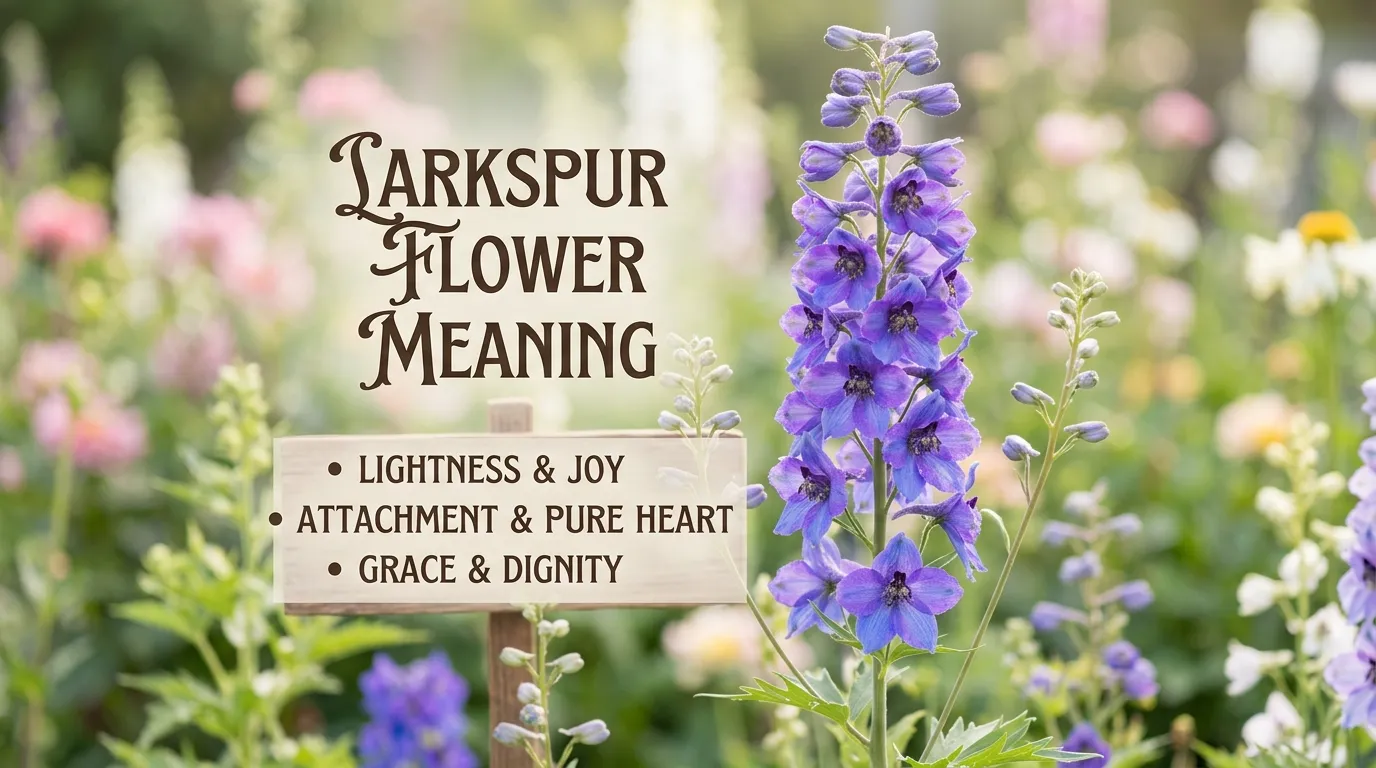
Larkspur means an open heart and strong, positive feelings. It also stands for lightness and fun. The flower earned this meaning partly through its light, airy spikes, and partly because it’s the official birth flower for July.
| Flower Color | Dominant Meaning | Best Occasion |
|---|---|---|
| Purple/Blue | Dignity, grace, an open heart | Formal events, thank-you gifts |
| Pink | Fickleness, a light heart | Playful, casual gifts |
| White | Joy, a happy heart | Celebrations, new beginnings |
| Red | Rare, tied to strong passion | Bold romantic gestures |
Botanical Foundations & Profile
Larkspur’s scientific name is Delphinium. It sits in the buttercup family, called Ranunculaceae. Some smaller, annual types get sold under the name Consolida instead. Wild larkspur grows across the Northern Hemisphere, with strong roots in Europe, Asia, and North America. Its name Delphinium comes from the Greek word for dolphin, since its buds looked dolphin-shaped to early botanists.
| Category | Detail |
|---|---|
| Scientific Classification | Delphinium spp. (also Consolida spp.), family Ranunculaceae |
| Native Region | Europe, Asia, North America |
| Bloom Period | Early to mid-summer, June to August |
| Average Lifespan | Perennial types: 3–4 years. Cut stem: 7–10 days |
| USDA Zones | 3–7 |
| Cultivar Count vs. Wild Species | Hundreds of cultivars vs. about 300 wild Delphinium species |
Deep History & Cultural Timeline
Ancient Greek writers used the name Delphinion for this flower, tied to the dolphin-shaped buds, well over 2,000 years ago. Carl Linnaeus later folded that old name into his own naming system in 1753, in his book Species Plantarum. Native peoples across North America used wild larkspur species for dye, turning the blue pigment into paint and cloth color. Victorian flower-language guides picked up larkspur in the 1800s and gave it its now-common meaning of an open heart and light spirit. In 1948, the Society of American Florists named larkspur the official birth flower for July, a title it still holds today.
Symbolism Deep-Dive
Open heart.
Larkspur’s tall, open spikes of bloom read as generous and welcoming, which is likely why Victorian guides linked it to an open, honest heart.
Lightness.
The flower’s airy, delicate look on a tall stem gave it a reputation for cheer and a light, uncomplicated spirit.
Fickleness.
Pink larkspur in particular picked up a “fickle” meaning in some old guides, likely because pink shades were newer and less fixed in tradition than deep purple.
Dignity.
Purple larkspur, the most common wild color, carries a more formal reading tied to grace and quiet strength, fitting its tall, upright growth.
Color Meanings & Cultural Safety Matrix
Purple/Blue
- Primary sentiment: Dignity, grace, an open heart
- Geographic nuances: This is the most common wild color, so it carries the strongest and oldest traditional meaning of the bunch.
- Gifting warning: A safe, respected choice for almost any formal or thankful occasion.
Pink
- Primary sentiment: A light heart, sometimes read as fickle
- Geographic nuances: Pink cultivars are mostly a newer breeding development, so this shade carries less old folklore weight than purple.
- Gifting warning: Great for a playful, casual gift. Skip it if you want to send a serious, steady message.
White
- Primary sentiment: Joy, a happy heart
- Geographic nuances: White larkspur fits general Western celebration traditions well, without strong regional disagreement.
- Gifting warning: A safe, cheerful choice for most occasions and most cultures.
Red
- Primary sentiment: Rare passion, boldness
- Geographic nuances: True red larkspur is uncommon and prized, so it naturally carries a “rare and special” reading in modern floral use.
- Gifting warning: Confirm availability first, since red larkspur isn’t always easy to find at your local florist.
Global Traditions & Literary Impact
Victorian England folded larkspur into its detailed flower-language system, and pink larkspur specifically picked up a “fickleness” meaning that still shows up in flower guides today. Native American groups across the western United States used larkspur’s blue pigment as a dye, extracting color from the petals for paint and fabric work long before European settlers arrived. In 1948, the Society of American Florists gave larkspur its modern claim to fame by naming it July’s official birth flower, a title that now drives much of its popularity as a gift.
Economic, Culinary, or Medicinal Uses
Larkspur is not eaten, and no part of the plant is food-safe. In fact, the whole plant contains toxic alkaloids, which is the opposite of a culinary use. Historically, ranchers in the American West watched larkspur closely, since it’s one of the more dangerous plants for grazing cattle, causing real livestock losses in some regions. Some Native American groups used its blue pigment for dye and body paint, a practical use tied to color rather than any medicine. Today, larkspur’s only common use is ornamental, prized in gardens and cut-flower arrangements for its tall, colorful spikes.
The Ultimate Etiquette & Gifting Guide
| Relationship / Setting | Recommended Color | The Subtext Sent |
|---|---|---|
| Formal thank-you gift | Purple/Blue | Respect, gratitude, dignity |
| Casual, fun gift | Pink | Playful, light-hearted affection |
| July birthday | Any color | A fitting nod to their birth month |
| Celebration or new job | White | Joy and good wishes |
| Bold romantic gesture | Red | Rare, strong passion |
Universal Safety Rule: Keep larkspur away from any household with grazing animals or curious pets, since the whole plant is toxic if eaten, no matter which color you choose.
Direct Comparison: Larkspur vs. Close Lookalikes
| Feature | Larkspur (Delphinium spp.) | Foxglove (Digitalis) | Lupine (Lupinus) |
|---|---|---|---|
| Petal drop | Florets drop along the tall spike | Bell-shaped flowers drop one by one | Small pea-like flowers drop along the spike |
| Fragrance | Little to no scent | Little to no scent | Faint, slightly sweet scent |
| Foliage | Deeply cut, feathery leaves | Large, fuzzy, tongue-shaped leaves | Palm-shaped leaves with narrow leaflets |
| Bloom season | Early to mid-summer | Late spring to early summer | Late spring to early summer |
| Care needs | Full sun, rich soil, sturdy staking | Partial shade, moist soil | Full sun, well-drained, poorer soil |
How to tell them apart:
Larkspur flowers have a clear backward spur on each bloom. Foxglove flowers hang as open bells with no spur. Lupine flowers look small and pea-shaped, packed tightly around the spike.
Practical Maintenance & Domestic Safety
Larkspur wants full sun and rich, well-drained soil. Water it deeply once a week, especially during dry summer stretches. Stake tall varieties early, since their height makes them prone to toppling in wind and rain. Cut spent blooms to encourage a possible second, smaller round of flowers later in the season.
On toxicity, larkspur deserves real caution. The ASPCA lists Delphinium as toxic to dogs, cats, and horses. The whole plant contains toxic compounds called diterpenoid alkaloids, and even small amounts can cause serious harm if eaten. This isn’t a minor folk warning; ranchers have long tracked real livestock deaths tied to larkspur in Western grazing land. Keep it well out of reach of pets, and avoid planting it where grazing animals have access.
Expert Curations & Misconceptions
10 fun facts:
- The name Delphinium comes from the Greek word for dolphin.
- Larkspur got its common name from a spur that looked like a lark’s claw.
- It’s the official birth flower for July.
- Some wild Delphinium species grow over six feet tall.
- Native groups in the American West used larkspur’s blue color as a natural dye.
- Larkspur is toxic enough that ranchers still track it as a real risk to grazing cattle.
- There are around 300 wild Delphinium species worldwide.
- Larkspur flowers come in almost every shade except true orange.
- Bees and long-tongued moths are its main pollinators, since the nectar sits deep in the spur.
- The name Consolida, used for some annual larkspur, comes from a Latin word meaning “to make firm,” tied to old wound-healing folklore.
Myth vs. reality:
- Myth: Larkspur is a fully safe garden flower for any yard. Reality: The ASPCA lists it as toxic to dogs, cats, and horses, and it’s dangerous to grazing livestock too.
- Myth: Larkspur and delphinium are two different flowers. Reality: They’re the same genus; “larkspur” is just the common name for Delphinium.
- Myth: Larkspur only means an open heart. Reality: Pink larkspur specifically carries an older “fickle” meaning in some Victorian flower guides.
3 expert tips:
- Stake larkspur early in the season, before it gets tall, to avoid snapping stems in wind.
- Cut stems for a vase just as the lowest blooms open, so the rest opens gradually indoors.
- Deadhead right after the first bloom fades for a chance at a smaller second flush later in summer.
High-Value Section
What does larkspur flower mean?
Larkspur means an open heart and strong, positive feelings, along with lightness and joy, and it’s the official birth flower for July.
Is larkspur toxic to pets?
Yes. The ASPCA lists larkspur as toxic to dogs, cats, and horses, since the whole plant contains harmful alkaloid compounds.
Why is larkspur July’s birth flower?
The Society of American Florists named larkspur the official July birth flower in 1948, a title tied to its peak early-summer bloom time.
What’s the difference between larkspur and delphinium?
There isn’t one. Larkspur is simply the common name for the genus Delphinium; they refer to the same plant.
Can I grow larkspur if I have grazing animals?
It’s not recommended. Larkspur is a known cause of livestock poisoning in grazing regions, especially for cattle.
What does pink larkspur mean?
Pink larkspur carries a “fickle” or light-hearted meaning in some older Victorian flower-language guides, unlike the steadier purple shade.
How tall does larkspur grow?
Many garden varieties reach three to six feet tall, though some wild species grow even taller in the right conditions.
Does larkspur need full sun?
Yes, it grows best in full sun with rich, well-drained soil, and it often needs staking once it gets tall.
Why does larkspur need staking?
Its tall, top-heavy flower spikes can snap or fall over in wind and rain without support, especially in exposed garden spots.
Where does the name “larkspur” come from?
It comes from the flower’s thin backward spur, which early observers thought resembled the claw of a lark.
How long do cut larkspur stems last in a vase?
About seven to ten days with fresh water and a fresh angled cut on the stem.
Is larkspur related to buttercups?
Yes, it sits in the same plant family, Ranunculaceae, along with buttercups, columbine, and delphinium’s other relatives.
Conclusion
Larkspur Flower Meaning carries a real contradiction: a flower prized for its light, joyful meaning also holds real danger inside its stem. That tension runs through its whole story, from ancient Greek dolphin-shaped buds to Western ranchers still watching for it in grazing fields today. Maybe that’s the honest lesson in larkspur. Something this beautiful still deserves real respect, not just admiration.

Zahid Abbas is an educator, researcher, and digital publishing strategist behind BloomsyFlower, a flower and gardening resource covering flower meanings, symbolism, history, care, seasonal blooms, and gifting. He combines research with simple, reader-friendly writing to help people understand, grow, and enjoy flowers.