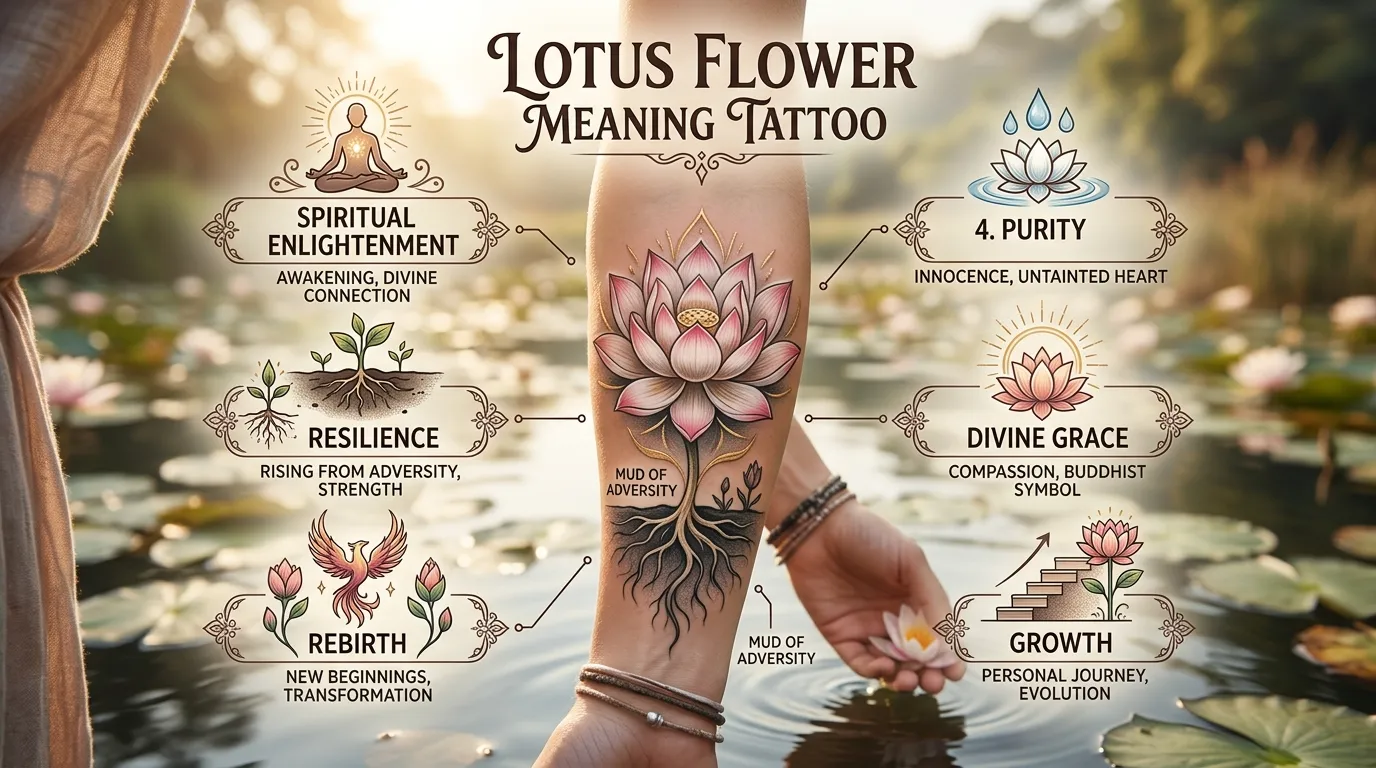
The lotus does something strange every night. It closes up, sinks a little, and rests in muddy water. Then, every morning, it rises back up. It opens clean, with no mud on its petals at all. That’s the whole reason people ink this flower on their skin. It’s not about beauty. It’s about coming back from something dark, clean and whole. Buddhist monks have used this exact image for over 2,000 years.
The Definitive Answer Block
A lotus tattoo means rising above hardship with a clean, unmarked spirit. The flower grows up through dirty pond water, then opens spotless above the surface. Buddhist and Hindu traditions both use this exact image for spiritual growth and enlightenment.
| Lotus Color | Dominant Meaning | Best For |
|---|---|---|
| Pink | Spiritual growth, the Buddha’s own lotus | Classic, traditional enlightenment tattoos |
| White | Purity, mental clarity | Minimalist or first-tattoo choices |
| Blue | Wisdom, victory over the ego | Meaningful, intellectual themes |
| Purple | Mysticism, higher awareness | Spiritual or esoteric-themed pieces |
| Red | Love, compassion, the heart | Romantic or heart-centered tattoos |
Botanical Foundations & Profile
The sacred lotus carries the scientific name Nelumbo nucifera. It sits alone in its own plant family, called Nelumbonaceae, unlike common water lilies. It grows wild across South and East Asia, and also in parts of northern Australia. [Link to: Kew Gardens plant profile for Nelumbo nucifera] Its root system can survive dried-out mud for years, then spring back to life the moment water returns. That’s part of why old traditions read it as a symbol of survival.
| Category | Detail |
|---|---|
| Scientific Classification | Nelumbo nucifera, family Nelumbonaceae |
| Native Region | South and East Asia, northern Australia |
| Bloom Period | Summer, one flower lasts about 3 days |
| Average Lifespan | Rhizome can survive dormant for years; single bloom: 3 days |
| USDA Zones | 4–10 (grown as an aquatic plant) |
| Cultivar Count vs. Wild Species | Hundreds of cultivars vs. just 2 wild Nelumbo species |
Deep History & Cultural Timeline
Ancient Egyptian art from around 2000 BCE shows a similar-looking blue lotus in tomb paintings, though that flower is actually a separate species, Nymphaea caerulea. In India, Hindu texts from roughly 1500 BCE name the lotus, or padma in Sanskrit, as the seat of the goddess Lakshmi and the god Brahma. Buddhism picked up the same flower a few centuries later. Buddhist art almost always shows the Buddha seated on a lotus throne, a detail that spread across Asia along trade routes by the first century CE. [Link to: British Museum Buddhist art collection] Western tattoo culture picked up the lotus much later, through 20th-century interest in Buddhist and Hindu imagery, and it’s stayed one of the most requested spiritual tattoo designs since.
Symbolism Deep-Dive
Rising above hardship.
The lotus grows up through mud and dark water, then blooms clean on the surface. This exact cycle is why the flower stands for overcoming struggle.
Enlightenment.
In Buddhism, the flower’s clean bloom out of dirty water mirrors the mind reaching clarity after moving past suffering.
Rebirth.
The lotus closes each night and reopens each morning. Old traditions read this daily cycle as a small symbol of death and return.
Purity.
No matter how muddy the water gets, the petals stay spotless. This is likely the single most common reason people choose a lotus tattoo.
Color Meanings & Cultural Safety Matrix
Pink
- Primary sentiment: Spiritual growth, sacred devotion
- Geographic nuances: In Buddhist tradition, pink lotus is reserved for the Buddha himself, unlike other lotus colors used for lesser deities or general symbolism.
- Cultural note: Since this shade holds the highest spiritual rank, some practicing Buddhists view a pink lotus tattoo as a serious symbol, not just decoration.
White
- Primary sentiment: Purity, calm, mental clarity
- Geographic nuances: White lotus appears often in Hindu art tied to the goddess Saraswati, linked to knowledge and clear thought.
- Cultural note: A safe, widely accepted choice, since white carries a fairly universal “purity” reading across both Buddhist and Hindu contexts.
Blue
- Primary sentiment: Wisdom, victory over desire
- Geographic nuances: Blue lotus in Buddhist art usually stands for wisdom and knowledge, tied to depictions of a specific Buddhist deity’s throne.
- Cultural note: True blue lotus tattoos are stylized, since real Nelumbo flowers don’t grow true blue in nature.
Purple
- Primary sentiment: Mysticism, spiritual awareness
- Geographic nuances: Purple carries less fixed traditional meaning than pink, white, or blue, and reads mainly as a modern Western addition to lotus symbolism.
- Cultural note: A flexible, low-risk choice for anyone wanting spiritual meaning without ties to one specific tradition.
Red
- Primary sentiment: Love, compassion, an open heart
- Geographic nuances: Red lotus in Buddhist tradition ties to compassion and the heart, distinct from the romantic love reading it often gets in the West.
- Cultural note: Know which meaning you want before you ink it, since Western and Buddhist readings of red lotus don’t fully match.
Global Traditions & Literary Impact
In Hindu tradition, the lotus appears constantly in scripture and art, most often as the seat beneath the goddess Lakshmi, tied to fortune and purity. Buddhist temples across Asia use the lotus so often that an eight-petaled version became a specific symbol, standing for the Noble Eightfold Path, the core set of Buddhist teachings. In Egypt, the blue lotus, Nymphaea caerulea, showed up in tomb art and creation myths tied to the sun god Ra, since the flower closes at night and opens at dawn, mirroring the sun’s own cycle. Modern tattoo culture in the West often blends the lotus with other symbols, like the Om sign or a mandala pattern, though this mixing sometimes strays from the original, separate meanings of each symbol.
Economic, Culinary, or Medicinal Uses
Lotus root, called ou in Chinese cooking, is a common vegetable across East and Southeast Asian cuisine, sliced and stir-fried for its crunchy texture. Lotus seeds get dried and ground into paste for mooncakes and other traditional sweets in China. Some traditional Ayurvedic and Chinese medicine systems use lotus seeds and leaves for calming or digestive remedies, though modern clinical evidence for these uses stays limited. None of this connects directly to the flower’s tattoo symbolism, but it does show how deeply the plant sits in daily Asian life, not just in religious art.
Tattoo Placement & Design Style Guide
| Placement | Common Design Style | The Message Sent |
|---|---|---|
| Forearm | Linework, geometric | Visible personal growth story |
| Shoulder/Back | Large watercolor or mandala | Bold spiritual statement |
| Ankle/Wrist | Small minimalist outline | Quiet, personal reminder |
| Chest, over the heart | Detailed realism or blackwork | Deep emotional or spiritual meaning |
| Ribcage/Spine | Vertical lotus stem design | Growth, rising upward theme |
Universal Cultural Rule: Before getting a lotus tattoo, learn which tradition its design pulls from. A lotus paired with Buddhist iconography, like a Buddha figure or Om symbol, carries real religious weight for practicing Buddhists and Hindus, so treat those combinations with real thought, not just as visual style.
Direct Comparison: Lotus vs. Close Lookalikes in Tattoo Art
| Feature | Sacred Lotus (Nelumbo nucifera) | Water Lily (Nymphaea) | Peony |
|---|---|---|---|
| Petal shape in art | Pointed, layered, symmetrical | Rounder, softer petal edges | Full, ruffled, many-layered petals |
| Symbolic root | Buddhist/Hindu enlightenment | Egyptian sun and rebirth myths | Wealth and honor in Chinese tradition |
| Common tattoo style | Linework, mandala, geometric | Watercolor, realism | Bold color, traditional Japanese (irezumi) |
| Stem in design | Straight, rising stem often shown | Floats flat, little stem shown | No stem tradition, often shown alone |
| Typical placement | Arm, back, spine | Thigh, hip, side | Chest, thigh, sleeve pieces |
How to tell them apart: True lotus tattoos usually show a straight stem rising up from below, echoing the flower’s real growth from mud to surface. Water lily designs skip the stem and float the bloom flat. Peony designs use far more layered, ruffled petals with no spiritual stem imagery at all.
Practical Notes on Getting the Tattoo
Book with an artist who has real experience in the specific style you want, whether that’s fine linework, watercolor, or traditional blackwork, since lotus designs live or die on clean petal symmetry. Bring reference images that show the exact number of petals and the color meaning you’re going for, since small design choices shift the symbolism. Expect a small lotus outline to take one to two hours, while a large detailed back piece can take multiple sessions.
On skin safety, this applies to any tattoo, not lotus specifically: confirm your artist uses single-use needles and proper sterilization, and ask about aftercare before you leave the shop. If you’re allergic to certain tattoo inks, mention it beforehand, since red and yellow pigments cause reactions more often than black ink does.
Expert Curations & Misconceptions
10 fun facts:
- A lotus seed found in China was carbon-dated and still sprouted after over 1,000 years dormant.
- The Egyptian blue lotus isn’t a true lotus at all; it’s a water lily, Nymphaea caerulea.
- Buddhist art uses an eight-petal lotus to represent the Noble Eightfold Path.
- India, Vietnam, and Egypt all name the lotus their national flower.
- The lotus can regulate its own flower temperature, staying warmer than the surrounding air.
- Lotus root has natural air pockets, which is why slices show a lace-like pattern when cut.
- The Buddha is shown seated on a lotus throne in most classical Buddhist statues.
- A single lotus flower blooms for only about three days before it closes for good.
- Lotus leaves repel water almost perfectly, an effect engineers now call the “lotus effect.”
- The goddess Lakshmi is traditionally shown standing or seated on an open lotus.
Myth vs. reality:
- Myth: The lotus and the water lily are the same flower. Reality: They’re different plant families entirely; true lotus is Nelumbo, water lily is Nymphaea.
- Myth: Any lotus tattoo automatically shows respect for Buddhism. Reality: Context matters. Pairing it with sacred figures or scripture carries more weight than a plain outline does.
- Myth: Blue lotus tattoos copy a real flower color. Reality: True Nelumbo nucifera doesn’t bloom blue in nature; blue lotus designs are a stylized, symbolic choice.
3 expert tips:
- Choose an odd number of petals, like 7 or 9, if you want your design to echo traditional Buddhist petal-count symbolism.
- Ask your artist to show you a stencil on your actual skin before the needle starts, since lotus symmetry shows flaws easily.
- If deep religious meaning matters to you, talk to someone from that tradition before finalizing the design, not just a tattoo artist.
High-Value Section
What does a lotus flower tattoo mean?
A lotus tattoo means rising above struggle with a clean, unmarked spirit, based on the flower’s real growth up through muddy water into a spotless bloom.
Does lotus tattoo color matter?
Yes. Pink ties to the Buddha directly, white means purity, blue means wisdom, purple means mysticism, and red means love or compassion.
Is a lotus tattoo disrespectful to Buddhism?
Not inherently, but pairing it with sacred figures or scripture carries real religious weight, so it’s worth understanding the symbol before combining it with other spiritual imagery.
What’s the difference between a lotus and a water lily tattoo?
True lotus designs usually show a rising stem and pointed petals; water lily designs float flat with rounder, softer petals and no stem.
Where do most people get a lotus tattoo?
Common spots include the forearm, shoulder, back, and ankle, chosen based on whether the design is small and personal or large and bold.
Why does the lotus close at night?
The flower closes its petals at night and reopens each morning, a cycle old traditions read as a small, daily symbol of death and rebirth.
Is the Egyptian lotus the same species as the Asian lotus?
No. The Egyptian blue lotus is Nymphaea caerulea, a water lily, while the Asian sacred lotus is Nelumbo nucifera, a completely different plant family.
How many petals should a lotus tattoo have?
There’s no fixed rule, but eight petals reference the Buddhist Noble Eightfold Path, and this count is a popular, meaningful choice.
What does an eight-petal lotus mean?
An eight-petal lotus represents the Noble Eightfold Path in Buddhism, the core set of teachings guiding right thought and action.
Can a lotus tattoo be combined with other symbols?
Yes, commonly with mandalas, Om symbols, or koi fish, though it’s worth knowing each symbol’s separate meaning before combining them into one piece.
Does lotus tattoo placement change its meaning?
Not the core symbolism, but placement can shift the feel: a spine piece emphasizes rising growth, while a wrist piece reads as a quiet personal reminder.
How long does a lotus tattoo take to heal?
A typical lotus tattoo takes about two to three weeks to heal on the surface, with full healing underneath taking up to a few months.
Conclusion
The Lotus Flower Meaning Tattoo honestly, not through marketing but through biology. A flower that survives in mud, closes each night, and opens clean each morning became, across three separate ancient cultures, the same symbol for the same idea: you can come through something dark and still come out whole. That’s the real weight behind the ink. A small flower, doing the same quiet work it’s done for thousands of years, now carried on someone’s skin instead of a temple wall.

Zahid Abbas is an educator, researcher, and digital publishing strategist behind BloomsyFlower, a flower and gardening resource covering flower meanings, symbolism, history, care, seasonal blooms, and gifting. He combines research with simple, reader-friendly writing to help people understand, grow, and enjoy flowers.