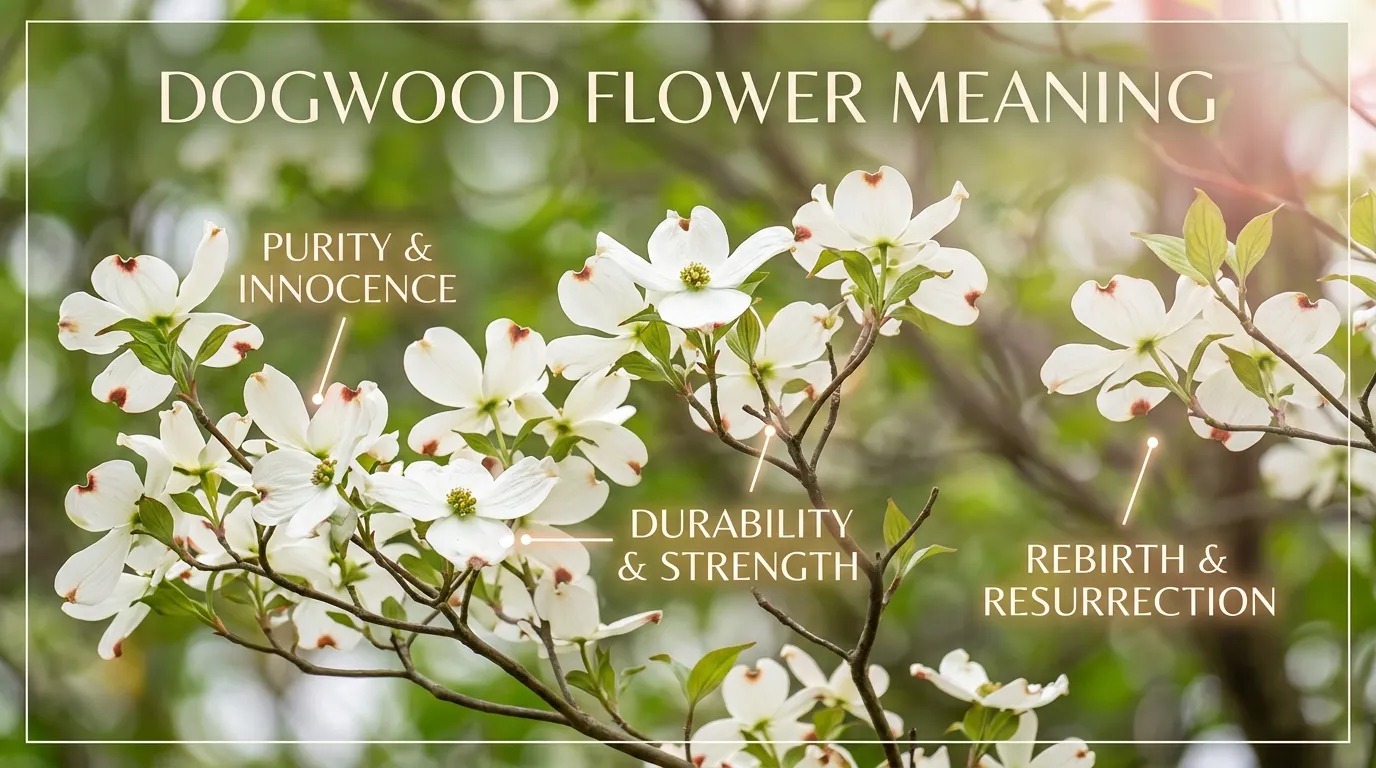
Look closely at a dogwood bloom. What you’re seeing isn’t really a flower. Those four big white petals are actually bracts, a kind of modified leaf. The real flowers sit tiny and yellow-green, clustered right in the center. Each bract also has a small notch at its tip, sometimes tinged reddish-brown. That detail alone launched one of America’s most-told flower legends. It’s also where the tree’s odd name comes from. Early colonists once called it “dagwood,” since its rock-hard wood made sharp tool handles, or daggers.
The Definitive Answer Block
Dogwood flowers mean rebirth, durability, and quiet strength. This meaning comes from real biology. Dogwood blooms early, before its leaves even open, right as spring returns after winter. Its wood is also famously hard, which built its reputation for toughness.
| Flower Color | Dominant Meaning | Best Occasion |
|---|---|---|
| White | Rebirth, purity, new starts | Easter, sympathy, spring gifts |
| Pink | Gentle affection, gratitude | Thank-you gifts, Mother’s Day |
| Red (bract edges) | Sacrifice, deep emotion | Memorial or reflective gifts |
Botanical Foundations & Profile
Flowering dogwood carries the scientific name Cornus florida. It sits in the dogwood family, called Cornaceae. The tree grows wild across eastern North America, from Maine down to Florida and west to Texas. What looks like one big flower is really four bracts around a tight cluster of tiny true flowers. This trick likely evolved to help early spring pollinators spot the tree from far away.
| Category | Detail |
|---|---|
| Scientific Classification | Cornus florida, family Cornaceae |
| Native Region | Eastern North America |
| Bloom Period | Early spring, March to April, before leaves open |
| Average Lifespan | Tree: 80 years or more; single bloom: 2–3 weeks |
| USDA Zones | 5–9 |
| Cultivar Count vs. Wild Species | Over 100 cultivars vs. about 60 wild Cornus species worldwide |
Deep History & Cultural Timeline
Cherokee healers used dogwood bark as a fever remedy long before European settlers arrived, boiling it into a bitter tea similar to quinine. Carl Linnaeus formally named the species Cornus florida in 1753, in his book Species Plantarum. Early American colonists prized the wood for its extreme hardness, using it for tool handles, weaving shuttles, and golf club heads well into the 20th century. Virginia named dogwood its official state flower in 1918, and North Carolina followed in 1941. The famous “legend of the dogwood,” which ties the tree’s notched bracts to the crucifixion, is actually a fairly modern American folk story, first widely printed in the early 1900s, not an ancient one.
Symbolism Deep-Dive
Rebirth.
Dogwood blooms before its own leaves open, right at the start of spring. That timing made it a natural symbol for new life after winter.
Durability.
Dogwood’s wood ranks among the hardest of any North American tree. This real, physical toughness built its reputation as a symbol of quiet strength.
Sacrifice.
The reddish notch at each bract’s tip fueled a 20th-century American legend linking the flower to the crucifixion. This meaning is folklore, not old scripture.
Protection.
Native tradition sometimes planted dogwood near homes, tied to its bark’s use as a real, practical fever remedy rather than pure symbolism.
Color Meanings & Cultural Safety Matrix
White
- Primary sentiment: Rebirth, purity, a fresh start
- Geographic nuances: In the American South, white dogwood carries strong regional pride as the state flower of both Virginia and North Carolina.
- Gifting warning: A safe, well-liked choice for spring gifts and sympathy arrangements alike.
Pink
- Primary sentiment: Gentle affection, gratitude
- Geographic nuances: Pink dogwood cultivars are a garden-breeding development, so they carry less old folklore than the wild white form.
- Gifting warning: Works well for a warm thank-you gift; less common for formal or somber occasions.
Red (bract edges or fall foliage)
- Primary sentiment: Sacrifice, deep or reflective emotion
- Geographic nuances: This reading ties closely to the 20th-century American legend, so it may not carry the same weight outside that specific cultural context.
- Gifting warning: Best suited to a memorial or reflective gift, given its heavier symbolic tone.
Global Traditions & Literary Impact
The American “legend of the dogwood” tells a story where the tree once grew tall and strong, then shrank small and twisted after being used for the cross, its four bract-tips marked with rust-colored stains meant to recall wounds. This tale spread widely through church bulletins and Easter cards in the early 20th century, though historians can’t trace it back further than that period. In Cherokee tradition, dogwood bark served a real, practical purpose as a fever remedy, a use with genuine medicinal roots rather than symbolic ones. In Japan, a different but related species, Cornus kousa, appears in gardens and art as a symbol of endurance, since the tree tolerates poor soil and harsh conditions well.
Economic, Culinary, or Medicinal Uses
Dogwood isn’t used in cooking today, and its berries aren’t considered food for people, though birds eat them readily. Historically, Cherokee and other Native healers used dogwood bark as a fever treatment, since it contains a compound chemically similar to quinine. Colonial-era craftsmen prized dogwood wood for tool handles, weaving shuttles, and mill parts, thanks to its extreme density and hardness. Golf club heads, called “woods,” were traditionally made from persimmon and dogwood before manufacturers switched to metal in the late 20th century.
The Ultimate Etiquette & Gifting Guide
| Relationship / Setting | Recommended Color | The Subtext Sent |
|---|---|---|
| Spring celebration | White | Renewal, fresh beginnings |
| Thank-you gift | Pink | Warm, quiet gratitude |
| Sympathy or memorial | White | Peaceful remembrance |
| Easter gift | White | Rebirth, seasonal tradition |
| Housewarming | Pink or white | Good wishes, a fresh start |
Universal Safety Rule:
Dogwood’s crucifixion legend is specifically Christian and American in origin, so skip that framing when gifting to someone outside that context. The flower’s plainer “rebirth” meaning travels much better across cultures.
Direct Comparison: Dogwood vs. Close Lookalikes
| Feature | Flowering Dogwood (Cornus florida) | Cherry Blossom (Prunus spp.) | Star Magnolia (Magnolia stellata) |
|---|---|---|---|
| Petal drop | Bracts hold shape for 2–3 weeks | True petals drop fast, often within days | Petals drop gradually over 1–2 weeks |
| Fragrance | Faint or none | Light, sweet scent | Light, lemony scent |
| Foliage | Opens after the bracts, oval leaves | Leaves open with or just after blooms | Leaves open after the blooms fade |
| Bloom season | Early spring, before leaves | Early to mid-spring | Very early spring |
| Care needs | Partial shade, moist well-drained soil | Full sun, well-drained soil | Full sun to part shade, moist soil |
How to tell them apart:
Dogwood shows four wide, notched bracts around a tiny center cluster. Cherry blossom shows five small, rounded true petals in loose clusters. Star magnolia shows many thin, strap-like petals in a starburst shape.
Practical Maintenance & Domestic Safety
Dogwood grows best in partial shade with soil that stays moist but drains well. Water young trees deeply during dry spells, especially in their first two years. Avoid planting it in full, hot afternoon sun, which stresses the tree and invites disease. Prune only in late fall or winter, since spring cuts can cause heavy sap loss.
On pet safety, dogwood is one of the more reassuring choices. The ASPCA lists Cornus florida as non-toxic to both dogs and cats. That said, the berries aren’t meant for people to eat, and it’s still smart to discourage pets from chewing on any woody plant material, since it can cause minor stomach upset even without true toxicity.
Expert Curations & Misconceptions
10 fun facts:
- What looks like dogwood’s petals are actually bracts, a type of modified leaf.
- The true dogwood flowers are tiny, yellow-green, and cluster in the center.
- Dogwood wood is so hard it was once used for golf club heads.
- The name “dogwood” likely comes from “dagwood,” tied to its use for dagger handles.
- Virginia and North Carolina both claim dogwood as their state flower.
- Cherokee healers used dogwood bark as a natural fever remedy.
- The famous crucifixion legend is a 20th-century story, not an ancient one.
- Dogwood blooms before its own leaves open each spring.
- A related species, Cornus kousa, is native to Japan and Korea.
- Dogwood trees can live 80 years or more in the right conditions.
Myth vs. reality:
- Myth: Dogwood’s four petals are true flower petals. Reality: They’re bracts, modified leaves surrounding the small true flowers at the center.
- Myth: The crucifixion legend is an old Christian tradition. Reality: Historians trace the story only to the early 1900s in America.
- Myth: Dogwood is toxic to pets. Reality: The ASPCA lists it as non-toxic to both dogs and cats.
3 expert tips:
- Plant dogwood where it gets some afternoon shade; full, hot sun stresses the tree and shortens its bloom.
- Prune only in late fall or winter to avoid heavy sap loss from spring cuts.
- Watch for powdery mildew and anthracnose, two common dogwood diseases; good airflow around the tree helps prevent both.
High-Value Section
What does the dogwood flower mean?
Dogwood means rebirth, durability, and quiet strength, tied to its early spring bloom and famously hard, tough wood.
Is the dogwood crucifixion legend real history?
No. It’s a well-known American folk story, but historians can only trace it back to the early 1900s, not ancient times.
Is dogwood toxic to dogs or cats?
No. The ASPCA lists Cornus florida as non-toxic to both dogs and cats.
Why does dogwood bloom before its leaves open?
This early bloom timing helps the tree attract scarce early-spring pollinators before leaves would otherwise block the flowers from view.
What’s the difference between dogwood and cherry blossom?
Dogwood shows four wide, notched bracts around a tiny center. Cherry blossom shows five small, rounded true petals in loose clusters.
Why is dogwood Virginia’s state flower?
Virginia named dogwood its state flower in 1918, honoring the tree’s wide presence across the state’s forests and its early, showy spring bloom.
What soil does dogwood need?
Dogwood wants soil that stays moist but drains well, ideally slightly acidic, and it does best with some afternoon shade.
Are the red berries on dogwood poisonous?
They aren’t listed as toxic to pets, but they aren’t meant for people to eat either; birds are the main ones who rely on them.
How did dogwood bark get used historically?
Cherokee and other Native healers boiled dogwood bark into a bitter tea, using it as a natural remedy for fever.
Where does the name “dogwood” come from?
It likely comes from “dagwood,” a nod to the tree’s hard wood once used for dagger and tool handles.
How long does dogwood bloom last?
A dogwood tree typically stays in bloom for two to three weeks in early spring, depending on weather conditions.
Can dogwood grow in full sun?
It can, but it usually does better with some afternoon shade, especially in warmer climates where full sun adds extra stress.
Conclusion
Dogwood Flower Meaning story rests on a small trick of biology. What looks like one bold flower is really four quiet bracts, standing in for something smaller and easy to miss. That same quiet strength runs through the tree’s whole reputation, from its rock-hard wood to its early, hopeful spring bloom. The real history and the folk legend don’t always agree, but both point to the same idea. Something tough enough to survive winter deserves to be noticed when it finally blooms

Zahid Abbas is an educator, researcher, and digital publishing strategist behind BloomsyFlower, a flower and gardening resource covering flower meanings, symbolism, history, care, seasonal blooms, and gifting. He combines research with simple, reader-friendly writing to help people understand, grow, and enjoy flowers.