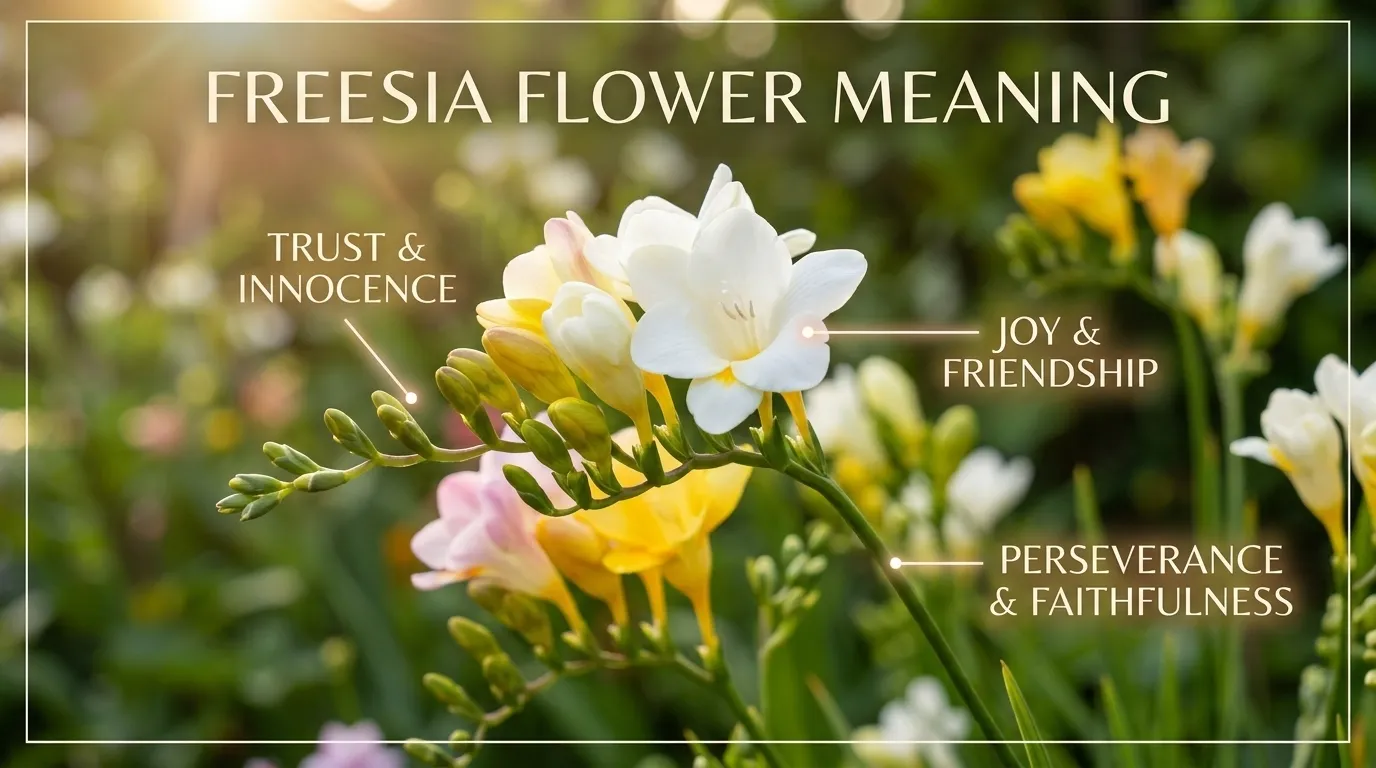
Freesia has one trick most flowers can’t match. It smells strong from a stem that looks almost too delicate to hold a scent at all. The blooms grow along one curved side of a thin, wiry stem, all facing the same direction, like a row of small trumpets. That odd, one-sided shape has a real purpose. In the wild, it helps pollinators find every flower fast, without wasting energy circling the plant. This flower didn’t reach Europe until the 1800s, and it got its name from a German doctor who never even discovered it himself
The Definitive Answer Block
Freesia means trust, friendship, and innocence. This meaning grew out of Victorian flower language, tied to the flower’s soft, unshowy look and its honest, sweet scent. Freesia is also the official birth flower for November.
| Flower Color | Dominant Meaning | Best Occasion |
|---|---|---|
| White | Innocence, pure trust | New friendships, sympathy gifts |
| Yellow | Joy, friendship | Thank-you gifts, get-well wishes |
| Purple | Admiration, spiritual trust | Meaningful, thoughtful gifts |
| Red/Pink | Warm affection, gratitude | Anniversaries, thank-you bouquets |
Botanical Foundations & Profile
Freesia’s scientific name is simply Freesia. It sits in the iris family, called Iridaceae. The plant is native to South Africa, mostly the Cape region, where it grows from small underground corms. Its name honors Friedrich Heinrich Theodor Freese, a German doctor and botanist. He never actually found the flower himself. His friend and fellow botanist, Christian Friedrich Ecklon, named the genus after him in 1866.
| Category | Detail |
|---|---|
| Scientific Classification | Freesia spp., family Iridaceae |
| Native Region | South Africa, Cape region |
| Bloom Period | Spring outdoors; year-round when grown in greenhouses |
| Average Lifespan | Corm can rebloom for years; cut stem lasts 7–10 days |
| USDA Zones | 9–10 outdoors; grown as an annual or forced bulb elsewhere |
| Cultivar Count vs. Wild Species | Hundreds of cultivars vs. about 16 wild Freesia species |
Deep History & Cultural Timeline
European botanists first collected freesia species from South Africa in the early 1800s, though exact records from that period are thin. Christian Friedrich Ecklon formally named the genus Freesia in 1866, honoring his friend and colleague Friedrich Freese. Dutch and English growers began breeding freesia for the cut-flower trade in the early 1900s, crossing wild species to boost both color range and scent strength. By the mid-1900s, the Netherlands had become a major global grower of freesia, a position it still holds in the modern flower trade. The Society of American Florists later named freesia the official birth flower for November, cementing its place in modern gift-giving.
Symbolism Deep-Dive
Trust. Freesia doesn’t show off with huge blooms or bold color. Victorian flower-readers linked that quiet, honest look to trust between friends.
Friendship. The plant’s sweet, welcoming scent gave it a reputation as a “friendly” flower, often used in Victorian nosegays meant for close companions rather than lovers.
Innocence. White freesia in particular picked up this meaning, since white already carried a purity association across most Western flower traditions.
Thoughtfulness. Freesia’s many small blooms on one stem read as generous and considered, a small gesture rather than a grand, showy one.
Color Meanings & Cultural Safety Matrix
White
- Primary sentiment: Innocence, pure trust
- Geographic nuances: In Western tradition, white freesia fits new friendships and quiet sympathy alike, without the strong regional split seen in some other white flowers.
- Gifting warning: A safe, low-risk choice for almost any early-stage relationship or respectful occasion.
Yellow
- Primary sentiment: Joy, warm friendship
- Geographic nuances: Yellow freesia leans into general Western “friendship flower” symbolism, shared with other yellow blooms like daisies and sunflowers.
- Gifting warning: Great for a coworker or casual friend; not strong enough alone for a serious romantic message.
Purple
- Primary sentiment: Admiration, spiritual trust
- Geographic nuances: Purple freesia carries less fixed old folklore than white, since many purple cultivars are a more recent breeding development.
- Gifting warning: Works well for a thoughtful, slightly more formal gift than the plainer white or yellow shades.
Red/Pink
- Primary sentiment: Warm affection, gratitude
- Geographic nuances: Red and pink freesia lean toward modern Western romantic and thank-you gifting trends rather than older, fixed traditions.
- Gifting warning: Fits anniversaries and thank-you gifts well; check that the recipient reads freesia as romantic, since its core meaning is friendship, not passion.
Global Traditions & Literary Impact
Victorian England folded freesia into its detailed flower-language system fairly late, since the plant only reached Europe in real numbers during the 1800s, giving it a shorter symbolic history than older garden staples like roses. Dutch flower growers, who still dominate global freesia production today, helped push the flower’s popularity across Europe through the 20th century cut-flower trade. In modern Western wedding culture, freesia often appears in bouquets specifically for its scent, paired with less fragrant flowers like roses to round out the arrangement’s smell as much as its look. As November’s official birth flower, freesia now shows up regularly in personalized gifts tied to birth month, a modern tradition layered on top of its older Victorian meaning.
Economic, Culinary, or Medicinal Uses
Freesia isn’t used in cooking, and no part of the plant is considered food-safe. Its main economic role sits firmly in the cut-flower and perfume industries, where its strong, sweet scent makes it a popular note in commercial fragrances. The Netherlands remains one of the largest commercial growers of freesia worldwide, supplying much of the global cut-flower market. There’s no established medicinal use for freesia in either historical or modern practice.
The Ultimate Etiquette & Gifting Guide
| Relationship / Setting | Recommended Color | The Subtext Sent |
|---|---|---|
| New friendship | White | Trust and openness |
| Coworker or casual friend | Yellow | Warm, easy friendliness |
| November birthday | Any color | A fitting nod to their birth month |
| Anniversary or thank-you | Pink or Red | Warm affection, gratitude |
| Sympathy | White | Quiet, respectful remembrance |
Universal Safety Rule:
Freesia’s core meaning is trust and friendship, not passion, so pair it with a note if you want it read as a romantic gift rather than a friendly one.
Direct Comparison: Freesia vs. Close Lookalikes
| Feature | Freesia (Freesia spp.) | Gladiolus (Gladiolus spp.) | Iris (Iris spp.) |
|---|---|---|---|
| Petal drop | Small blooms drop gradually along the stem | Large florets drop from the bottom of the spike up | Petals fold and wilt after a few days |
| Fragrance | Strong, sweet scent | Little to no scent | Faint, varies by species |
| Foliage | Thin, grass-like, upright leaves | Broad, sword-shaped leaves | Broad, sword-shaped leaves |
| Bloom season | Spring, or year-round in greenhouses | Summer | Spring |
| Care needs | Full sun, well-drained soil, corms | Full sun, staking for tall spikes | Full sun, well-drained soil |
How to tell them apart:
Freesia blooms sit small and trumpet-shaped, all facing one side of a thin, curved stem. Gladiolus grows much taller, with larger florets on a straight, upright spike. Iris shows a distinct three-petal, flag-like bloom shape, unlike either of the other two.
Practical Maintenance & Domestic Safety
Freesia grows from small corms, planted in full sun with soil that drains well. Water it regularly while it’s actively growing, then cut back once the foliage yellows and dies down. In cold climates, dig up the corms after bloom and store them indoors over winter, replanting them in spring.
On pet safety, freesia deserves real caution. The ASPCA lists freesia as toxic to both cats and dogs, capable of causing vomiting, drooling, and diarrhea if eaten. This is a common surprise, since freesia’s soft, friendly reputation doesn’t hint at any risk. Keep cut freesia stems and potted plants out of reach of curious pets, especially in homes with cats prone to chewing on leaves.
Expert Curations & Misconceptions
10 fun facts:
- Freesia is named after Friedrich Freese, a German doctor who never actually discovered the flower.
- Christian Friedrich Ecklon named the genus in 1866, honoring his friend Freese.
- Freesia is native to South Africa, mostly the Cape region.
- The plant grows from underground corms, not bulbs or seeds alone.
- Freesia is the official birth flower for November.
- The Netherlands is one of the largest commercial growers of freesia today.
- Freesia blooms all face the same direction along a curved stem.
- There are about 16 wild Freesia species, but hundreds of bred cultivars.
- Freesia’s scent is a popular note in commercial perfumes.
- Freesia sits in the iris family, alongside gladiolus and crocus.
Myth vs. reality:
- Myth: Freesia is safe for pets since it looks soft and gentle. Reality: The ASPCA lists freesia as toxic to both cats and dogs.
- Myth: Freesia has ancient, deep-rooted folklore like roses or lilies. Reality: It only reached Europe in the 1800s, giving it a much shorter symbolic history.
- Myth: Freesia mainly symbolizes romance. Reality: Its core traditional meaning is trust and friendship, not passion.
3 expert tips:
- Buy freesia corms in fall for spring blooms, or force them indoors for a scented winter display.
- Cut stems when the lowest bloom just opens, so the rest open gradually indoors.
- Keep cut freesia away from ripening fruit, since ethylene gas from fruit can shorten its vase life.
High-Value Section
What does the freesia flower mean?
Freesia means trust, friendship, and innocence, a meaning rooted in Victorian flower language and the flower’s soft, honest scent.
Is freesia toxic to cats or dogs?
Yes. The ASPCA lists freesia as toxic to both cats and dogs, and it can cause vomiting, drooling, and diarrhea if eaten.
Why is freesia November’s birth flower?
The Society of American Florists named freesia the official November birth flower, tying it to modern birth-month gifting traditions.
Where does freesia originally come from?
Freesia is native to South Africa, especially the Cape region, and reached Europe for the first time in the early 1800s.
Why does freesia smell so strong?
Its strong scent likely evolved to attract pollinators efficiently, and breeders have since bred many cultivars specifically for stronger fragrance.
What’s the difference between freesia and gladiolus?
Freesia grows small, trumpet-shaped blooms along a thin, curved stem, while gladiolus grows much taller with larger florets on a straight spike.
How long do cut freesia stems last in a vase?
About seven to ten days with fresh water changes and a fresh angled cut on the stem.
Can I grow freesia outdoors year-round?
Only in USDA zones 9–10. In colder climates, freesia corms need to be dug up and stored indoors over winter.
Does freesia color affect its meaning?
Yes. White leans toward innocence, yellow toward friendship, purple toward admiration, and red or pink toward warmer affection.
Is freesia a good wedding flower?
Yes, it’s popular for its strong, sweet scent, often paired with less fragrant flowers like roses to round out a bouquet’s smell.
Where does the name “freesia” come from?
It honors Friedrich Heinrich Theodor Freese, a German doctor and botanist, named by his colleague Christian Friedrich Ecklon in 1866.
What soil does freesia need?
Freesia wants full sun and soil that drains well; soggy soil can rot its corms before they ever bloom.
Conclusion
Freesia Flower Meaning earns it through scent, not size. A small, unshowy bloom on a thin stem still manages to fill a whole room with fragrance, which is likely why Victorian flower-readers linked it to something honest and trustworthy rather than bold or dramatic. It took until the 1800s for this South African native to reach Europe at all, yet it built a lasting reputation fast. Sometimes the flowers people trust most aren’t the loudest ones in the room.

Zahid Abbas is an educator, researcher, and digital publishing strategist behind BloomsyFlower, a flower and gardening resource covering flower meanings, symbolism, history, care, seasonal blooms, and gifting. He combines research with simple, reader-friendly writing to help people understand, grow, and enjoy flowers.