Carnation has a strange trick. Its petals aren’t soft and thin like most flowers. They’re thick. They’re sturdy. Almost waxy. That’s why cut carnations can last two weeks in a vase, sometimes three. Ancient Greeks used this flower in ceremonial crowns. Its old botanical name, Dianthus, means “flower of the gods.” That name tells you a lot. People once ranked this simple, ruffled bloom very high.
The Definitive Answer Block
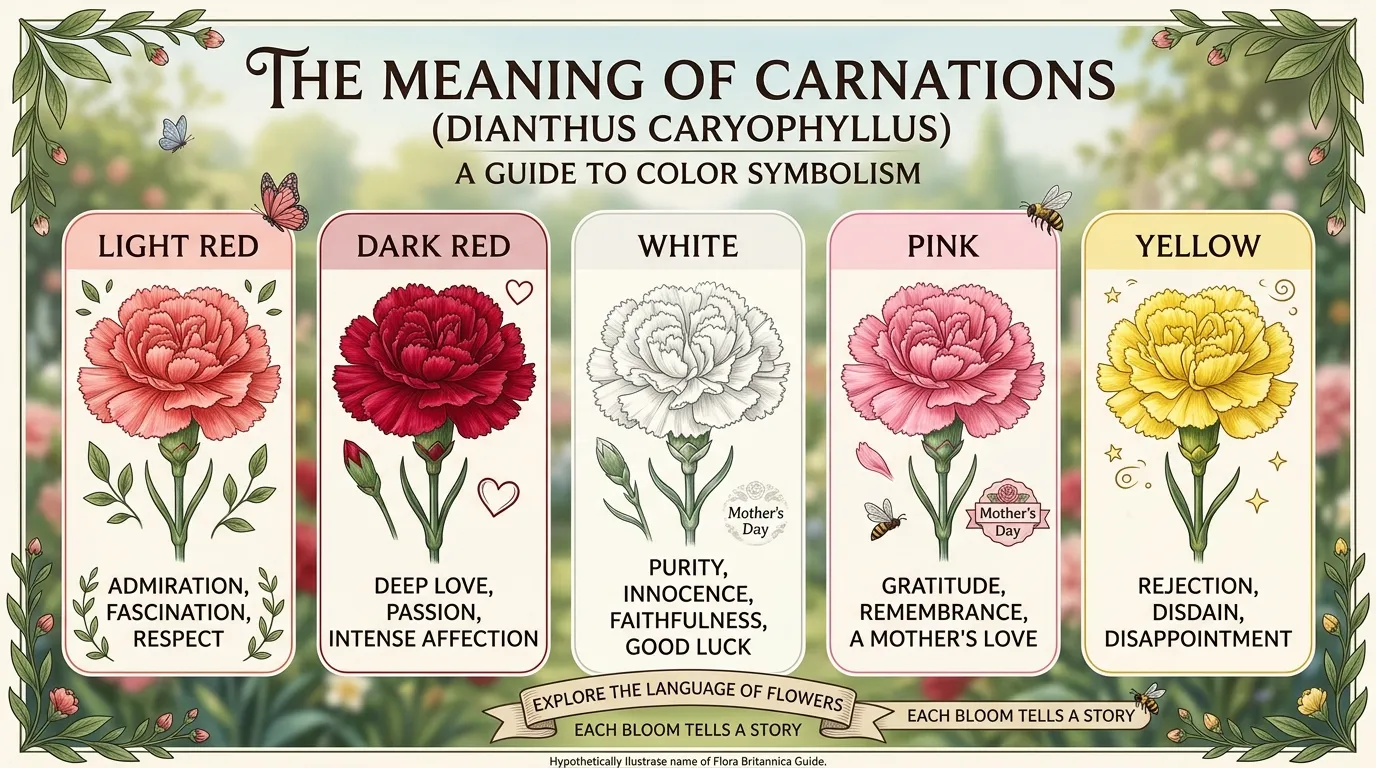
Carnation means love, fascination, and honor. But the real meaning shifts hard by color. This range didn’t come from one source. Greek myth, Christian legend, and Victorian flower books all added layers over time. All of that got stacked onto one tough, long-lasting bloom.
| Flower Color | Dominant Meaning | Best Occasion |
|---|---|---|
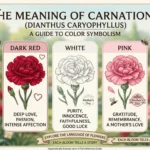
| Red | Deep love, admiration | Anniversaries, Valentine’s Day |
| Pink | A mother’s undying love | Mother’s Day, baby showers |
| White | Pure love, good luck | Weddings, sympathy |
| Yellow | Disappointment, rejection | Avoid for romantic gifts |
| Striped | Regret, “I wish I could be with you” | Handle with care, or skip |
Botanical Foundations & Profile
Carnation’s scientific name is Dianthus caryophyllus. It sits in the pink family, called Caryophyllaceae. The plant is native to the Mediterranean. It likely grew wild first in Greece or nearby land. Its genus name, Dianthus, comes from Greek. Dios means “of Zeus.” Anthos means “flower.” Carnation’s petals have a jagged, zigzag edge. Old cloth-cutters copied that exact edge. That’s how pinking shears got their name and their shape.
| Category | Detail |
|---|---|
| Scientific Classification | Dianthus caryophyllus, family Caryophyllaceae |
| Native Region | Mediterranean region |
| Bloom Period | Late spring through fall |
| Average Lifespan | Perennial: 2–3 years. Cut stem: 2–3 weeks |
| USDA Zones | 6–9 |
| Cultivar Count vs. Wild Species | Over 300 cultivars vs. about 300 wild Dianthus species |
Deep History & Cultural Timeline
Ancient Greeks used carnations in ceremonial garlands. This goes back roughly 2,000 years. They tied the flower to their gods. Carl Linnaeus gave it the formal name Dianthus caryophyllus in 1753. He wrote it in his book Species Plantarum. A later Christian legend claimed pink carnations first bloomed from Mary’s tears. This happened, the story says, at the crucifixion. That gave the flower a new, deeper meaning in medieval Europe. Victorian flower guides picked up carnation in the 1800s. They split its meaning by color, far past one simple message. In 1907, Anna Jarvis chose the white carnation for the first Mother’s Day. That choice locked in its modern American meaning.
Symbolism Deep-Dive
Fascination
Carnation’s ruffled, layered petals catch the eye fast. Victorian readers likely built this meaning right off that look.
Motherly love
Pink carnation ties to the old Mary’s-tears legend. That story gave the color a lasting link to a mother’s love.
Honor
Ancient Greeks and Romans wore carnation crowns for honor. This meaning still shows up in some award and graduation traditions.
Rejection
Yellow carnation earned a bad reputation in Victorian guides. This breaks from the flower’s usual warmth. Give yellow with real care.
Read More about https://bloomsyflower.com/white-flower-meaning/
Color Meanings & Cultural Safety Matrix
Red
- Primary sentiment: Deep love, admiration
- Geographic nuances: In much of the West, red carnation stands in for red roses. It sends a similar message, at a lower cost.
- Gifting warning: A safe, strong choice for romance almost anywhere in Western gift-giving.
Pink
- Primary sentiment: A mother’s undying love
- Geographic nuances: In the U.S., pink carnation holds special weight. It ties straight to Mother’s Day, a tradition running since the early 1900s.
- Gifting warning: Save it for mothers or maternal figures. Its meaning is too specific for a romantic partner.
White
- Primary sentiment: Pure love, good luck
- Geographic nuances: White carnation fits both weddings and funerals in the West, much like white lilies and roses do.
- Gifting warning: Check the occasion first. White can carry a sympathy meaning too.
Yellow
- Primary sentiment: Disappointment, rejection
- Geographic nuances: This negative meaning comes mostly from old Victorian tradition. Most modern gift-givers don’t know it at all.
- Gifting warning: Skip yellow for romance completely. Save it for cheerful, non-romantic gifts, like a get-well card, only if you’re sure the older meaning won’t matter.
Striped
- Primary sentiment: Regret, “I wish I could be with you”
- Geographic nuances: Striped carnation carries one of the odder meanings in flower language. It points to longing, not plain affection.
- Gifting warning: Handle with care. Most people today won’t know this meaning, but skip it for a first romantic gift anyway.
Global Traditions & Literary Impact
Ancient Greek and Roman cultures wove carnations into wreaths and crowns. They honored the flower with a name that means “flower of the gods.” Medieval Christian legend tied pink carnations to Mary’s tears. This gave the flower real religious weight, long before Victorian guides ever touched it. In 1907, American activist Anna Jarvis picked the white carnation for the first Mother’s Day. Pink carnation later became the standard color for honoring living mothers. In South Korea, red and pink carnations play a big role in Parents’ Day. This falls every May 8. Children pin the flowers on their parents’ clothes as a sign of love and respect.
Economic, Culinary, or Medicinal Uses
Carnation petals are edible. Some bakers use them to decorate cakes or infuse sugar. They carry a mild, slightly spicy taste. The plant’s genus, Dianthus, is related to clove. Some carnation types even smell a little like it. Carnation ranks among the most-grown cut flowers in the world. Growers value it heavily for how long it lasts after cutting. There’s no strong modern medical use for it. Old folk remedies once steeped the petals as a mild tonic, but no real science backs that up today.
The Ultimate Etiquette & Gifting Guide
| Relationship / Setting | Recommended Color | The Subtext Sent |
|---|---|---|
| Romantic partner | Red | Deep love and admiration |
| Mother or mother figure | Pink | Undying maternal love |
| Wedding | White | Pure, lasting love |
| Sympathy | White | Peaceful remembrance |
| Graduation or achievement | Any color, formal style | Honor and distinction |
Universal Safety Rule
Skip yellow and striped carnations for romantic gifts. The older, less flattering meanings behind them still exist, even if most people forget them.
Direct Comparison: Carnation vs. Close Lookalikes
| Feature | Carnation (Dianthus caryophyllus) | Sweet William (Dianthus barbatus) | Peony |
|---|---|---|---|
| Petal drop | Holds shape 2–3 weeks as a cut flower | Smaller blooms drop faster, about a week | Petals drop within a week once open |
| Fragrance | Faint, clove-like scent | Sweet, stronger scent than carnation | Rich, sweet, heavier scent |
| Foliage | Thin, grass-like, blue-green leaves | Similar thin, grass-like leaves | Broad, glossy dark green leaves |
| Bloom season | Late spring through fall | Late spring to early summer | Late spring |
| Care needs | Full sun, well-drained soil | Full sun, well-drained soil | Full sun, rich soil |
How to tell them apart
Carnation grows one large bloom per stem. Sweet William, a close cousin, clusters many small blooms in one flat head. Peony has much bigger, softer petals, with no ruffled edge at all.
Practical Maintenance & Domestic Safety
Carnation wants full sun and soil that drains well. Water it often, but skip soggy soil. Wet roots rot fast. Deadhead spent blooms to keep it flowering longer. Cut stems for a vase early in the morning. The plant holds the most water then.
Now, about pets. The ASPCA lists carnation as mildly toxic to cats and dogs. It can cause mild stomach upset. It can also irritate skin a little. This surprises a lot of people, since carnation is such a common, friendly gift. The risk stays low compared to truly dangerous plants like lilies. Still, keep cut carnations out of reach of pets that like to chew on flowers.
Expert Curations & Misconceptions
10 fun facts:
- Dianthus means “flower of the gods” in Greek.
- Carnation’s jagged petal edge inspired pinking shears.
- Ancient Greeks used carnations in ceremonial crowns.
- Pink carnation ties to a Christian legend about Mary’s tears.
- White carnation became the first Mother’s Day flower in 1907.
- Carnation is related to clove, and some types smell like it.
- South Korea marks Parents’ Day with red and pink carnations.
- Cut carnations can last two to three weeks in a vase.
- About 300 wild Dianthus species grow worldwide.
- Yellow carnation carries a rare, negative meaning: disappointment.
Myth vs. reality:
- Myth: Carnation has one simple meaning, like love. Reality: Its meaning shifts sharply by color, from deep love to disappointment.
- Myth: Carnation is fully safe for pets. Reality: The ASPCA lists it as mildly toxic, capable of causing stomach upset and skin irritation.
- Myth: Carnation is a plain filler flower with no real story. Reality: It carries some of the oldest layered symbolism of any common cut flower, going back to ancient Greece.
3 expert tips:
- Cut stems at an angle, early in the morning, for the longest vase life.
- Strip off any leaves that would sit below the waterline. Wet leaves rot fast and shorten vase life.
- Skip yellow or striped carnations for romance, unless you know the recipient won’t mind the old meaning.
High-Value Section
What does the carnation flower mean?
Carnation means love, fascination, and honor overall. The exact message shifts sharply depending on the flower’s color.
Is carnation toxic to cats or dogs?
Yes, mildly. The ASPCA says carnation can cause stomach upset and skin irritation in cats and dogs.
Why is white carnation linked to Mother’s Day?
Anna Jarvis picked the white carnation as the symbol for the first Mother’s Day in 1907. Pink became common soon after.
What does a yellow carnation mean?
Yellow carnation traditionally means disappointment or rejection. That’s a rare negative reading among common gift flowers.
How long do cut carnations last in a vase?
Carnations often last two to three weeks in a vase. That’s among the longest of any common cut flower.
What’s the difference between carnation and Sweet William?
Carnation grows one large bloom per stem. Sweet William clusters many small blooms together in one flat head.
Why does carnation smell like clove?
Carnation belongs to a plant family related to clove. Some types carry a faint version of that same spicy scent.
Is carnation a good wedding flower?
Yes, especially white. It stands for pure, lasting love. It’s also a budget-friendly, long-lasting pick for big arrangements.
What does striped carnation mean?
Striped carnation traditionally means regret. It’s often read as “I wish I could be with you.” Worth knowing before you gift it.
Where does the name “carnation” come from?
Its scientific name, Dianthus, comes from Greek words meaning “flower of the gods.” That ties to its ancient use in ceremonial crowns.
What soil does carnation need?
Carnation wants full sun and soil that drains well. Wet, soggy soil can rot its roots fast.
Do all cultures see carnation the same way?
No. In South Korea, red and pink carnations sit at the center of Parents’ Day. That’s a specific tradition, separate from Western Mother’s Day.
Conclusion
Carnation Flower Meaning its layered meaning through sheer staying power. A flower tough enough to last weeks in a vase also lasted centuries in human tradition. It picked up new meaning from Greek myth, Christian legend, and Victorian flower guides along the way. That’s rare for one simple, ruffled bloom to carry. Few flowers hold this many stories in one small, sturdy shape.

Zahid Abbas is an educator, researcher, and digital publishing strategist behind BloomsyFlower, a flower and gardening resource covering flower meanings, symbolism, history, care, seasonal blooms, and gifting. He combines research with simple, reader-friendly writing to help people understand, grow, and enjoy flowers.