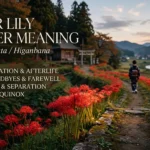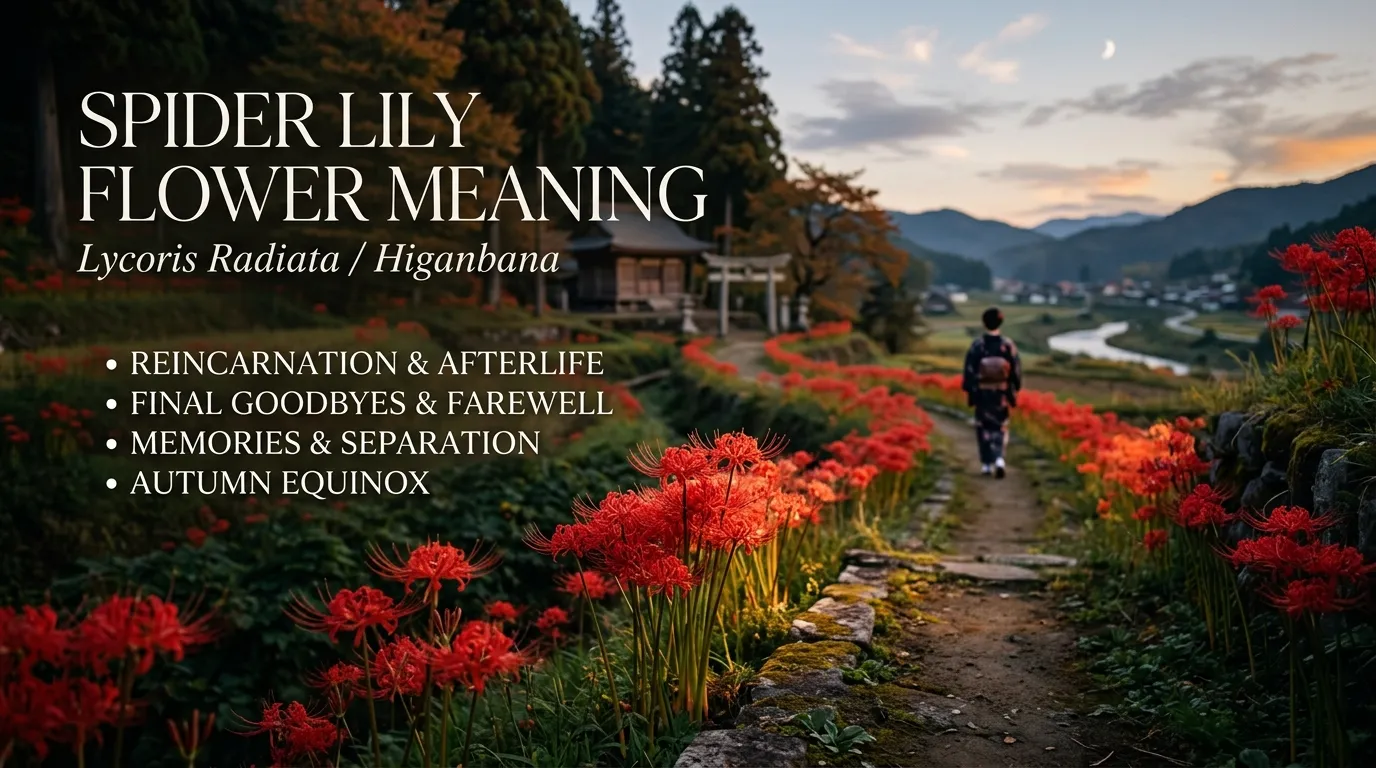
Spider lily does something odd. It blooms with no leaves at all. The leaves grow earlier, in winter. They die back completely before the flower ever appears. So the leaves and the flower never meet. Not once, not ever. In Japan, this strange timing gave the flower a heavy meaning. People call it “higanbana,” or equinox flower. It blooms right around the fall equinox, near old graves and rice fields.
The Definitive Answer Block
Spider lily means final goodbye and loss. Its most common form, the red spider lily, blooms with no leaves in early fall. Old Japanese and Chinese tradition read that leafless bloom as a symbol of separation. The leaves and flower never see each other, so the flower stands for endings that can’t be undone.
| Flower Color | Dominant Meaning | Best Occasion |
|---|---|---|
| Red | Final goodbye, death, lost memory | Memorials, remembrance (use with care) |
| White | Purity, a fresh chance at reunion | Sympathy, quiet remembrance |
| Yellow | Rare, tied to broken promises | Avoid for most gifts |
Botanical Foundations & Profile
Red spider lily has the scientific name Lycoris radiata. It sits in the amaryllis family, called Amaryllidaceae. The plant is native to China. It later spread to Japan and Korea, where it now grows wild along paths and rice paddies. Swedish botanist Carl Peter Thunberg first described the species in 1782. The genus name Lycoris honors a Roman actress from ancient history, not any flower trait at all.
| Category | Detail |
|---|---|
| Scientific Classification | Lycoris radiata, family Amaryllidaceae |
| Native Region | China, naturalized in Japan and Korea |
| Bloom Period | Early fall, around the autumn equinox |
| Average Lifespan | Bulb can live for years; bloom lasts about 1 week |
| USDA Zones | 6–10 |
| Cultivar Count vs. Wild Species | A small number of cultivars vs. about 20 wild Lycoris species |
Deep History & Cultural Timeline
Chinese Buddhist texts named this flower “manjusaha,” found in the Lotus Sutra, a text dating back over 1,000 years. The flower was said to guide the dead through the underworld toward rebirth. Carl Peter Thunberg gave the plant its first formal name in 1782. William Herbert later placed it in the genus Lycoris in 1821, naming the group after Lycoris, a Roman actress and the lover of Mark Antony. In Japan, farmers began planting the bulbs around rice paddies and graves centuries ago. The bulbs are toxic, so they kept rodents and pests away from crops and burial sites alike. That old farming practice is a big reason the flower still clusters near cemeteries in Japan today.
Symbolism Deep-Dive
Final goodbye
The leaves die back before the flower opens. Leaves and bloom never meet. Old tradition reads this as a symbol of two people who never see each other again.
Death and the afterlife
The flower blooms near graves each fall. Buddhist legend says it lines the road to the next life, guiding lost souls along the way.
Lost memory
Some Japanese folklore claims the scent of this flower can make people forget past lives, right before reincarnation.
A fresh start
White spider lily softens the darker red meaning. It reads more as hope for a future reunion than a final loss.
Color Meanings & Cultural Safety Matrix
Red
- Primary sentiment: Final goodbye, death, loss
- Geographic nuances: In Japan and China, red spider lily carries strong ties to funerals and graves. In the West, most people don’t know this meaning at all.
- Gifting warning: Avoid gifting red spider lily to anyone with ties to East Asian culture unless the occasion is a memorial. It can read as a bad omen otherwise.
White
- Primary sentiment: Purity, hope for reunion
- Geographic nuances: White spider lily carries a gentler reading in Japanese tradition, sometimes tied to a hopeful afterlife rather than a final ending.
- Gifting warning: Better suited to quiet remembrance than a bold romantic or celebratory gift.
Yellow
- Primary sentiment: Rare, tied to broken promises
- Geographic nuances: Yellow spider lily is far less common in folklore, so this meaning carries less weight than red or white.
- Gifting warning: Uncommon enough that most florists won’t stock it regularly; skip it for typical gifting.
Global Traditions & Literary Impact
Japanese Buddhist tradition ties the red spider lily to funerals so closely that some older generations still avoid planting it near a home, fearing it invites death. The flower appears often in Japanese anime and film as a visual shorthand for loss, memory, and goodbye, a modern extension of its older folk meaning. In China, the same flower carries the name “manjusaha,” tied to the Lotus Sutra and its story of a flower that blooms on the road between life and death. Farmers across Japan still plant the bulbs along rice paddy borders today, a practical habit passed down from a time before modern pest control existed.
Economic, Culinary, or Medicinal Uses
No part of spider lily is safe to eat. The bulb contains toxic compounds, including one called lycorine. Traditional Chinese medicine has used small, carefully prepared doses of the bulb for specific remedies, but this practice carries real risk and isn’t something to try without expert guidance. The plant’s main practical use in history was pest control, since farmers relied on its toxic bulb to keep rodents and insects away from crops and graves. Today, spider lily is grown almost entirely for its striking look in gardens and floral arrangements.
The Ultimate Etiquette & Gifting Guide
| Relationship / Setting | Recommended Color | The Subtext Sent |
|---|---|---|
| Memorial or funeral | Red | Acknowledging final loss |
| Quiet sympathy gift | White | Gentle remembrance, hope |
| Autumn-themed arrangement | Red or white | A nod to fall and change |
| Romantic gift | Avoid spider lily entirely | Risk of an unintended, somber message |
Universal Safety Rule
Never send red spider lily as a casual or romantic gift. Its strong death symbolism in East Asian culture can send a message you never intended.
Direct Comparison: Spider Lily vs. Close Lookalikes
| Feature | Red Spider Lily (Lycoris radiata) | White Spider Lily (Hymenocallis spp.) | Amaryllis (Hippeastrum spp.) |
|---|---|---|---|
| Petal drop | Thin, curled petals fade within a week | Star-shaped white blooms last about a week | Large blooms last two to three weeks |
| Fragrance | Little to no scent | Sweet, noticeable scent | Little to no scent |
| Foliage | No leaves present when it blooms | Strap-like leaves present at bloom time | Broad leaves present at bloom time |
| Bloom season | Early fall | Summer | Winter, often forced indoors |
| Care needs | Full sun, well-drained soil | Full sun to part shade, moist soil | Bright indoor light, moderate water |
How to tell them apart
Red spider lily has thin, spidery, curled petals and no leaves at bloom time. White spider lily, a different genus entirely, has broader star-shaped petals and green leaves present. Amaryllis has large, trumpet-shaped blooms and thick, upright leaves.
Practical Maintenance & Domestic Safety
Spider lily grows best in full sun with soil that drains well. Plant the bulbs in late summer for a fall bloom. Water them right after planting, then let the soil dry out between waterings once the plant is established. The leaves appear after the flower fades, staying green through winter before dying back in spring.
On pet safety, spider lily deserves serious caution. The ASPCA lists Lycoris species as toxic to cats and dogs. The bulb holds the highest concentration of toxic compounds, and eating it can cause vomiting, drooling, and stomach pain. Keep the bulbs, in particular, well out of reach of pets, especially during planting or digging season when they sit exposed in loose soil.
Expert Curations & Misconceptions
10 fun facts:
- Spider lily blooms with no leaves; the leaves grow separately, months apart.
- The Japanese name “higanbana” means “equinox flower.”
- Farmers once planted spider lily bulbs to keep rodents away from graves and crops.
- The genus Lycoris is named after a Roman actress, not a flower trait.
- Carl Peter Thunberg first described the species in 1782.
- The flower is called “manjusaha” in the Lotus Sutra, a major Buddhist text.
- Spider lily bulbs contain a toxic compound called lycorine.
- The flower often appears in Japanese anime as a symbol of death or memory.
- There are about 20 wild Lycoris species worldwide.
- Spider lily naturalized so widely in Japan that many assume it’s native there.
Myth vs. reality:
- Myth: Spider lily is native to Japan. Reality: It’s native to China and later naturalized across Japan and Korea.
- Myth: All “spider lily” flowers belong to one genus. Reality: The white spider lily, genus Hymenocallis, is a completely different plant from red spider lily, genus Lycoris.
- Myth: Spider lily is just a spooky-looking garden flower with no real toxicity. Reality: The ASPCA lists it as toxic to cats and dogs, with real risk from the bulb.
3 expert tips:
- Plant bulbs in late summer, about 5 inches deep, for a reliable fall bloom.
- Wear gloves when handling the bulbs, since the sap can mildly irritate skin.
- Avoid planting spider lily near a vegetable garden if pets or children dig in the soil.
High-Value Section
What does the spider lily flower mean?
Spider lily means final goodbye and loss, tied to its leafless bloom and its long history in Japanese and Chinese funeral tradition.
Why is spider lily linked to death?
The flower blooms near graves each fall, and Buddhist legend says it guides lost souls on the road to the afterlife.
Is spider lily toxic to cats or dogs?
Yes. The ASPCA lists Lycoris species as toxic, and the bulb can cause vomiting, drooling, and stomach pain if eaten.
Why doesn’t spider lily have leaves when it blooms?
The leaves grow earlier in the year and die back completely before the flower opens, so the two never appear at the same time.
Is it bad luck to plant spider lily near a house?
Some older Japanese tradition holds this belief, tied to the flower’s strong funeral association, though it’s not a universal or modern rule.
What’s the difference between red spider lily and white spider lily?
They’re different genera entirely. Red spider lily is Lycoris radiata, while white spider lily is Hymenocallis, a separate plant with leaves present at bloom time.
Can I grow spider lily in my garden?
Yes, in USDA zones 6–10. Plant the bulbs in late summer, in full sun, for a reliable early fall bloom.
Why is spider lily called “higanbana” in Japan?
The name means “equinox flower,” since it blooms almost exactly around the autumn equinox each year.
Is spider lily used in any traditional medicine?
Traditional Chinese medicine has used small, carefully prepared doses of the bulb, but this carries real risk and isn’t a safe home remedy.
Does spider lily appear in Japanese pop culture?
Yes, often. Anime and film use it as a symbol of memory loss, death, or a final goodbye, drawing on its older folk meaning.
What soil does spider lily need?
It wants full sun and soil that drains well; the bulb can rot if left in constantly wet ground.
Is spider lily a good gift for a memorial?
Yes, red spider lily fits a memorial setting well in cultures that recognize its meaning, though it’s not a typical Western sympathy flower.
Conclusion
Spider Lily Flower Meaning rests on a single, strange fact of biology. Its leaves and its flower never share the same season, never meet at all. Old tradition turned that quiet separation into one of the most direct death symbols in any flower’s story. From Buddhist scripture to modern anime, that leafless fall bloom still carries the same weight it always has. Some goodbyes, it seems, really are final.

Zahid Abbas is an educator, researcher, and digital publishing strategist behind BloomsyFlower, a flower and gardening resource covering flower meanings, symbolism, history, care, seasonal blooms, and gifting. He combines research with simple, reader-friendly writing to help people understand, grow, and enjoy flowers.