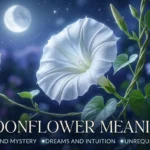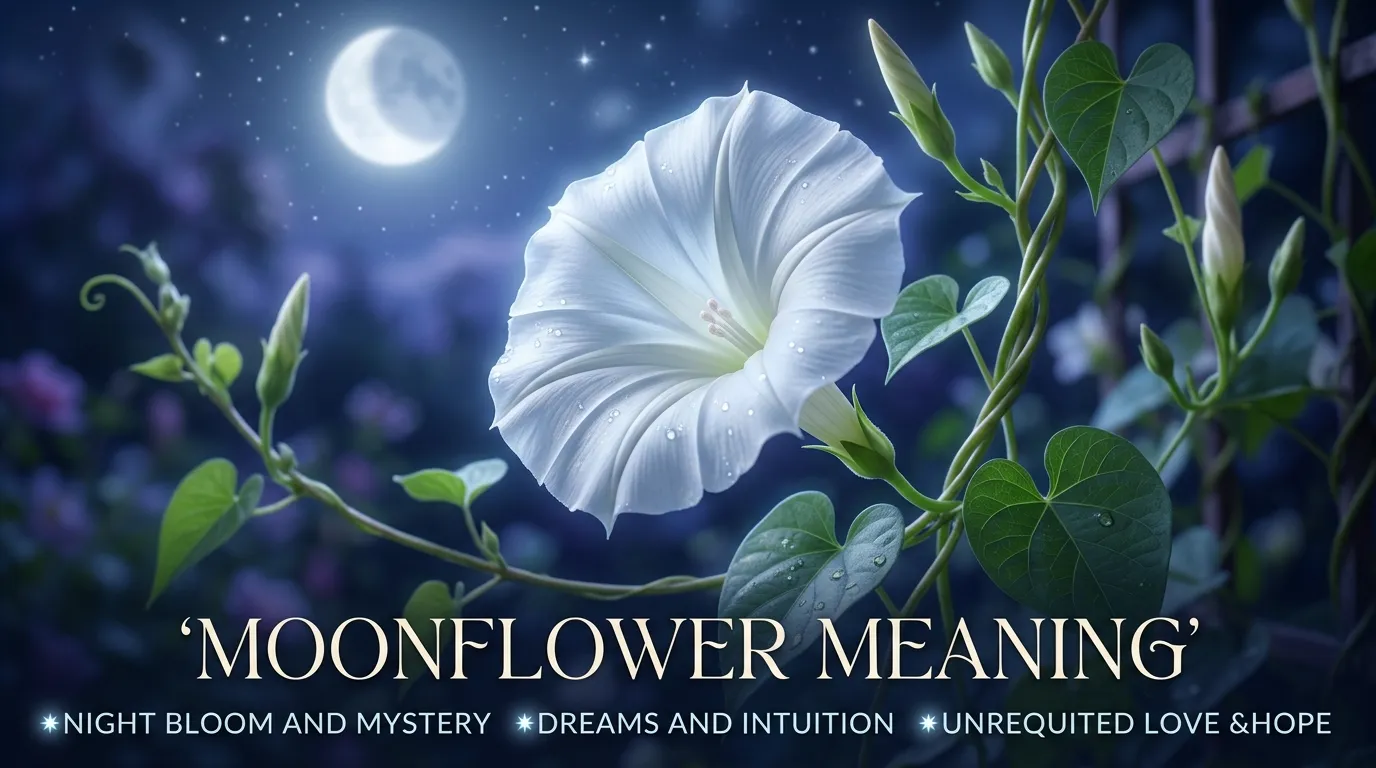
Moonflower opens fast. Really fast. Watch one at dusk. You can see the bloom unfurl in real time. It looks like a small firework, but slow. It’s done within minutes. The flower opens just once. It glows white through the night. Then it closes for good by late morning. One moth loves this timing. The hawk moth flies at night. It can’t resist the flower’s sweet scent. That one-night bloom is the whole reason moon flower means what it means.
The Definitive Answer Block
Moonflower means dreams, mystery, and a love that only shows at night. This meaning comes straight from real biology. The flower opens after sunset. It closes by morning. It blooms just once, ever, for a single night.
| Flower Color | Dominant Meaning | Best Occasion |
|---|---|---|
| White | Mystery, purity, nighttime devotion | Evening gardens, romantic gifts |
| Pale Yellow (rare) | Quiet hope, gentle change | Thoughtful, low-key gifts |
Botanical Foundations & Profile
True moonflower has the scientific name Ipomoea alba. It sits in the morning glory family, called Convolvulaceae. Sweet potato belongs to this same family. The plant is native to tropical parts of the Americas. It grows from Argentina up through Mexico and into the southern U.S. Moon flower grows as a fast climbing vine. It can reach ten feet or more in one season.
| Category | Detail |
|---|---|
| Scientific Classification | Ipomoea alba, family Convolvulaceae |
| Native Region | Tropical and subtropical Americas |
| Bloom Period | Summer through early fall |
| Average Lifespan | Grown as an annual in most places; each bloom lasts one night |
| USDA Zones | 10–11 outdoors; grown as an annual elsewhere |
| Vine Length | Often 10–15 feet in one growing season |
Deep History & Cultural Timeline
Moonflower grows wild across the tropical Americas. People there long noticed its odd, one-night bloom. European botanists gave the plant its formal name, Ipomoea alba. That placed it in the same genus as morning glory and sweet potato. Victorian gardeners in the 1800s grew moon flower in “night gardens.” They planted it beside other pale, sweet-smelling blooms, meant to enjoy after dark. Gardeners also noticed its strong pull on hawk moths. These are large night pollinators that hover like tiny hummingbirds while they feed. Gardeners still plant moon flower on trellises and porches today, for that same reason.
Symbolism Deep-Dive
Mystery. Moonflower blooms only after dark, hidden from view all day. That vanishing act made it a natural symbol for secrets.
Dreams. The flower’s pale white color and night-only bloom gave it a dreamlike feel, tied to a world that shows up only after dark.
Devotion. Each bloom lasts just one night before it closes forever. Some readings tie that short, intense bloom to a love that gives everything, even once.
Renewal. New blooms open fresh each evening, night after night, all season long. That daily return gave it a small link to constant renewal.
Color Meanings & Cultural Safety Matrix
White
- Primary sentiment: Mystery, purity, nighttime devotion
- Geographic nuance: No strong split by region here. White carries a steady “mystery and purity” reading wherever moonflower is grown.
- Gifting note: A safe, striking choice for a romantic or reflective gift, especially for an evening event.
Pale Yellow (rare cultivars)
- Primary sentiment: Quiet hope, gentle change
- Geographic nuance: Yellow moonflower is rare and mostly a modern breeding choice, without old folklore behind it.
- Gifting note: A soft, low-key pick if plain white feels too bold.
Global Traditions & Literary Impact
Victorian gardeners built whole “night gardens” around pale, fragrant, dark-blooming plants like moonflower. People walked through them after dinner, not during the day. In tropical parts of the Americas, where moonflower grows wild, its dramatic night bloom made it a favorite for porches and trellises. That’s where people tend to gather in the evening. Modern garden writers often call moonflower the perfect plant for a summer evening space. It blooms right as guests arrive after sunset. The flower’s fast, visible unfurling is also a favorite subject for time-lapse videos online.
A Critical Safety Note: Moonflower vs. Datura
This part matters. Two very different plants share the name “moonflower.” One is Ipomoea alba, the climbing vine in this guide. The other is Datura, sometimes called devil’s trumpet or jimsonweed. Datura comes from a totally different plant family, called Solanaceae. Datura is seriously toxic. It can cause severe illness or even death if eaten in real quantity. Ipomoea alba is much milder. Its seeds still carry some risk if eaten in large amounts, but nowhere near Datura’s level. The two plants do look alike at a glance. Both grow large white trumpet blooms. But Datura’s flowers sit low to the ground. True moonflower climbs as a vine instead. Datura’s seed pods are round and covered in spikes. Moonflower’s pods stay smooth and round. If you buy “moonflower” seeds, always check the scientific name first.
The Ultimate Etiquette & Gifting Guide
| Relationship / Setting | Recommended Use | The Subtext Sent |
|---|---|---|
| Romantic partner | White moonflower bouquet or vine gift | A love that reveals itself slowly |
| Evening garden party host | Potted moonflower vine | A thoughtful, atmospheric gift |
| Someone going through change | Moonflower seeds | Quiet hope, a fresh, private start |
| Reflective or artistic friend | White moonflower print or bouquet | An appreciation for mystery |
Universal Safety Rule
If you gift live moonflower seeds or plants, confirm they’re true Ipomoea alba, not Datura. This matters most if the recipient has pets or young kids at home.
Direct Comparison: Moonflower vs. Close Lookalikes
| Feature | Moonflower (Ipomoea alba) | Datura (Datura spp.) | Evening Primrose (Oenothera spp.) |
|---|---|---|---|
| Growth habit | Climbing vine, needs support | Low, bushy shrub, no climbing | Low or upright, no climbing |
| Bloom shape | Large, wide trumpet | Deeper, narrower trumpet | Small, cup-shaped bloom |
| Seed pods | Smooth, rounded | Round, covered in spikes | Small, slim capsules |
| Leaves | Heart-shaped | Arrow-shaped | Narrow, lance-shaped |
| Toxicity | Mild; seeds carry the most risk | Severe; every part is dangerous | Non-toxic, sometimes eaten |
How to tell them apart
True moonflower climbs, so it needs a trellis or fence. Datura grows low, with no climbing habit at all. Evening primrose stays much smaller, with a simple cup-shaped bloom instead of a deep trumpet.
Practical Maintenance & Domestic Safety
Moonflower wants full sun and soil that drains well. Give it something to climb, like a trellis or fence. The vine grows fast and heavy through summer. Water it often, especially in hot, dry weather. Soak the seeds overnight before planting, to help them sprout faster. The vine dies back at first frost in most places. Gardeners outside zones 10–11 grow it fresh from seed each year.
Now, about pets. Treat moonflower with real care. Treat any plant sold as “moonflower” with extra care too, until you know the species. True Ipomoea alba seeds carry mild toxins. Eating a large number can cause an upset stomach or a racing heart. That risk sits far below Datura’s, but it’s still real, especially for a small pet chewing on fallen seed pods. Keep seeds picked up and out of reach. Never assume a “moon flower” plant is the safer type without checking its name first.
Expert Curations & Misconceptions
10 fun facts:
- Moonflower blooms can fully open in under an hour.
- Each single bloom lasts for just one night.
- Hawk moths are moonflower’s main night pollinator.
- Moonflower shares a family with sweet potato.
- The vine can grow 10 to 15 feet in one summer.
- Moonflower seeds float in water for over a year.
- Victorian gardeners built “moon gardens” around plants like this one.
- “Moonflower” is also a name for the unrelated, more dangerous Datura.
- Moonflower grows wild from Argentina to the southern U.S.
- The flower’s scent grows stronger specifically after dark.
Myth vs. reality:
- Myth: Moonflower and Datura are the same plant. Reality: They’re different genera, from different plant families, with very different toxicity.
- Myth: True moonflower is fully harmless. Reality: Its seeds carry mild toxins and should stay away from pets and kids.
- Myth: Moonflower is rare and hard to grow. Reality: It’s a fast, easy annual vine, often blooming within a few months.
3 expert tips:
- Soak moonflower seeds overnight, or scratch their tough coat lightly, to help them sprout faster.
- Plant moonflower where you’ll sit in the evening, like near a porch, to enjoy the bloom.
- Always check the scientific name on any “moonflower” seed packet, to avoid buying Datura by mistake.
High-Value Section
What does the moonflower mean?
Moon flower means dreams, mystery, and a devotion that shows itself only at night, tied to its one-night bloom.
Is moonflower toxic to pets?
True Ipomoea alba carries mild toxins, mostly in the seeds. It’s far less risky than Datura, but still worth keeping from curious pets.
Is moonflower the same as Datura?
No. They’re different genera from different plant families. Datura is far more toxic. They just share the common name.
How long does a single bloom last?
Just one night. The flower opens at dusk and closes for good the next morning.
What pollinates moonflower?
Hawk moths are its main pollinator, drawn in by the flower’s strong, sweet scent after dark.
Can I grow moonflower where I live?
Yes, almost anywhere. It’s only a true perennial in zones 10–11. Elsewhere, growers plant it fresh from seed each year.
How fast does moonflower grow?
Very fast. The vine can reach 10 to 15 feet in one season, given a trellis or fence to climb.
What’s the difference between moonflower and evening primrose?
Moonflower is a tall vine with large trumpet blooms. Evening primrose stays much smaller, with simple cup-shaped flowers.
Why does moonflower open so fast?
The bloom reacts fast to falling light at dusk. It unfurls within minutes as the sun goes down.
Is moon flower a good gift for a garden lover?
Yes, especially as seeds or a young potted vine. It rewards patience with a dramatic evening show.
Does moonflower smell strong?
Yes, a strong, sweet scent that grows stronger after dark, meant to draw in night moths.
How do I tell if a “moonflower” is really Datura?
Check if it climbs. True moonflower is a vine. Datura grows low and bushy, with spiky seed pods.
Conclusion
Moonflower Meaning earns its meaning through pure timing. A bloom that opens once, glows for a single night, and closes forever by morning became a symbol for dreams and hidden love. That fast, visible bloom still stops people mid-conversation on a summer evening. It’s done the same thing to gardeners and moths for centuries. Some things really are only meant to be seen once, and moonflower seems to know it.

Zahid Abbas is an educator, researcher, and digital publishing strategist behind BloomsyFlower, a flower and gardening resource covering flower meanings, symbolism, history, care, seasonal blooms, and gifting. He combines research with simple, reader-friendly writing to help people understand, grow, and enjoy flowers.