An exiled English prince once picked this flower as his badge. That was in 1398. His name was Henry Bolingbroke. King Richard II had banished him. Henry wore the small blue bloom the whole time he was away. He kept it as his symbol even after he came home. In 1399, he returned and took the throne. He became King Henry IV. That tiny flower rode along with him the whole way. It was even stitched into his royal collar.
The Definitive Answer Block
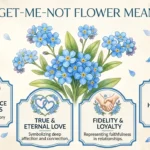
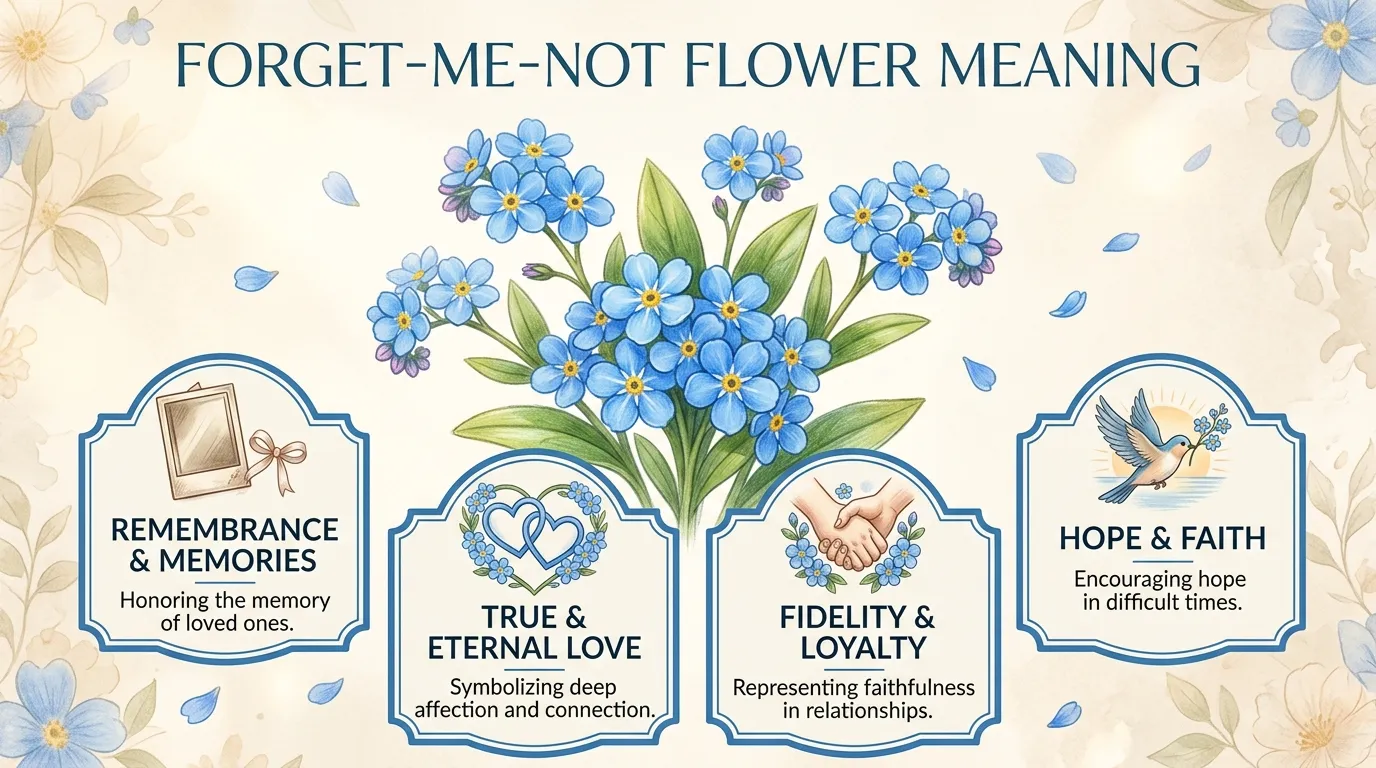
Forget-me-not means true love and lasting memory. The name says it all. Medieval Europeans already linked the flower to loyalty. This happened even before it got its now-famous English name.
| Flower Color | Dominant Meaning | Best Occasion |
|---|---|---|
| Blue | True love, remembrance | Memorials, anniversaries |
| Pink | Loyalty, quiet devotion | Thank-you gifts |
| White | Purity, gentle memory | Sympathy, christenings |
Botanical Foundations & Profile
Forget-me-not has the scientific name Myosotis. It sits in the borage family, called Boraginaceae. The name comes from Greek. Mys means “mouse.” Otos means “ear.” Early botanists thought the small leaves looked like a mouse’s ear. The most common type, Myosotis sylvatica, grows wild across Europe and Asia. It now grows across North America too.
| Category | Detail |
|---|---|
| Scientific Classification | Myosotis sylvatica and related species, family Boraginaceae |
| Native Region | Europe and Asia, naturalized in North America |
| Bloom Period | Mid to late spring |
| Average Lifespan | Perennial, though often grown as a self-seeding biennial |
| USDA Zones | 3–8 |
| Cultivar Count vs. Wild Species | Dozens of cultivars vs. about 50 wild species |
Deep History & Cultural Timeline
A German legend tells of a knight by the Danube River. He picked blue flowers for his lady. Then he fell into the water. As the current swept him away, he threw her the flowers. He called out, “Forget me not!” Historians can’t confirm this exact story ever happened. But 15th-century German poets did use the flower as a symbol of loyalty. Henry Bolingbroke picked the flower as his badge in 1398. He kept it after he became King Henry IV in 1399. In the 20th century, forget-me-not became a symbol too. The Alzheimer’s Society in Britain now uses it for memory awareness.
Symbolism Deep-Dive
True love
The name alone asks to be remembered. So it became shorthand for love that doesn’t fade with time or distance.
Remembrance
Alzheimer’s charities now use this flower as their symbol. That’s a modern spin on its older meaning about memory.
Loyalty
Henry Bolingbroke wore the flower during his exile. That gave it a lasting tie to steady, loyal support.
Fidelity
Old writers already linked the color blue to faithfulness. This small blue bloom picked up that meaning fast.
Color Meanings & Cultural Safety Matrix
Blue
- Primary sentiment: True love, remembrance
- Geographic nuances: Blue is the natural, most common color. It carries the oldest, strongest meaning across Europe.
- Gifting warning: A safe choice for memorials, anniversaries, or any gift about lasting connection.
Pink
- Primary sentiment: Loyalty, quiet devotion
- Geographic nuances: Pink forget-me-not is a rarer garden type. It carries less old folklore than classic blue.
- Gifting warning: Good for a thank-you gift. Less common for a memorial.
White
- Primary sentiment: Purity, gentle memory
- Geographic nuances: White fits general Western purity traditions well. It doesn’t carry a strong regional split.
- Gifting warning: A gentle choice for sympathy or a christening gift.
Global Traditions & Literary Impact
German poets in the 1400s used forget-me-not as a token of loyalty. The flower shows up in paintings from that century too. Henry Bolingbroke’s use of the flower marks its first English record. He paired it with an Old French motto. It meant “remember me.” In modern Germany, this flower honors fallen soldiers from both World Wars. It plays a role much like the remembrance poppy in Britain. The Alzheimer’s Society in Britain, New Zealand, and the Netherlands now uses forget-me-not as its symbol. That’s a direct, modern link between the flower and human memory.
Economic, Culinary, or Medicinal Uses
No one cooks with forget-me-not today. It’s not a food plant. Old healers once used the whole plant on wounds and eye infections. They also used it for lung trouble and nosebleeds. Modern herbalists don’t rely on these old uses. There isn’t much real research behind them. Today, people grow this flower just for its looks. It fills gardens with a dense, early carpet of small blue blooms.
The Ultimate Etiquette & Gifting Guide
| Relationship / Setting | Recommended Color | The Subtext Sent |
|---|---|---|
| Memorial or remembrance gift | Blue | Lasting memory, love |
| Long-distance relationship | Blue | “I won’t forget you” |
| Thank-you gift | Pink | Quiet loyalty, gratitude |
| Sympathy or christening | White | Gentle, pure remembrance |
| Alzheimer’s awareness event | Blue | Support for memory and care |
Universal Safety Rule
Forget-me-not works well across most Western cultures. Remembrance is a message almost everyone understands. Just know its strong tie to Alzheimer’s charities before you use it in that context by accident.
Direct Comparison: Forget-Me-Not vs. Close Lookalikes
| Feature | Forget-Me-Not (Myosotis sylvatica) | Bluebell (Hyacinthoides spp.) | Speedwell (Veronica spp.) |
|---|---|---|---|
| Petal drop | Tiny blooms drop slowly over weeks | Bell flowers drop after about 2 weeks | Small flowers drop fast, often in days |
| Fragrance | Faint or none | Light, sweet scent | Little to no scent |
| Foliage | Small, soft, mouse-ear leaves | Long, glossy, strap-like leaves | Narrow, slightly toothed leaves |
| Bloom season | Mid to late spring | Mid spring | Spring through summer |
| Care needs | Partial shade, moist soil | Partial to full shade, moist soil | Full sun to part shade |
How to tell them apart
Forget-me-not has tiny, flat, five-petal flowers in loose clusters. Bluebell has drooping, bell-shaped flowers on one stalk. Speedwell has small, four-petal flowers with a thin stripe pattern.
Practical Maintenance & Domestic Safety
Forget-me-not likes partial shade and soil that stays moist. Water it often, especially in dry spring weather. It naturally grows near riverbanks in the wild. Let a few blooms go to seed if you want the patch to spread next year. Cut back spent flowers to keep the plant tidy.
Now, about pets. Forget-me-not is one of the safer garden flowers. The ASPCA lists true forget-me-not, Myosotis sylvatica, as non-toxic to cats and dogs. One plant to watch for is Chinese forget-me-not, Cynoglossum amabile. That’s a different plant. It carries mild risk for livestock in large amounts. If you buy “forget-me-not” for a home with pets, check that it’s Myosotis, not Cynoglossum.
Expert Curations & Misconceptions
10 fun facts:
- Myosotis means “mouse ear” in Greek.
- King Henry IV wore forget-me-not as his badge starting in 1398.
- His motto with the flower meant “remember me.”
- The famous drowning-knight story can’t be confirmed as real history.
- Forget-me-not is the Alzheimer’s Society’s symbol in Britain.
- Germany uses the flower to honor fallen soldiers from both World Wars.
- About 50 wild Myosotis species grow worldwide.
- This plant naturally favors riverbanks and damp, shaded ground.
- Forget-me-not appears in paintings from the 1400s.
- Alaska adopted a forget-me-not as its state flower.
Myth vs. reality:
- Myth: The German drowning-knight legend is real medieval history. Reality: Historians call it a folk story, with no confirmed record from that time.
- Myth: All plants called “forget-me-not” are safe for pets. Reality: True Myosotis is safe. Chinese forget-me-not, a different plant, carries mild risk for livestock.
- Myth: Forget-me-not only means romance. Reality: It carries just as much weight in memory and remembrance causes today.
3 expert tips:
- Plant it where it gets morning sun and afternoon shade. This gives the longest bloom time.
- Let some flowers go to seed each year. The plant spreads on its own and fills bare spots.
- Divide crowded clumps every couple of years. This keeps the display full and healthy.
High-Value Section
What does the forget-me-not flower mean?
Forget-me-not means true love and lasting memory. Its own name carries the whole message.
Is forget-me-not toxic to cats or dogs?
No. The ASPCA lists true forget-me-not, Myosotis sylvatica, as non-toxic to both cats and dogs.
Where does the forget-me-not legend come from?
A German legend tells of a drowning knight who tossed flowers to his love. Historians can’t confirm the story as real history.
Why did King Henry IV use forget-me-not as his symbol?
He picked it in 1398 during his exile. He kept it as his badge after becoming king in 1399.
Is forget-me-not linked to Alzheimer’s awareness?
Yes. It’s the official symbol of Alzheimer’s groups in Britain, New Zealand, and the Netherlands. That ties to its older meaning around memory.
What’s the difference between forget-me-not and bluebell?
Forget-me-not has tiny, flat, five-petal flowers in loose clusters. Bluebell has drooping bell-shaped flowers on one stalk.
Can I grow forget-me-not in my garden?
Yes, easily. It likes partial shade and moist soil. It often self-seeds and spreads on its own each year.
Why is forget-me-not blue?
Its blue color ties to old symbolism. Writers in the Middle Ages already linked blue to faithfulness.
Is Chinese forget-me-not the same plant?
No. Chinese forget-me-not is a different genus. It carries mild risk for livestock, unlike true Myosotis.
What soil does forget-me-not need?
It wants soil that stays moist. The plant naturally favors damp, shaded ground near rivers.
How long does forget-me-not bloom?
It blooms for several weeks in mid to late spring. Cool, shaded spots can stretch that even longer.
Is forget-me-not a good sympathy flower?
Yes, especially white or blue types. Its core meaning of remembrance fits a sympathy gift naturally.
Conclusion
Forget-Me-Not Flower Meaning carries its whole meaning in three simple words. A small blue flower, easy to overlook, became a badge for an exiled prince. Six centuries later, it became a symbol for memory-loss charities too. Both uses point to the same quiet idea. Something small can still ask to be remembered. That request has traveled from an old river legend all the way to a modern hospital bedside. It still means exactly what it says.

Zahid Abbas is an educator, researcher, and digital publishing strategist behind BloomsyFlower, a flower and gardening resource covering flower meanings, symbolism, history, care, seasonal blooms, and gifting. He combines research with simple, reader-friendly writing to help people understand, grow, and enjoy flowers.