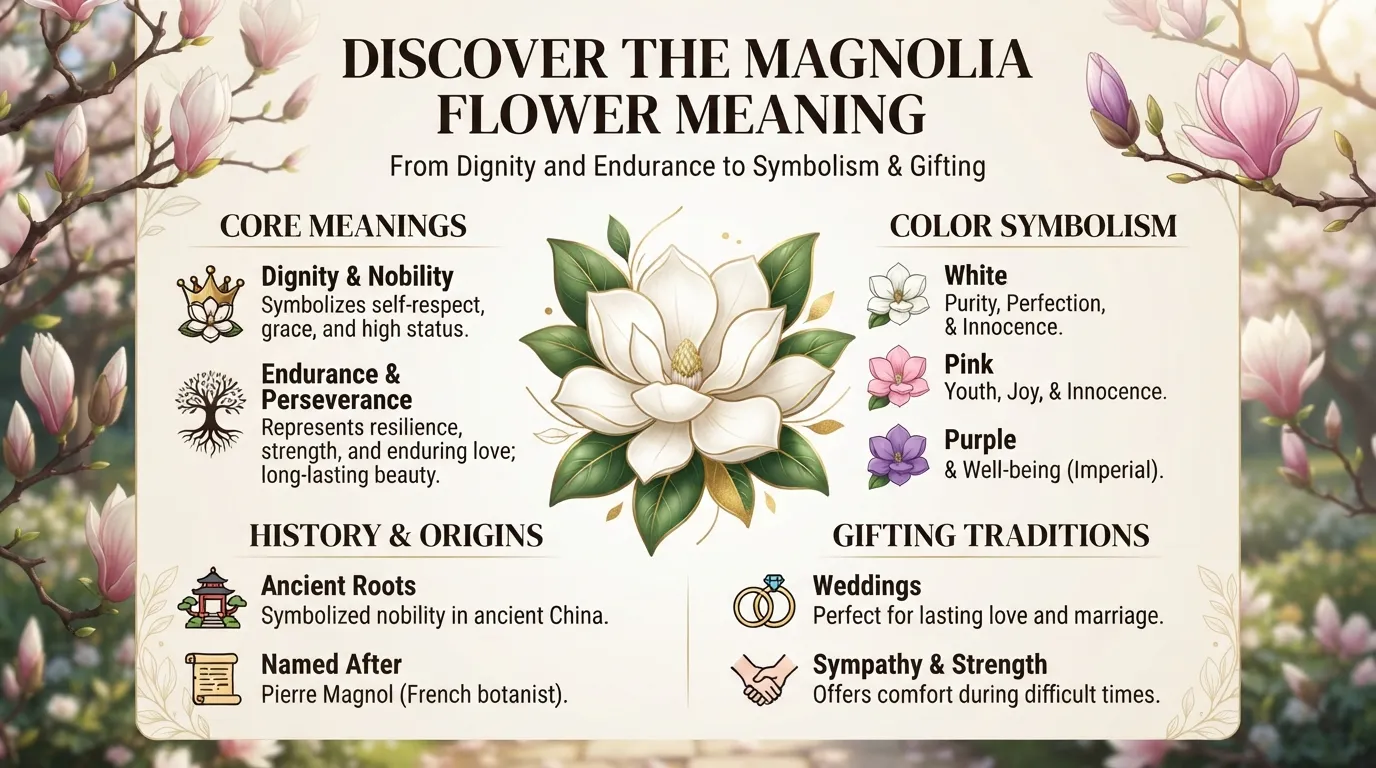
The magnolia flower means love of nature, dignity, and lasting beauty. It also stands for strength and quiet grace. People give magnolia to show deep respect and pure, steady love.
Origin of the Name
The word “magnolia” comes from the name Pierre Magnol. He was a French botanist who lived in the 1600s and 1700s. In 1703, another botanist named the flower after him to honor his work in plant science.
Magnolia in Victorian Flower Language
In Victorian times, the magnolia stood for love of nature and dignity. Giving someone a magnolia showed deep respect. Its large, strong blooms felt noble and calm, so people used it to send a message of quiet honor rather than loud passion.
Botanical Foundations & Profile
| Feature | Detail |
|---|---|
| Scientific Name | Magnolia grandiflora (and other Magnolia species) |
| Native Region | East Asia and eastern North America |
| Bloom Period | Spring, with some types blooming into summer |
| Average Lifespan | Trees can live 80 to 120 years |
| USDA Zones | Zones 4 through 9, depending on species |
| Species Count | About 210 to 340 species |
History & Cultural Timeline
- Magnolia fossils show this plant lived over 20 million years ago, long before bees existed.
- Early magnolia flowers were pollinated by beetles, not bees, since bees had not yet evolved.
- In 1703, French botanist Charles Plumier named the genus Magnolia after Pierre Magnol.
- Magnolia trees became popular in Southern American gardens by the 1700s and 1800s.
Also read more about: https://bloomsyflower.com/moonflower-meaning/
Symbolism Deep-Dive
Dignity
Magnolia flowers are large, smooth, and calm in shape. They do not need bright colors to stand out. This quiet strength is why the flower means dignity and self-respect.
Endurance
Magnolia trees are ancient. They survived millions of years of change on Earth. This long history makes the flower a symbol of endurance through hard times.
Nobility
Magnolia blooms often grow high on strong branches, standing above other plants. Their tall, proud shape has long linked the flower to nobility and high honor.
Meaning by Color
| Color | Meaning |
|---|---|
| White | Purity, dignity, and perfection |
| Pink | Gentleness, youth, and joy |
| Purple | Wealth, nobility, and admiration |
| Yellow | Warmth, friendship, and good luck |
Color Meanings & Cultural Safety Matrix
White Magnolia
- Primary sentiment: Purity, dignity, and quiet grace.
- Geographic nuances: In the Southern United States, white magnolia is deeply tied to genteel tradition and hospitality. In parts of Asia, white flowers can also connect to mourning.
- Gifting warning: Check local customs before gifting white magnolia at a celebration in some Asian communities.
Pink Magnolia
- Primary sentiment: Gentle joy and youthful beauty.
- Geographic nuances: In China, pink magnolia often marks feminine beauty and new beginnings.
- Gifting warning: A safe, cheerful choice for birthdays and new beginnings.
Purple Magnolia
- Primary sentiment: Wealth, nobility, and deep admiration.
- Geographic nuances: In parts of Asia, purple flowers are linked to royalty and high status.
- Gifting warning: Best for formal or respectful occasions, not casual gifts.
Yellow Magnolia
- Primary sentiment: Warmth, friendship, and good fortune.
- Geographic nuances: In the West, yellow often means cheerful friendship. In parts of Asia, yellow can also mean prosperity.
- Gifting warning: Avoid for sad events, as bright yellow can feel out of place.
Global Traditions & Literary Impact
In the Southern United States, the magnolia tree is a cherished symbol of grace and hospitality. Many old homes and gardens across states like Louisiana and Mississippi feature large magnolia trees, often planted generations ago and passed down as a family tradition.
In literature, the magnolia appears in The Awakening by Kate Chopin, published in 1899, where Southern flowers like magnolia help set the story’s warm, humid setting. Please double-check this literary reference, as I cannot search a live database and details may be inaccurate.
Economic, Culinary, and Medicinal Uses
In parts of Asia, magnolia bark is used in traditional herbal remedies, often believed to help with calm sleep and digestion. Magnolia flowers are sometimes pickled or used in tea in Japanese and Chinese cooking. Always check with a doctor or herbal expert before using any plant for health purposes, since safe use can depend on the person and preparation method.
Ultimate Etiquette & Gifting Guide
| Relationship | Recommended Color | The Subtext |
|---|---|---|
| Respected Elder | White | “I honor your wisdom and grace.” |
| Close Friend | Pink | “Your friendship brings me joy.” |
| Business Partner | Purple | “I deeply respect your success.” |
| New Neighbor | Yellow | “Welcome, I’m glad you’re here.” |
Universal Safety Rule
Always pick fresh, locally grown magnolia blooms, and pair the gift with a short note so your intended message stays clear.
Magnolia vs. Close Lookalikes
| Feature | Magnolia | Camellia | Tulip Tree (Liriodendron) |
|---|---|---|---|
| Petal Shape | Large, thick, waxy petals | Rounded, layered petals | Tulip-shaped, thinner petals |
| Fragrance | Strong, sweet, lemony scent | Little to no scent | Faint, mild scent |
| Foliage | Broad, glossy, leathery leaves | Glossy, dark green leaves | Leaves shaped like a tulip outline |
| Bloom Season | Spring into early summer | Winter through spring | Late spring |
| Growth Style | Grows as a tree or large shrub | Grows as a shrub | Grows as a tall tree |
How to tell them apart
Feel the petals. Magnolia petals feel thick and waxy. Camellia petals feel thin and smooth like silk.
Practical Maintenance & Domestic Safety
Care Basics
- Plant magnolia in full sun to partial shade.
- Use well-drained, slightly acidic soil.
- Water young trees regularly; established trees need less care.
- Prune only after blooming to avoid cutting off next year’s flowers.
Pet Toxicity Warning
Magnolia is generally considered non-toxic to cats, dogs, and horses, according to common ASPCA plant guidance. Still, eating large amounts of any plant material can cause mild stomach upset in pets, so it’s wise to discourage chewing on leaves or flowers.
Expert Curations & Misconceptions
10 Quick Fun Facts
- Magnolia is one of the oldest known flowering plants on Earth.
- Ancient magnolias were pollinated by beetles, not bees.
- Some magnolia trees can grow over 80 feet tall.
- Magnolia is the state flower of both Mississippi and Louisiana.
- Magnolia wood is sometimes used to make furniture and cabinets.
- The flowers can be white, pink, purple, or yellow.
- Some magnolia trees bloom before their leaves even appear.
- Fossil magnolia leaves have been found dating back millions of years.
- Magnolia blossoms can be as large as 12 inches across.
- The Chinese have grown magnolia trees in gardens for over 1,000 years.
3 Myth vs. Reality Pairs
Myth: All magnolia flowers smell the same.
Reality: Scent strength and sweetness vary a lot between species.
Myth: Magnolia trees are fast growing.
Reality: Most magnolia trees grow slowly and can take years to bloom fully.
Myth: Magnolia only grows in warm southern climates.
Reality: Some magnolia varieties survive cold winters in northern regions.
2 Quick Florist Tips
- Cut magnolia stems when buds are just starting to open for the longest vase life.
- Handle magnolia petals gently, since they bruise easily when touched too much.
Possible Asked Questions
What does the magnolia flower mean spiritually?
Magnolia means a pure, dignified spirit and a strong connection to nature and endurance.
Is magnolia a good gift for special occasions?
Yes, it works well for weddings, anniversaries, and moments of deep respect or celebration.
What does a white magnolia mean?
White magnolia stands for purity, dignity, and calm, lasting beauty.
Can you eat magnolia flowers?
Some cultures pickle or use magnolia petals in cooking, but always confirm safe preparation before eating any plant.
When does magnolia bloom?
Most magnolia trees bloom in spring, with some varieties blooming into early summer.
Is magnolia hard to grow at home?
Magnolia trees are fairly easy to grow with the right sun, soil, and patience, since they grow slowly.
How did the magnolia get its name?
It was named in 1703 after French botanist Pierre Magnol, honoring his work in plant science.
What did magnolia mean historically?
Historically, especially in Victorian times, magnolia meant dignity and a deep love of nature.
Final Thoughts
The magnolia flower carries a message of quiet strength, dignity, and lasting beauty. Its ancient roots, stretching back millions of years, make it a true survivor among flowering plants. Whether grown as a garden tree or gifted to honor someone special, the magnolia reminds us that true grace does not need to shout to be noticed. Consider planting a magnolia tree in a sunny spot, or gifting a bloom to someone who deserves quiet, lasting respect.

Zahid Abbas is an educator, researcher, and digital publishing strategist behind BloomsyFlower, a flower and gardening resource covering flower meanings, symbolism, history, care, seasonal blooms, and gifting. He combines research with simple, reader-friendly writing to help people understand, grow, and enjoy flowers.