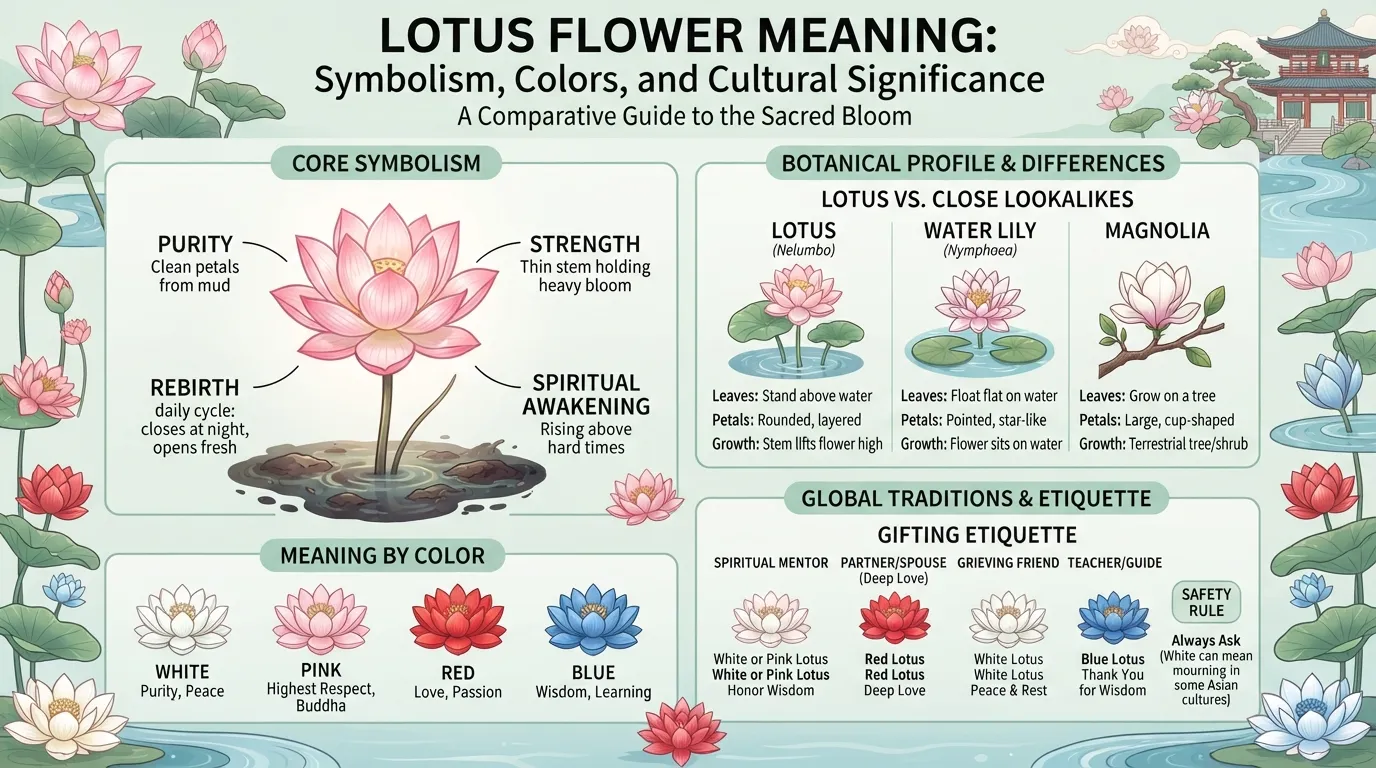
The lotus flower means purity, strength, and new beginnings. In Japan, it also stands for the soul rising above hard times. This flower grows in muddy water but opens clean and bright, which is why people see it as a sign of hope.
Origin of the Name
The word “lotus” comes from an old Greek word, lotos. Ancient Greek writers used this word for several sweet plants. Over time, the word “lotus” became linked to the water flower we know today. In Japan, the flower is called hasu (蓮). This word comes from old Japanese and has been used for over a thousand years in poems and Buddhist texts.
Lotus in Victorian Flower Language
In Victorian times, people used flowers to send secret messages. The lotus stood for purity and clean thoughts. Giving someone a lotus meant you saw them as honest and true. This meaning grew from the way the flower rises clean out of muddy water, staying spotless no matter where it grows.
Botanical Foundations & Profile
| Feature | Detail |
|---|---|
| Scientific Name | Nelumbo nucifera |
| Native Region | Asia, including Japan, India, and China |
| Bloom Period | Summer, June to August |
| Average Lifespan | Many years as a plant; single flowers last 3–5 days |
| USDA Zones | Zones 4 through 10 |
| Species Count | 2 main species: Nelumbo nucifera and Nelumbo lutea |
History & Cultural Timeline
- The lotus has grown in Asia for over 1,000 years, long before written records began.
- Buddhism arrived in Japan around 552 CE and brought strong lotus symbolism with it.
- Japanese Buddhist art from the 7th century often shows the Buddha sitting on a lotus.
- Today, lotus ponds still grow near many Japanese temples, kept alive as living symbols.
Symbolism Deep-Dive
Purity
The lotus grows in muddy, dirty water. Yet its petals stay clean and smooth. This is why people link the flower to a pure heart, even in a hard world.
Rebirth
Each morning, the lotus flower opens fresh. Each night, it closes and sinks a little into the water. This daily cycle makes people think of new starts and second chances.
Strength
The lotus stem is thin, but it holds up a heavy flower against wind and water. This quiet strength is why the flower stands for calm power that does not need to shout.
Meaning by Color
| Color | Meaning |
|---|---|
| White | Pure heart, peace, spiritual growth |
| Pink | Highest respect, often linked to Buddha |
| Red | Deep love, passion, and the heart |
| Blue | Wisdom, learning, and clear thinking |
Color Meanings & Cultural Safety Matrix
White Lotus
- Primary sentiment: Purity and spiritual peace.
- Geographic nuances: In Japan, white lotus often appears at temples and quiet ceremonies. In India, it also marks spiritual purity.
- Gifting warning: In some Asian homes, white flowers connect to funerals. Ask before gifting for a happy event.
Pink Lotus
- Primary sentiment: Deep respect and high honor.
- Geographic nuances: In Japan and much of Buddhist Asia, pink lotus is the most sacred color, often tied to the Buddha himself.
- Gifting warning: This color fits respectful or spiritual gifts, not casual ones.
Red Lotus
- Primary sentiment: Passion, love, and a warm heart.
- Geographic nuances: In China, red lotus can mean love and luck. In Japan, red is less common but still linked to strong feeling.
- Gifting warning: Save red lotus for close, loving relationships.
Blue Lotus
- Primary sentiment: Wisdom and calm thinking.
- Geographic nuances: Rare in nature, blue lotus is prized in Egyptian and Asian art alike as a symbol of knowledge.
- Gifting warning: A thoughtful gift for teachers, mentors, or wise friends.
Global Traditions & Literary Impact
In Japan, many Buddhist funerals and memorials use lotus flowers or lotus-shaped decorations. Families place them near photos of loved ones to wish the soul a peaceful rise, much like the flower rising from mud into clean air.
In literature, the lotus appears in old Japanese poetry collections, including some poems in the Man’yōshū, an early Japanese poetry book from the 8th century. Please double-check this literary reference, as I cannot search a live database and details may be inaccurate.
Also read more about: https://bloomsyflower.com/moonflower-meaning/
Economic, Culinary, and Medicinal Uses
In Japan, people eat the lotus root, called renkon. It has a crunchy texture and is used in soups, stir-fries, and New Year dishes. Some traditional health practices also use lotus seeds and leaves in herbal teas, believed to help calm the mind and support digestion. Always check with a doctor before using any plant for health reasons, since effects can vary by person.
Ultimate Etiquette & Gifting Guide
| Relationship | Recommended Color | The Subtext |
|---|---|---|
| Spiritual Mentor | White or Pink | “I honor your wisdom and peace.” |
| Partner or Spouse | Red | “My love for you runs deep.” |
| Grieving Friend | White | “I wish peace and rest for your loved one.” |
| Teacher or Guide | Blue | “Thank you for your wisdom.” |
Universal Safety Rule
Always ask about local customs before gifting lotus flowers, especially white ones, since their meaning can shift from purity to mourning depending on the culture.
Lotus vs. Close Lookalikes
| Feature | Lotus (Nelumbo) | Water Lily (Nymphaea) | Magnolia |
|---|---|---|---|
| Petal Shape | Rounded, layered petals | Pointed, star-like petals | Large, cup-shaped petals |
| Fragrance | Light, sweet scent | Mild to strong sweet scent | Strong, lemony scent |
| Foliage | Leaves rise above water | Leaves float flat on water | Leaves grow on a tree, not water |
| Bloom Season | Summer | Spring through fall | Spring |
| Growth Style | Grows in ponds, stem lifts flower high | Grows in ponds, flower sits on water | Grows on land as a tree or shrub |
How to tell them apart
Look at the leaves. Lotus leaves stand up above the water. Water lily leaves float flat on top of the water.
Practical Maintenance & Domestic Safety
Care Basics
- Plant lotus in full sun for the best blooms.
- Use a large, still pond or a wide container with mud and water.
- Keep water warm; lotus loves heat in summer.
- Remove dead leaves and flowers to keep the plant healthy.
Pet Toxicity Warning Lotus is generally considered non-toxic to cats and dogs, but pets should still be kept from chewing on any pond plant, since some pond water can carry bacteria or added chemicals. Watch for stomach upset and contact a vet if you notice unusual symptoms.
Expert Curations & Misconceptions
10 Quick Fun Facts
- Lotus seeds can stay alive for hundreds of years before sprouting.
- The flower closes at night and reopens each morning.
- Lotus plants can grow in water up to several feet deep.
- The leaves repel water, so drops roll off like tiny balls.
- Lotus root has holes inside, which help the plant breathe underwater.
- Some lotus ponds in Asia are hundreds of years old.
- The flower can raise its own temperature slightly to attract insects.
- Lotus is often confused with water lily, though they are different plants.
- Ancient Egyptians also prized a flower they called “lotus,” though it was a different plant.
- Ceremonial cakes in Japan use lotus root as a New Year good-luck food.
3 Myth vs. Reality Pairs
Myth: Lotus and water lily are the same plant. Reality: They belong to different plant families, even though they look alike.
Myth: All lotus flowers are white. Reality: Lotus flowers come in white, pink, red, and rare blue shades.
Myth: Lotus only grows in warm countries. Reality: Some lotus varieties survive cooler climates, including parts of Japan with cold winters.
2 Quick Florist Tips
- Cut lotus stems early in the morning when flowers are freshest.
- Keep cut lotus in cool water and out of direct sun to help it last longer.
Possible Asked Questions
What does the lotus flower mean spiritually?
The lotus means a pure soul rising above hardship, much like the flower rising clean from muddy water.
Is lotus a good gift for special occasions?
Yes, especially for spiritual events, memorials, or as a sign of deep respect and honor.
What does a pink lotus mean in Japan?
Pink lotus is the most sacred color in Japan, often tied to Buddha and spiritual peace.
Can you eat lotus?
Yes, lotus root is a common food in Japan, often used in soups and stir-fries. Always check for safe preparation before eating any plant part.
When does lotus bloom?
Lotus blooms in summer, usually from June through August.
Is lotus hard to grow at home?
Lotus needs a pond or large water container and full sun, but with the right space, it can be grown by home gardeners.
How did the lotus get its name?
The English name comes from the Greek word lotos. In Japan, it is called hasu, a word used for over a thousand years.
What did the lotus mean historically in Japan?
Historically, the lotus symbolized the soul’s rise toward enlightenment, closely tied to Buddhist teaching since the 6th century.
Final Thoughts
The lotus flower carries deep meaning across Japan and much of Asia. It stands for purity, strength, and the soul rising above hard times. Its daily bloom, opening fresh each morning after resting each night, makes it a lasting symbol of hope and renewal. Whether seen in a quiet temple pond or gifted to honor someone special, the lotus reminds us that beauty can rise from even the muddiest beginnings. Consider planting a lotus in a sunny pond, or gifting one to someone who could use a little hope today.

Zahid Abbas is an educator, researcher, and digital publishing strategist behind BloomsyFlower, a flower and gardening resource covering flower meanings, symbolism, history, care, seasonal blooms, and gifting. He combines research with simple, reader-friendly writing to help people understand, grow, and enjoy flowers.